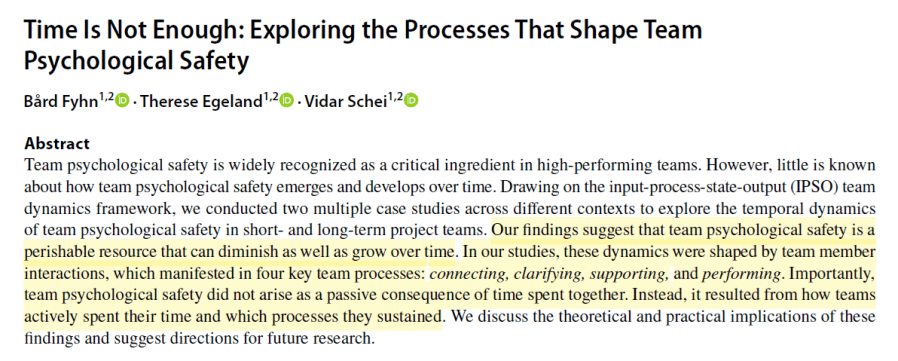
This study explored the factors that shaped psychological safety:
· “Team psychological safety is a perishable resource that can diminish as well as grow over time”
· “Team psychological safety did not arise as a passive consequence of time spent together. Instead, it resulted from how teams actively spent their time and which processes they sustained”
· “Time alone is insufficient; rather, it is how teams use their time that shapes the development of team psychological safety”
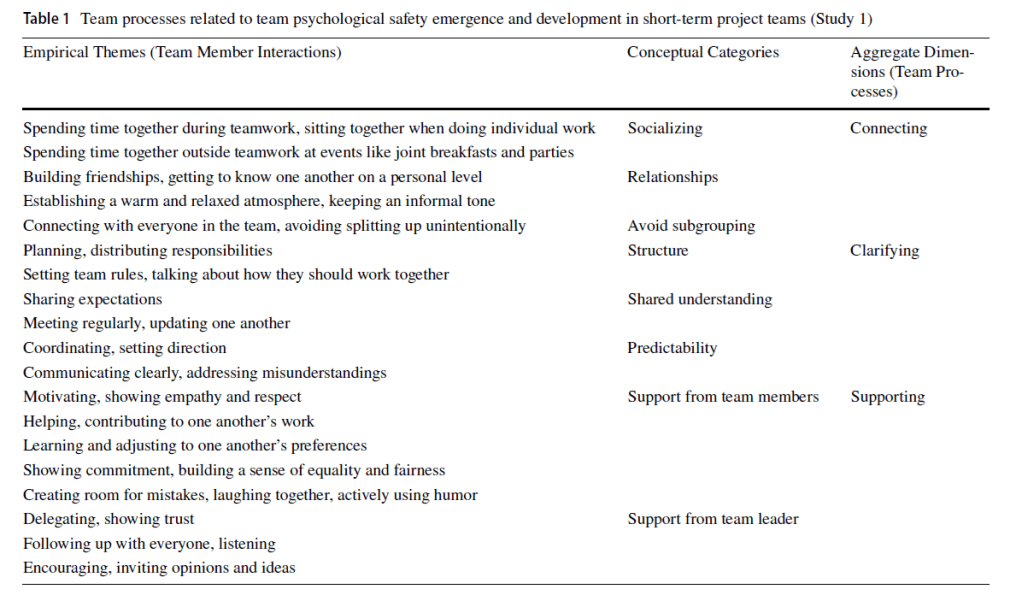
· They identified four recurring processes that shape PS: connecting (building relationships, socialising, and avoiding subgrouping); supporting (encouragement, inclusivity, mutual help), clarifying (establishing shared understanding, expectations, coordinating work), performing (achieving tangible results)
· “Early team behaviors lay important groundwork for the emergence of team psychological safety”
· “It is through these everyday interactions—whether inclusive or exclusionary, encouraging or dismissive—that a climate of psychological safety begins to form”
· “Subgrouping is a key barrier to team psychological safety: those outside subgroups often report lower levels of psychological safety”
· “Team members reported higher psychological safety when they could see concrete results from their work”
· “Team psychological safety should not be regarded as a static property but as a perishable resource, one that requires continuous investment if it is to be maintained and further developed”
· “Actions speak louder than words. As Team Yellow illustrated, a team charter has limited impact if it is not actively applied in practice”
· These teams “began with relatively similar levels of team psychological safety. As interactions unfolded, however, trajectories diverged— some teams experienced increased psychological safety, while others saw declines. This variation .. underscores that team psychological safety is a dynamic construct”
· “when considering the element of time, familiarity is not always beneficial for team psychological safety in the early phases of team development. On the contrary, several participants … highlighted the value of equality that arose from initially not knowing one another, as this allowed members to start on common ground”
· “Clarifying processes, such as establishing team rules, aligning expectations, and coordinating work, were vital for building team psychological safety. These processes provide team members with direction and a shared understanding of both objectives and methods”
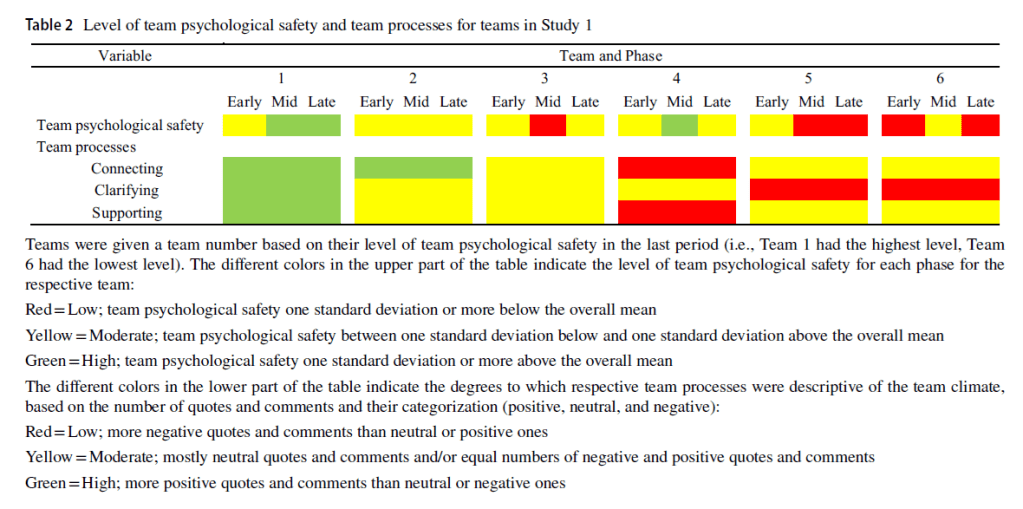
· “For teams that met regularly, kept one another updated, and coordinated their work, this clarity positively contributed to their team psychological safety”
· “humor operated as a supportive interaction by lowering the perceived interpersonal risk of contributing. However, its positive effect depended on inclusivity”
Ref: Fyhn, B., Egeland, T., & Schei, V. (2025). Journal of Business and Psychology, 1-23.

Shout me a coffee (one-off or monthly recurring)
Study link: https://link.springer.com/article/10.1007/s10869-025-10078-9

 SafetyInsights.org