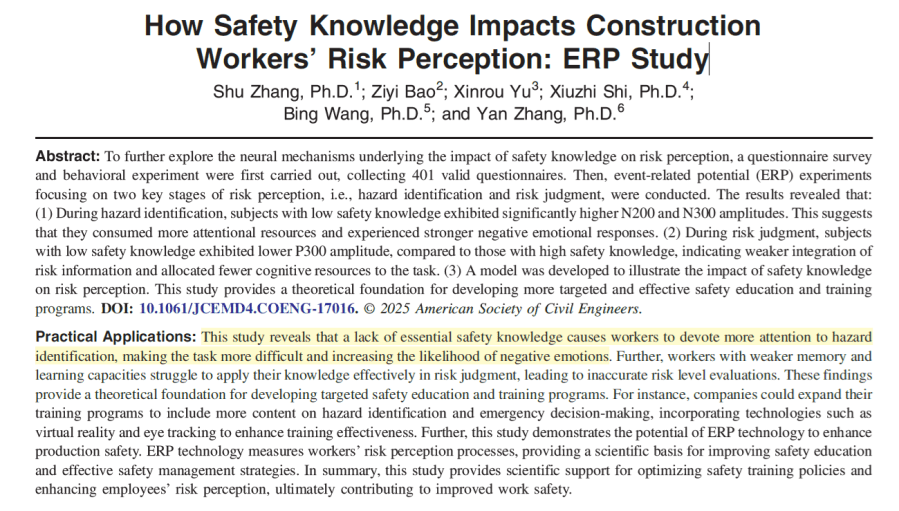
This used a multimethod approach via surveys, behavioural experiments and Event-Related Potential (ERP) experiments, exploring hazard ID and risk perception with subjects with high or low safety knowledge. They also employed EEG.
Note. Their use of overestimate or “inaccurate risk level evaluations” is likely to trigger some
Extracts:
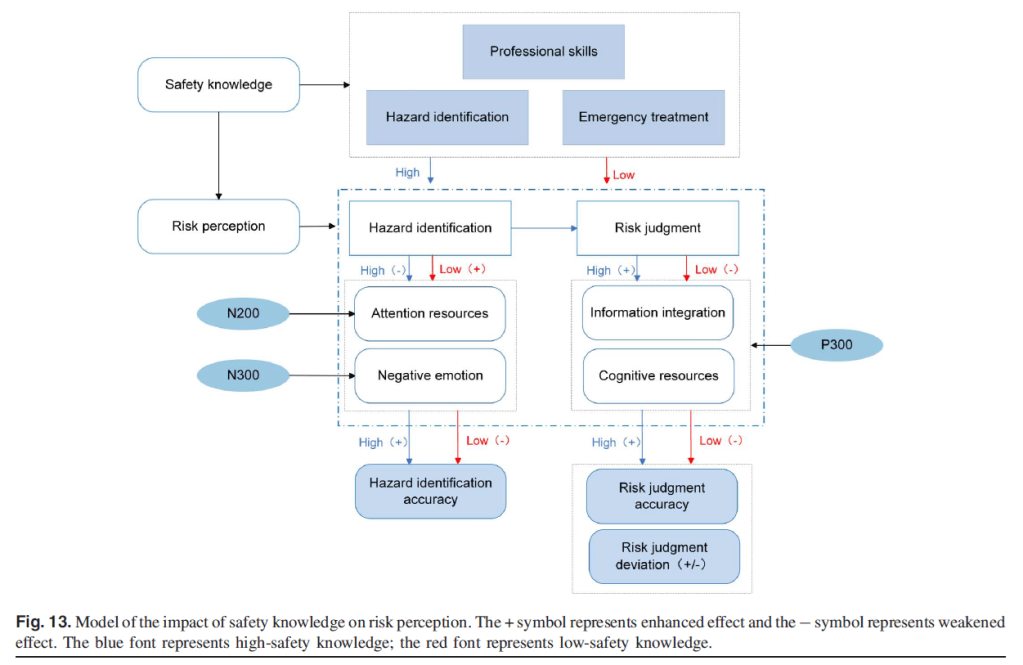
· “During hazard identification, subjects with low safety knowledge exhibited significantly higher N200 and N300 amplitudes”
· “During risk judgment, subjects with low safety knowledge exhibited lower P300 amplitude… indicating weaker integration of risk information and allocated fewer cognitive resources to the task”
· “participants generally tended to overestimate risk levels” [** compared to a panel of 10 experts]
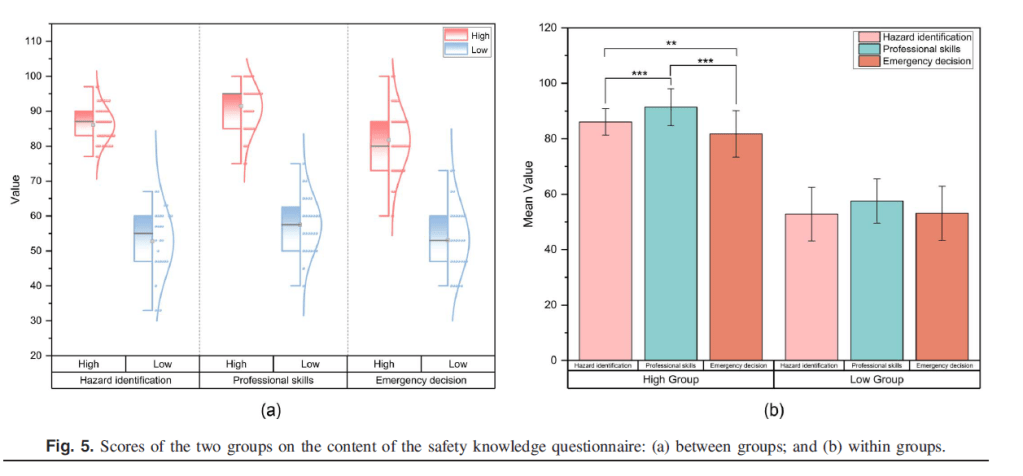
· “There are significant positive correlations among safety knowledge and the accuracy of hazard identification (r = 0.189; p < 0.001), risk judgment accuracy (r = 0.182; p < 0.001), and risk judgment deviation (r = 0.126; p = 0.011)”
· “Subjects with high safety knowledge demonstrated stronger analytical and judgment skills… In contrast, low‑knowledge workers struggled to identify and assess risks”
· “Individuals with high levels of knowledge tend to overestimate risk”
· “A lack of essential safety knowledge causes workers to devote more attention to hazard identification, making the task more difficult and increasing the likelihood of negative emotions”
· “Companies could expand their training programs to include more content on hazard identification and emergency decision‑making, incorporating technologies such as virtual reality and eye tracking to enhance training effectiveness”
· “In risk judgment, workers with low safety knowledge demonstrated weaker integration of risk information and allocated fewer cognitive resources to the task compared to those with higher safety knowledge”
· “Individuals with low safety knowledge struggle with hazard identification, requiring more attention to process risk information, which increases task difficulty, induces anxiety and leads to rushed decisions”
· “Individuals with higher levels of safety knowledge possess a more robust foundation in hazard identification, enabling them to efficiently detect and analyze risk cues within visual stimuli, thereby requiring fewer attentional resources”
· “Further, their confidence in hazard recognition mitigates the impact of negative emotional interference, facilitating more composed and deliberate decision-making”
· “This ultimately contributes to greater accuracy and reliability in hazard identification. These findings highlight the crucial role of safety knowledge in attentional control and emotional regulation during the initial phase of hazard identification”
Ref: Zhang, S., Bao, Z., Yu, X., Shi, X., Wang, B., & Zhang, Y. (2026). Journal of Construction Engineering and Management, 152(1), 04025234.
Study link: https://doi.org/10.1061/JCEMD4.COENG-17016