How was blame distributed across different actors after the Grenfell disaster?
This study used network analysis to explore this question, specifically how responsibility “was negotiated, resisted, and redirected among a heterogeneous set of actors”.
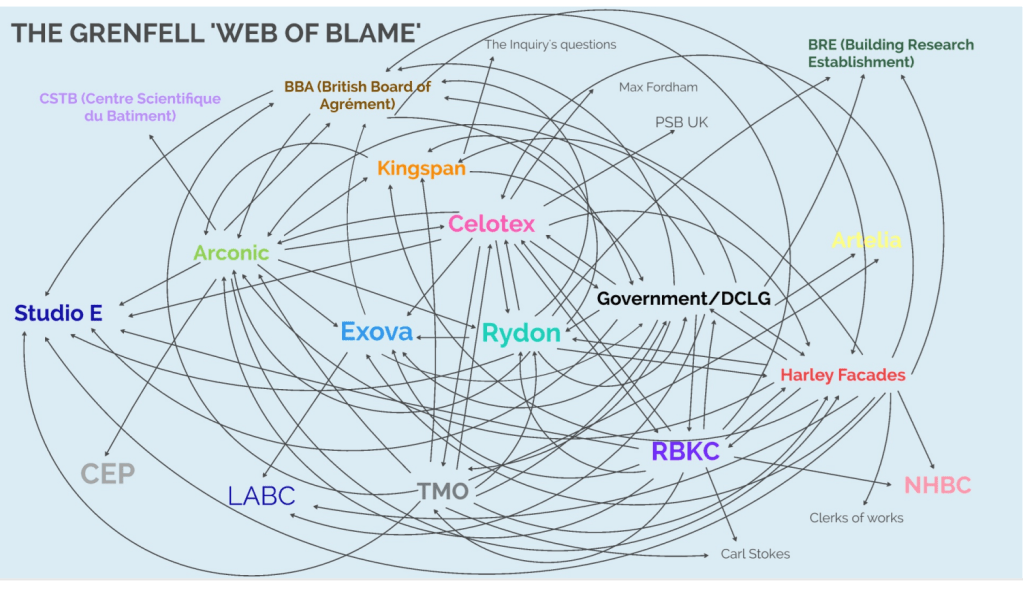
They used the below Grenfell web of blame from an inquiry submission (image not found in this paper):
Extracts:
· “Understanding blame attribution is a complex task that involves disentangling chains of causality, responsibility, and influence within highly interconnected systems”
· “studies of organizational crises emphasize how accountability is often fragmented across multiple stakeholders, each with differing incentives to shift or deflect blame”
· “The result is frequently an intricate web of accusations, defenses, and counter-accusations, whose patterns require analysis at a systemic rather than anecdotal level”
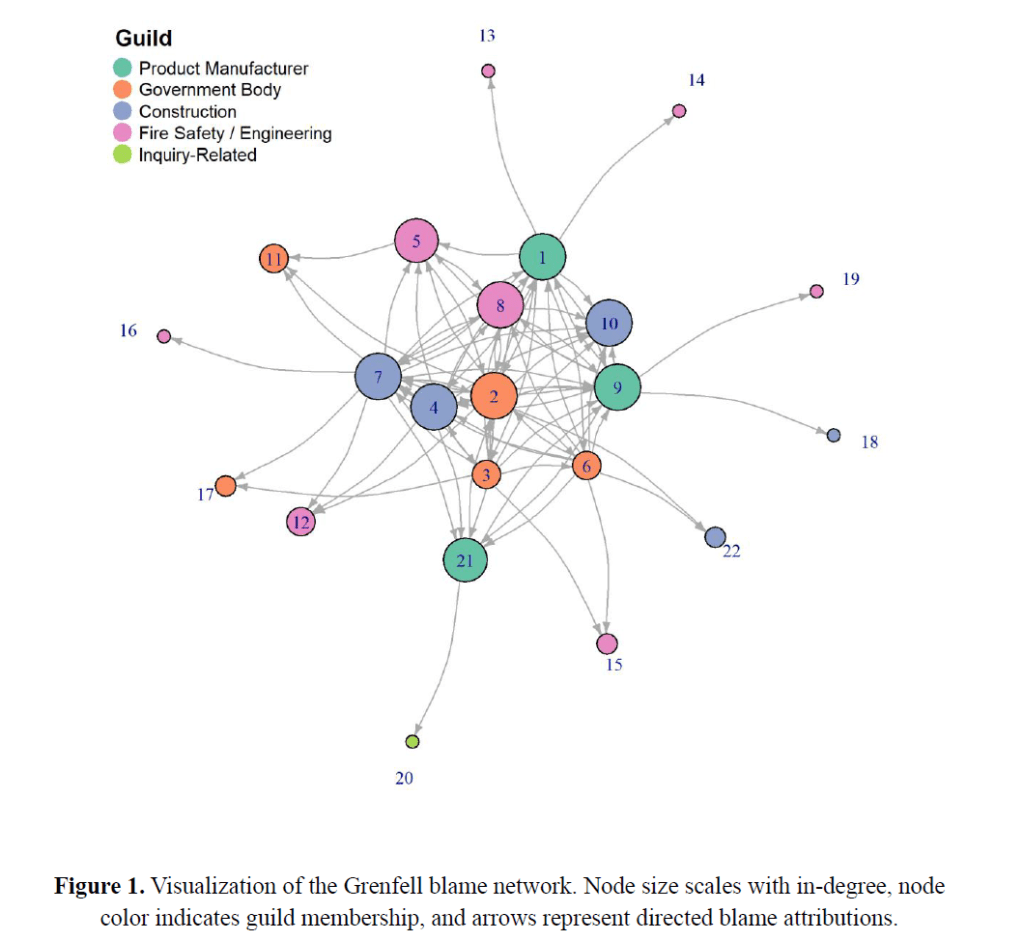
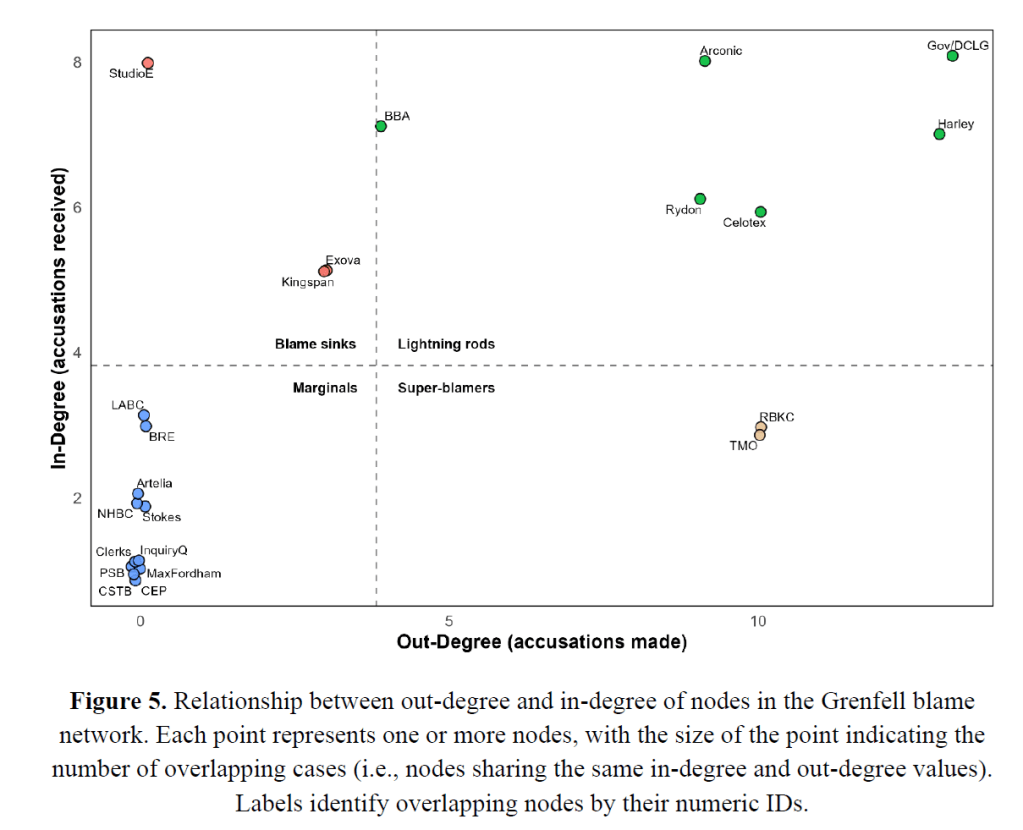
· They found a “strongly disassortative pattern of ties, and polarized node roles ranging from “super-blamers” to “blame sinks.”
· Some of these blame features “are best understood as consistent with deliberate strategies of counter-blame and coalition building”
· Their findings indicated that “almost no actor remained outside the arena of conflict: responsibility contests became system-wide rather than confined to isolated dyads”
· “In practical terms, accusations could cascade quickly, implicating nearly every actor within a few steps”
· “accusations rarely remained one-sided but often triggered counter-blame, producing spirals of retaliation”
· They also found evidence of “blame coalitions” .. or “circular firing squads” … where actors engaged in bilateral defence while mobilizing alliances that magnified conflict”
· “the crisis was perceived as so pervasive that no coherent subgroup could isolate itself from blame. The result was an all-against-all contest, tendencies. Highly active blamers disproportionately targeted actors less central in the network”
· They also identified another scapegoating dynamic, where “Central authorities and major contractors shifted responsibility onto peripheral organizations such as testing bodies, consultants, or small firms, which had limited capacity to retaliate”
· “scapegoating produced a layered accountability structure in which dominant actors were simultaneously targets of criticism and sources of downward blame”
· “Actors such as Government/DCLG, RBKC, and TMO emerged as super-blamers, issuing numerous accusations outward”
· “In contrast, organizations such as Celotex, Arconic, and Studio E functioned as blame sinks, absorbing accusations without mounting a substantial counter-offensive”
· Some actor “acted as lightning rods, simultaneously receiving and redistributing blame, while Exova and LABC remained peripheral”
· DCLG’s role was notable where “the department was not merely a recipient or source of blame but a central broker in its circulation”
Ref: Devoto, M., & Cipriotti, P. A. (2025). arXiv preprint arXiv:2510.21681.

Shout me a coffee (one-off or monthly recurring)
Study link: https://arxiv.org/pdf/2510.21681

 SafetyInsights.org