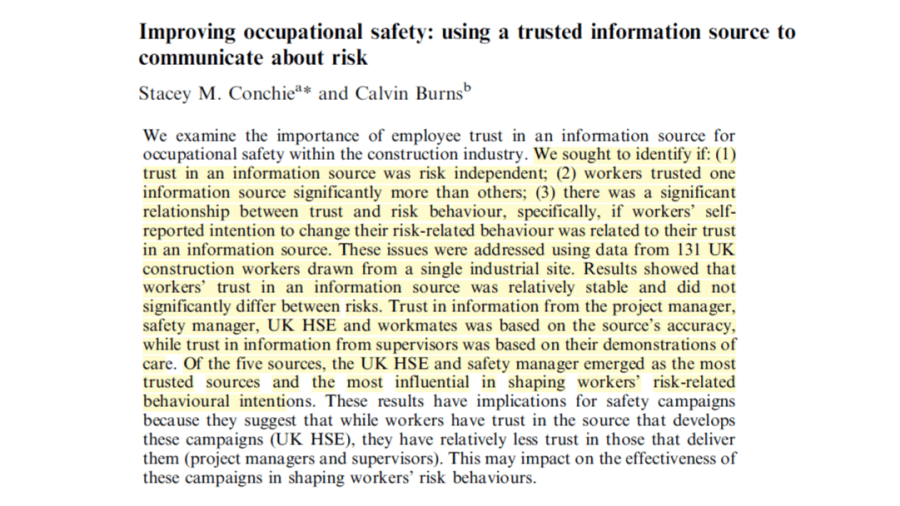
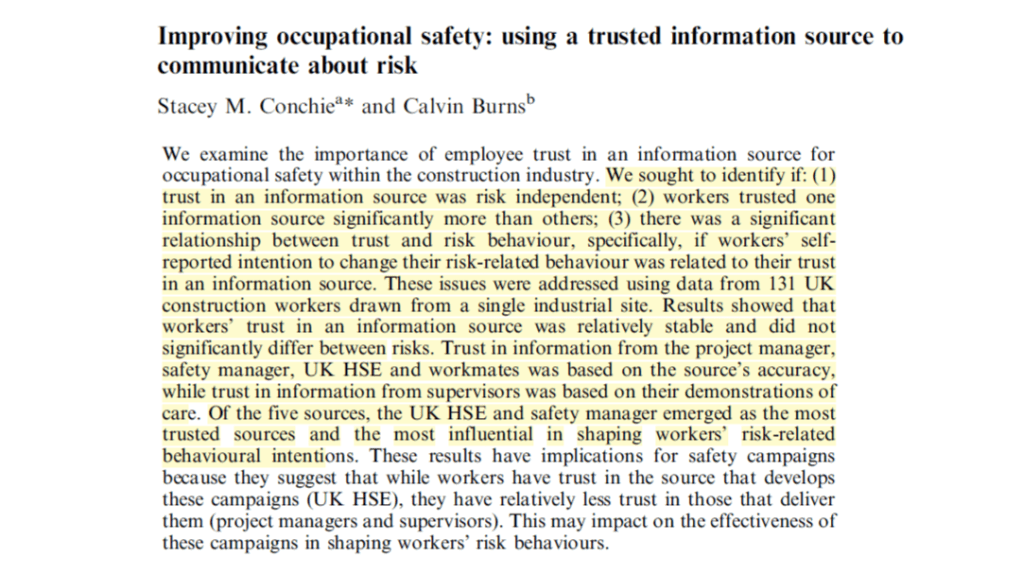
“Trust in information from the project manager, safety manager, UK HSE and workmates was based on the source’s accuracy, while trust in information from supervisors was based on their demonstrations of care”
This examined employee trust in risk information from a sample of construction workers.
131 UK construction workers from the same company were surveyed.
Extracts:
· “an individual’s response to risk communication is determined by how trustworthy they
· believe the information source to be … rather than the actual content of the information being communicated”
· “This is especially true when the information is complex because individuals are likely to rely on simple decision heuristics such as ‘is the person trustworthy’”
· “Studies show that the belief that a person is trustworthy generally leads to greater acceptance of social risks (e.g. mobile phones and base stations in residential areas; …), and changes in risk-related behaviour”
· “a trustor’s expectations about a trustee relate to the trustee’s trustworthiness, which is indicated through a number of personal qualities”, including trustworthiness qualities like competence, knowledge, honesty, openness, care and concern
· “Results showed that workers’ trust in an information source was relatively stable and did not significantly differ between risks”
· “Trust in information from the project manager, safety manager, UK HSE and workmates was based on the source’s accuracy, while trust in information from supervisors was based on their demonstrations of care”
· “This suggests that campaigns to improve occupational safety may have their success determined, in part, on how trustworthy the information source delivering these campaigns is believed to be”
· “Of the five sources, the UK HSE and safety manager emerged as the most trusted sources and the most influential in shaping workers’ risk-related behavioural intentions”
· “we found that construction workers’ trust in an information source was risk independent. That is, workers reported a similar level of trust in a source irrespective of whether they were communicating information about the risks of back pain, working at heights, slips/trips, or site transport”
· “In other studies, this finding has been accounted for with the suggestion that individuals employ simple heuristics (e.g. ‘do I trust this source’) when interpreting and responding to risk communication (Rosati and Saba 2004). We believe that construction workers engage in similar cognitive shortcuts as they are often given information about safety, job roles and site-specific issues simultaneously, which they have insufficient time and resources to fully evaluate”
· “Workers’ trust in an information source was largely determined by the belief that the source’s information was accurate”
· “This finding was true for trust towards the project manager, safety manager, supervisors and the UK HSE. However, trust in workmates was also influenced by their perceived honesty”
· “This latter finding may be explained through a combination of prevailing beliefs of role-specific expertise and familiarity. Put simply, workmates are often expected to have less expertise in risk-reduction measures compared to more senior positions and safety personnel”
· “The opportunity (or familiarity) that workers have to evaluate workmates’ honesty increases the likelihood that this additional information will be taken into account when making trust decisions”
· “These findings imply that trust in an information source will be based, in part, on the qualities that the source is expected to hold, to have within their control, or to express on a frequent basis”
· “our results showed that of the different sources, workers hold relatively high levels of trust in the UK HSE and safety managers, and significantly lower levels of trust in information from the project manager and workmates”
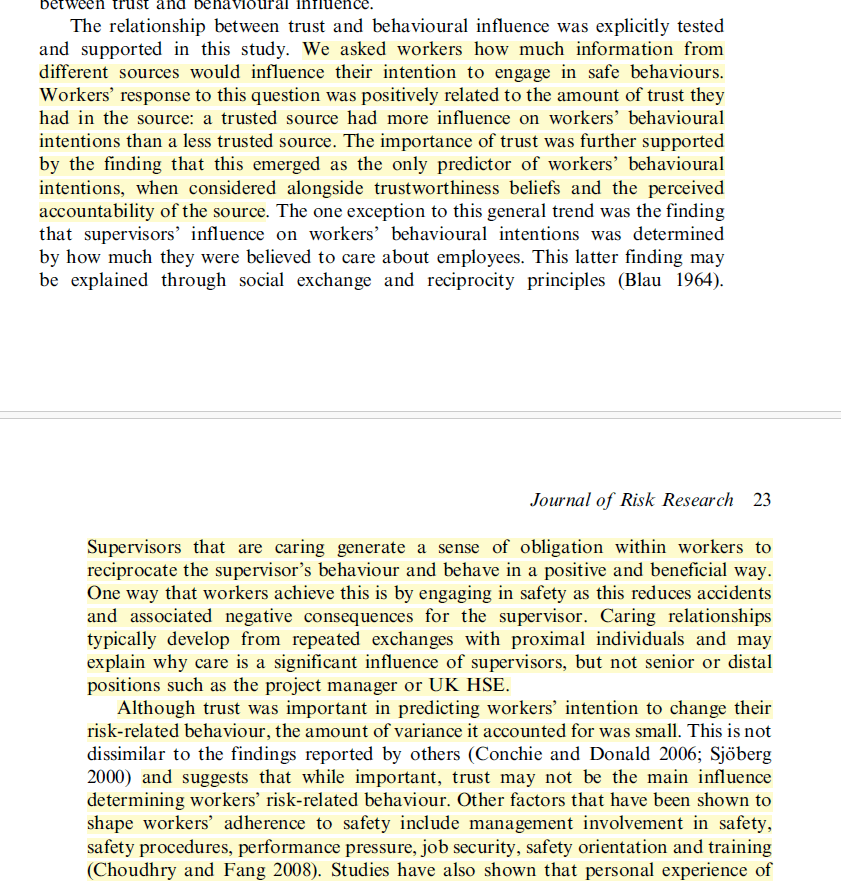
· “We asked workers how much information from different sources would influence their intention to engage in safe behaviours. Workers’ response to this question was positively related to the amount of trust they had in the source: a trusted source had more influence on workers’ behavioural intentions than a less trusted source”
· “The importance of trust was further supported by the finding that this emerged as the only predictor of workers’ behavioural intentions, when considered alongside trustworthiness beliefs and the perceived accountability of the source”
· “Supervisors that are caring generate a sense of obligation within workers to reciprocate the supervisor’s behaviour and behave in a positive and beneficial way”
· “Caring relationships typically develop from repeated exchanges with proximal individuals and may explain why care is a significant influence of supervisors, but not senior or distal positions such as the project manager or UK HSE”
· “Although trust was important in predicting workers’ intention to change their risk-related behaviour, the amount of variance it accounted for was small”
· Limitations of this study is that all respondents were from the same company, and data was based on self-report measures of intended behaviour change rather than actual behavioural change
Ref: Stacey M. Conchie & Calvin Burns (2009) Improving occupational safety: using a trusted information source to communicate about risk, Journal of Risk Research, 12:1, 13-25.

Shout me a coffee (one-off or monthly recurring)
Study link: https://doi.org/10.1080/13669870802433749

 SafetyInsights.org