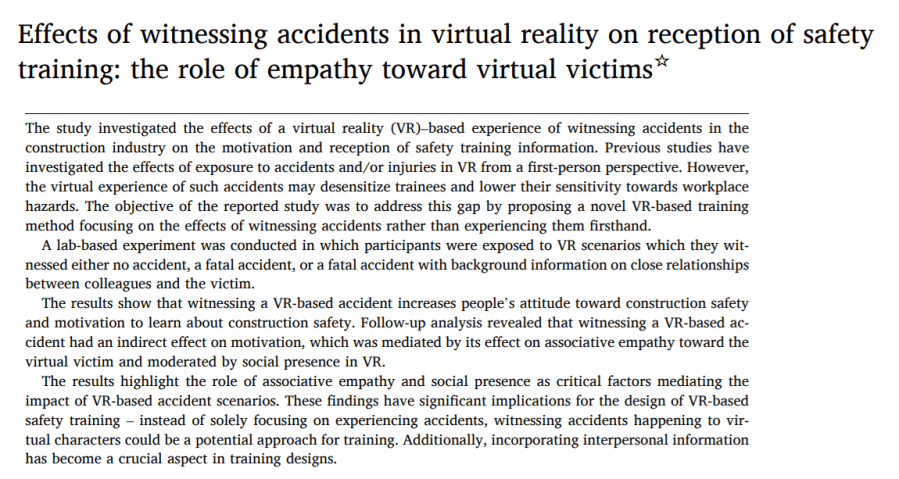
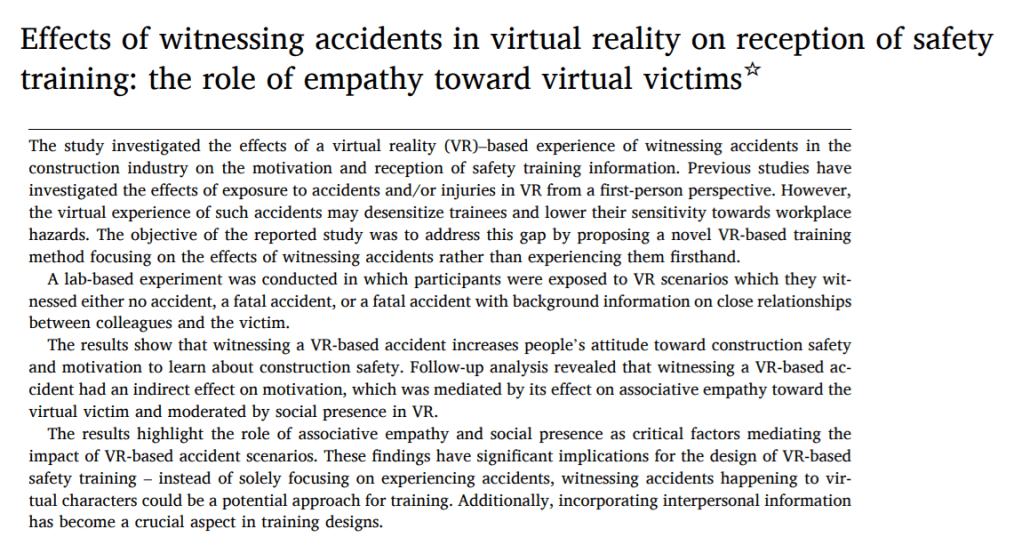
Can simply witnessing a virtual accident, not experiencing it, improve the saliency of training?
This interesting study used VR construction training scenarios, including no accident, witnessing an accident with distant coworker, and witnessing a close coworker.
Extracts:
· “witnessing an accident in VR significantly enhances one’s at[1]titudes toward safety when the victim is a distant coworker and no close relationship information is provided”
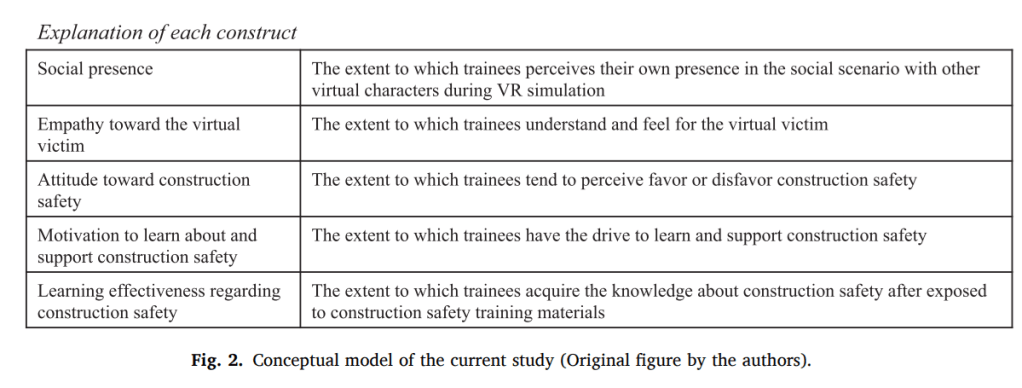
· “a VR-based accident had an indirect effect on motivation, which was mediated by its effect on associative empathy toward the virtual victim and moderated by social presence in VR”
· “Conversely, when the virtual victim is presented as a familiar coworker, there is a significant increase in motivation to learn about construction safety in VR marginally improves learning effectiveness in terms of memory retention for safety training materials”
· “witnessing a VR-based accident happening to a virtual victim makes users identify and relate to the accident as if it happens to them, provided that they feel a certain level of social presence”
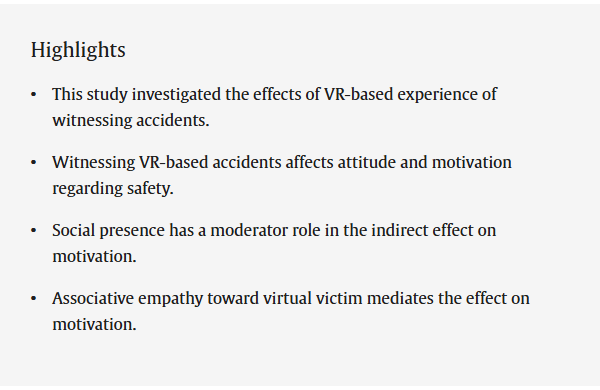
· “Even though the virtual victim is an NPC instead of a real person, users can still build empathy toward him to an extent that can influence their motivation in the real world”
· “Having a familiar coworker as the virtual victim did not significantly influence the internal mechanisms by which witnessing a VR-based accident impacts the MotCS when trainees experience medium to high social presence. However, when trainees did not feel a sense of presence in the social context of the scenario, presenting a familiar character as the virtual victim may reduce the indirect effect of witnessing the virtual accident on [their motivation to learn about construction safety]”
· “the design of VR scenarios involving characters, social relationships, and interactions is critically important. Ensuring that the design fosters a sense of social presence for trainees in the VR scenario is essential for maximizing the impact”
· “aspects that are traditionally considered “softers” (e.g., social presence and associative empathy toward virtual victims) are very important in how VR training and scenarios impact trainees”
· “These softer aspects may not be overshadowed by traditional considerations of building VR-based safety training, such as the accuracy of the environmental layout and equipment details”
· “Our findings reveal that the social presence in virtual scenarios is equally important and can moderate the effects of the VR scenario”
· “One of the implications of our findings is that existing applications of VR in safety can be further enhanced by carefully designing the social aspects between trainees and virtual characters”
· “A significant insight of our study is that the social aspects, even though they occurred in a virtual scenario involving a virtual character (in our case, the virtual victim), had real-world effects”
Ref: Ho, J. C., & Wong, A. L. L. (2026). Safety Science, 196, 107087.

Shout me a coffee (one-off or monthly recurring)
Study link: https://doi.org/10.1016/j.ssci.2025.107087

 SafetyInsights.org