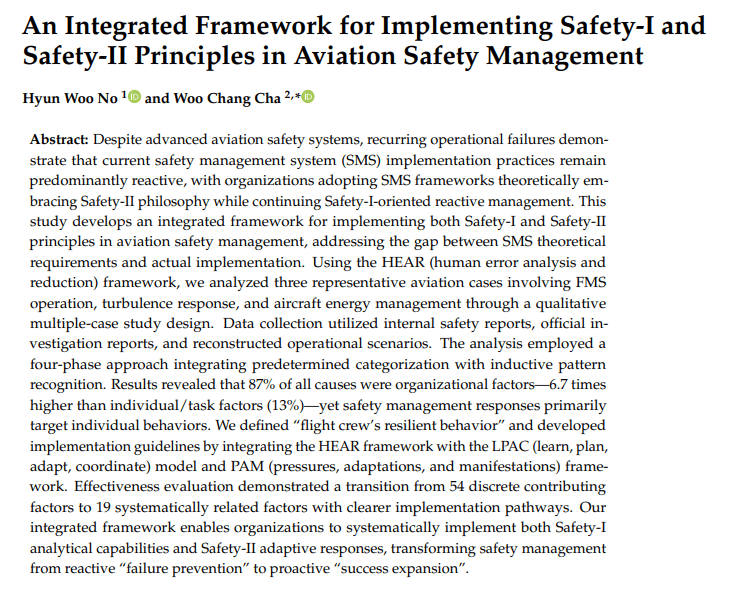
87% of factors attributed in operational failures linked to the organisation, hence 6.7 times more common than individual mistakes, according to this study.
The attached PDF explored the application of Safety-II principles in aviation.
Not a summary – let’s consider it a #lazyNYupload.
(** Note: Shared under an Open Access CC BY 4.0 licence, allowing it to be uploaded here.)
Some points:
· As above, 87% of the factors attributed in failures were at the org level – whereas 13% were individual; hence the 6.7:1 ratio
· Despite the organisational factors – “…safety departments focus predominantly on individual behavior modification and procedural compliance”
· Safety activities may be treated as a checkbox or surface condition, until something goes wrong, rather than efforts to weave it into daily work
· Even with advanced tech, pilots are still blamed for things that were designed poorly from the start
· They operationalised “flight crew’s resilient behavior” models, “transforming abstract Safety-II concepts into concrete operational behaviors that address organizational deficiencies identified through Safety-I analysis”
· And, their framework “demonstrated a transition from 54 discrete
contributing factors to 19 systematically related factors with clearer implementation pathways, indicating a potential for 65% reduction in implementation complexity while maintaining comprehensive improvement coverage”
As always, limitations present.
Ref: No, H. W., & Cha, W. C. (2025). An Integrated Framework for Implementing Safety-I and Safety-II Principles in Aviation Safety Management. Safety, 11(2), 56.

Shout me a coffee (one-off or monthly recurring)
Study link: https://doi.org/10.3390/safety11020056

 SafetyInsights.org