This NSW prosecution unpacks officer duties, reasonably practicable, and expected systems of training and audit.
It resulted from a workplace fatality, when a worker used a high pressure water spray gun to clean a tank, which had MEK resin. An explosion occurred.
Extracts:
· A director said he “had never completely read the occupational health and safety legislation and did not have an in-depth appreciation of its terms”, but did “understood the company’s obligation to employees was to provide a safe working environment”
· The director “took no personal steps to ensure that staff were trained in their positions. There were other people to deal with that subject who were under his direction”
· “He took no personal steps to ensure staff were trained in occupational health and safety because there was a system set up to ensure people had training”
· The director was unaware that the appointed OHS officer had not been trained for the position – noting “it was a failure of the system if [OHS officer] was appointed the [OHS] officer when he had no training for the position, and he accepted there was nothing in place to bring that to his attention”
· He was also “not aware of a safety audit of the Race facility conducted in 2002. There was no part of the system that brought to his attention any failures disclosed by a safety audit”
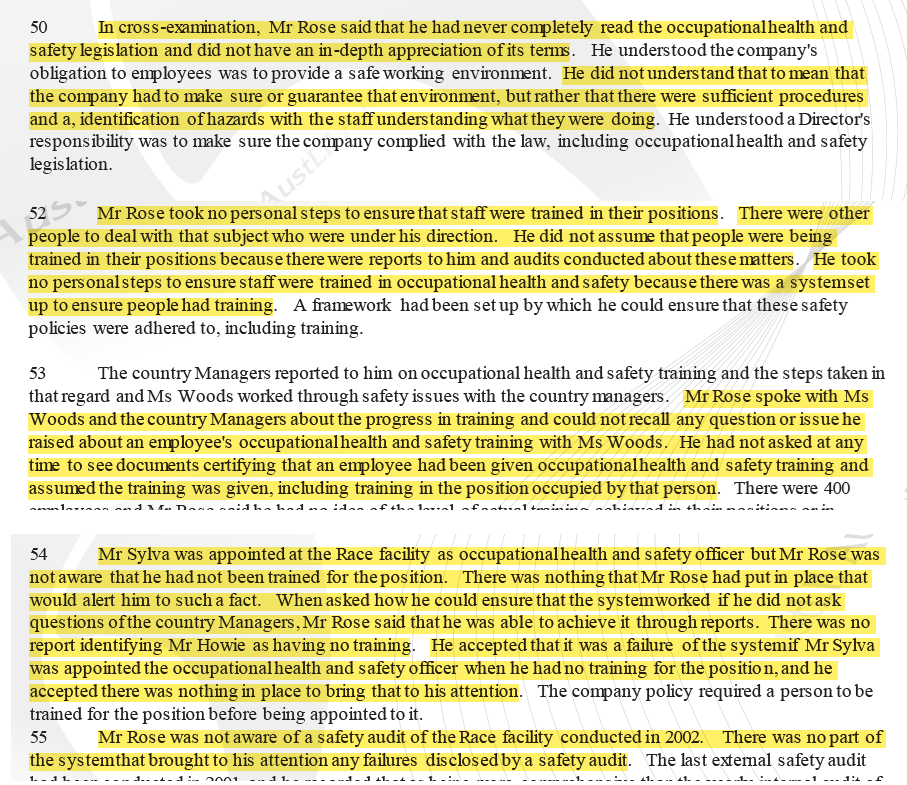
· The director had to be satisfied the facility complied with OHS laws but “had no knowledge of how the wash bay operated other than in very general terms, and had no detailed knowledge of the products used and how they were used”
· There was a lack of training or reports on the substances being used, and “It was assumed that others were looking at these matters and [the director] did not call for a risk assessment”
· “There was no daily monitoring of the facilities and [the director] said he did not know how to do that and that he may have to use external sources to do so”
· “Some audit forms had shown defects in the system or at the facility and [the director] was still unaware if those defects had been rectified”
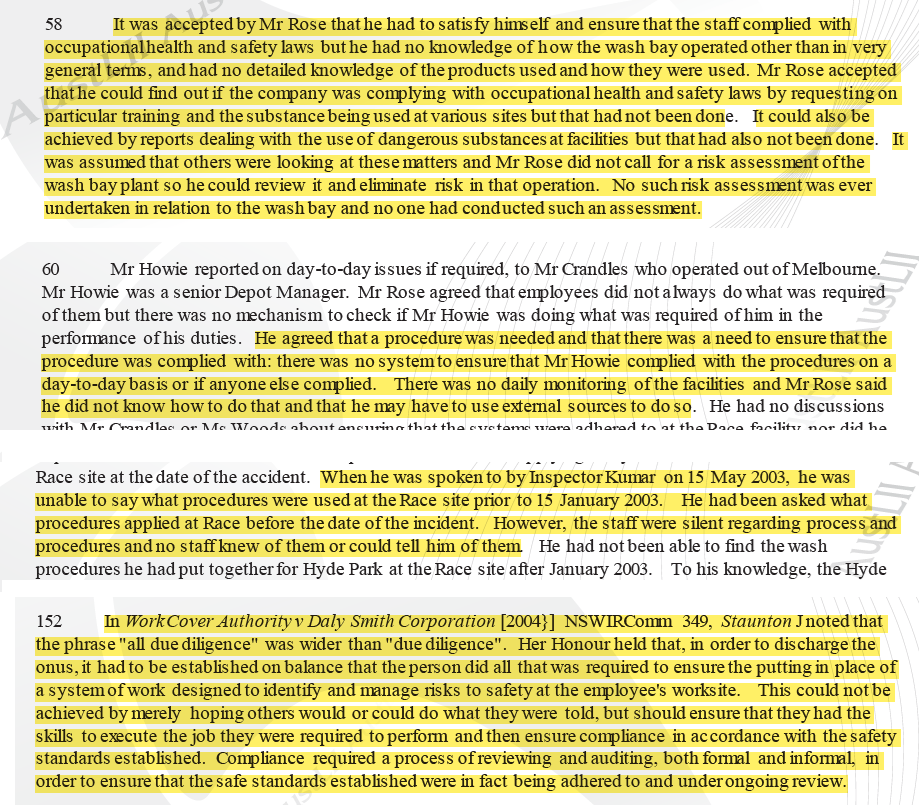
· After the incident, the inspector “asked what procedures applied at Race before the date of the incident. However, the staff were silent regarding process and procedures and no staff knew of them or could tell him of them”
- For due diligence, one has to do “all that was required to ensure the putting in place of a system of work designed to identify and manage risks to safety at the employee’s worksite”
- “This could not be achieved by merely hoping others would or could do what they were told, but should ensure that they had the skills to execute the job they were required to perform and then ensure compliance”
- “Compliance required a process of reviewing and auditing, both formal and informal, in order to ensure that the safe standards established were in fact being adhered to and under ongoing review”
- The OHS officer was unaware whether the worker was trained in dangerous goods, and the company “did nothing to ensure that persons employed as occupational health and safety officers were trained. There was nothing in the system that would bring the lack of training of these people to the defendant’s attention”
- “There were significant matters that the defendant had no knowledge of but he had made assumptions”
- “The defendant’s evidence, ultimately, relied upon a series of assumptions and reports he received from managers as well as audits in order to ensure the safety of the Race workforce. He assumed that the managers were doing their job”
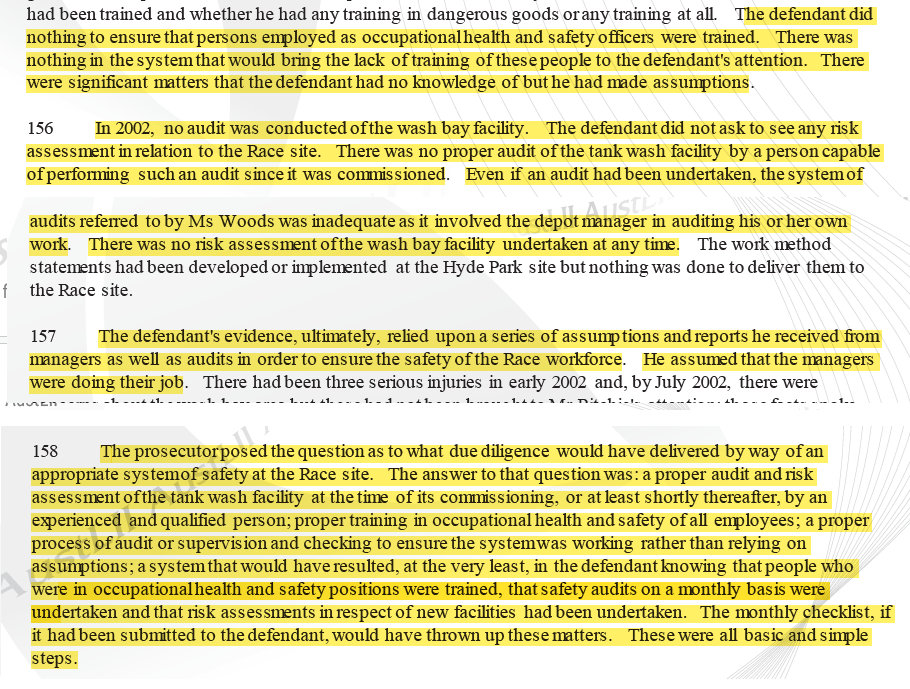
- “The prosecutor posed the question as to what due diligence would have delivered by way of an appropriate system of safety at the Race site. The answer to that question was: a proper audit and risk assessment of the tank wash facility at the time of its commissioning, or at least shortly thereafter, by an experienced and qualified person; proper training in occupational health and safety of all employees; a proper process of audit or supervision and checking to ensure the system was working rather than relying on assumptions; a system that would have resulted, at the very least, in the defendant knowing that people who were in occupational health and safety positions were trained, that safety audits on a monthly basis were undertaken and that risk assessments in respect of new facilities had been undertaken”
- “The monthly checklist, if it had been submitted to the defendant, would have thrown up these matters. These were all basic and simple steps”
Case: Inspector Ken Kumar v David Aylmer Ritchie [2006] NSWIRComm 323 (12 October 2006)
PS. Check out my new YouTube channel (links in comments), where I’m posting both long- and short-form videos. This one will be released sometime in the near future. https://www.youtube.com/@Safe_A_Pod
If you like the channel, then please consider subscribing, liking and commenting on my videos (it’s free to ‘Like’ and comment!).



Hey ben
Its great that you are unpacking legal cases but i would avoid cases where there has been a guilty plea. There is no testing of the prosecutions case and judges comments are generally much wider than the law supports and are not good precedence. This case whilst the director did have failings what those failings are alleged to be go way beyond established law re: director’s duties.
If you want to post about a case i would be happy to discuss first.
S
Get Outlook for Androidhttps://aka.ms/AAb9ysg ________________________________
LikeLike
Thanks, that’s really helpful! NB, I covered this one because it was cited in newer cases
LikeLike