An interesting Master’s thesis from Tony Willis, exploring high-risk work in small businesses, and how they learn and adapt to risk and avoid workplace accidents – particularly from a Safety-II lens.
11 interviews undertaken with owner-managers and employees.
Way too much to cover.
Extracts:
· “Small business possesses unique characteristics not found within larger organisations, such as being more centralised in decision-making and having multiple resource constraints, including limited finances and expert safety personnel, leaving such obligations to the owner-manager”
· Small businesses are “Not ideally suited to the principles of bureaucratic safety management, where safety management systems and procedures dictate workflow, small business is more simplistic in its approach and relies upon dynamic social interaction to manage risks”
· “small business is primarily motivated to complete individual everyday tasks over safety. Small business navigates the safety landscape in terms of job completion, and any act that seeks to interrupt the anticipated load for the day is seen as a threat and managed appropriately”
· “Safety activities are viewed either as an annoyance or a resource, dependent upon whether they hinder or support the timely completion of work”
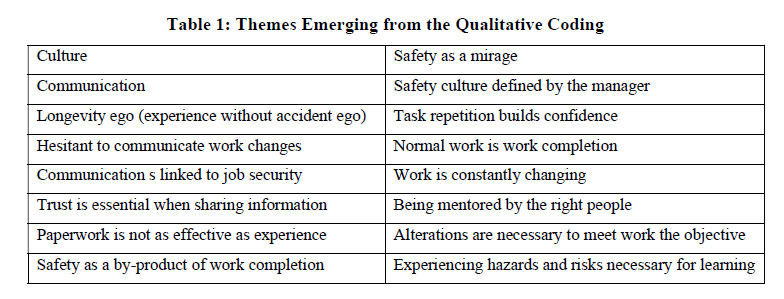
· Hence, they “manage safety through the practice of sidelining if a choice between the two is required”
· “The necessity to identify hazards and risks to prevent accidents is informed via an experiential learning cycle that can be experienced practically, shared personally by colleagues”
· “Small business does not appear to have a conscious view of safety until an actor within the task, be it the undertaker of the task or a witness to the actual or intended task, perceives they are dangerously close to an interaction with a hazard”
· “workers do not navigate daily work through a belief that procedures will provide a safe work environment, nor do they navigate daily work through looking at what goes well”
· “work is navigated via a mixture of simplistic organised chaos that is borderline anarchy and certain disorder”
· “Basic communication emerged as a strong informal learning tool for workers, although not when the process is routine or formal or, in other words, conducted formally on a routine basis”
· “These opportunities can be what is commonly referred to in Australia as ‘smoko’ breaks (morning tea breaks) or lunch breaks”
· In contrast, “The ever-popular ‘toolbox talk’ designed to be an informal storytelling opportunity does not draw out the intended learnings either as it is often structured by management and utilised as a forum for what is counter-phrased as ‘toolbox telling”
· “workers build resilience to unwanted circumstances through experiencing disruption and then sharing these experiences in an environment that workers consider trustworthy”
· “Occasionally this work self-regulation drifts a little close to the unwanted, and the limits of safety are tested in the interest of work completion. It is important to note at this point that safe, unsafe, go, no-go limits are expressed as person specific within small business and are informed, or formed, by past experience and, in particular, successful task completion from past experience”
· “Left unassessed due to a successful outcome, these experiences can generate a longevity ego or longevity confidence in task completion”
· “It is an oversimplification to suggest that workers, and supervisors or managers, are driven by safety. Work is driven by the task being undertaken with both production targets and profit margins”
· “Safety as a by-product of the work, and any improvements desired, needs to support the fundamental principles. In this case, the measure intended by the inspector did not support completion and resulted in camouflage tactics”
· “Story telling among workers is apparent as a vital tool in post-work learning for workers and accident prevention for new workers inexperienced with hazards and risks. Participants expressed the value of hearing stories from co-workers, particularly when involving a near injury/illness moment”
· “An element of laughing or joking about the experience was common in this learning tool. The laughter was sometimes at the worker’s expense”
· E.g. “A lot of these times things are said almost in a humorous way, of, “You should have seen what happened to me yesterday. I tripped and nearly fell off the roof”
· “Storytelling demonstrated in real-time is used informally and opportunistically. Workers use the opportunity subconsciously when preparing to undertake work”
· “Small business does not use the common method of risk assessment (paper-based alpha numeric tables to establish go/no-go parameters) until the workers become uncomfortably close to the hazard or, in some examples, come into contact with the hazard”
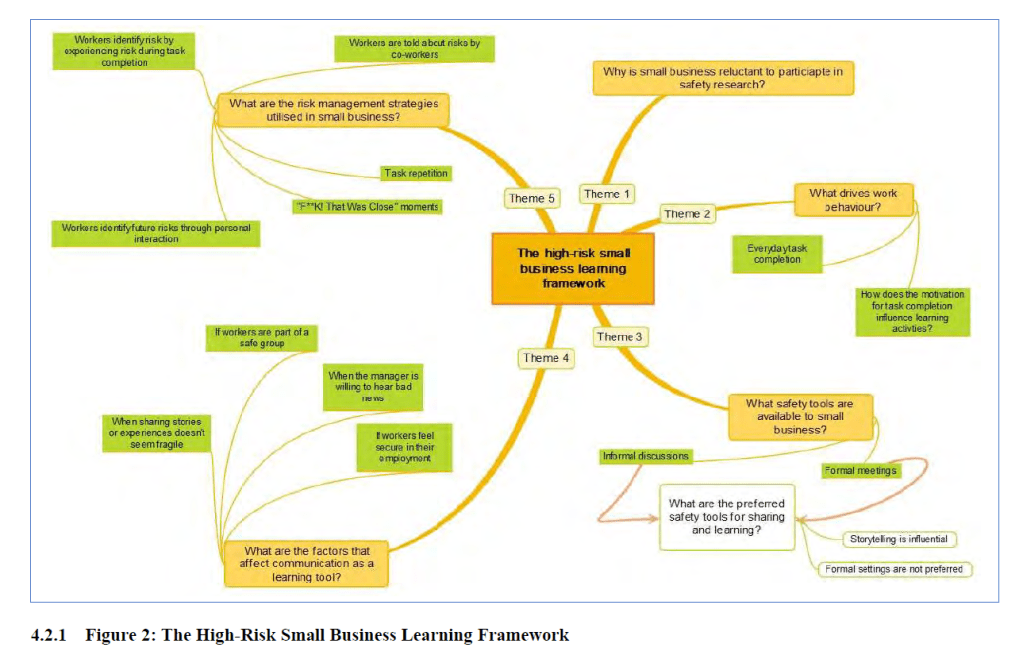
· “This is the reality of learning and becoming more risk-aware. The reality is this is a genuine learning tool utilised regularly during everyday work activities by small business frontline workers”
· “Workers gave numerous examples of these, what were often referred to as, ‘F**k! That was close’ (FTWC) moments”
· “it became clear that the line of right and wrong appeared to form where a threshold had been crossed, apparent by a self-belief or a witness’s belief that risk-taking had gone too far”
· “The issue with the label ‘risk-taking’ is it conjures a belief that a worker understood the risk before task completion and ‘accepted’ the risk. As this research has identified, this is often not true”
· “In a study carried out in forestry work, researchers found ‘it is the individual performance variability shaped by experience and “know-how” that guides the application of technical skills in such a (forestry work) complex, dynamic, high-risk environment”
#safety2 #safetyII #hop #ohs #hse #newview
LinkedIn article: https://www.linkedin.com/pulse/how-do-high-risk-small-business-frontline-workers-hutchinson-phd–c0jyc
Thesis: https://research-repository.griffith.edu.au/items/c1ff2f7f-94fd-4065-bf05-78f648041350
My YouTube: https://www.youtube.com/@safe_as_pod
Shout me a coffee: https://buymeacoffee.com/benhutchinson
Safe As LinkedIn group: https://www.linkedin.com/groups/14717868


