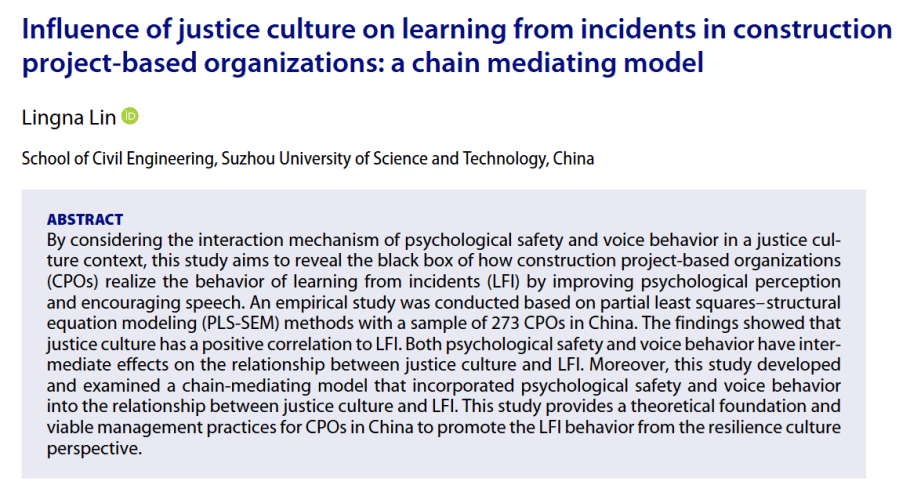
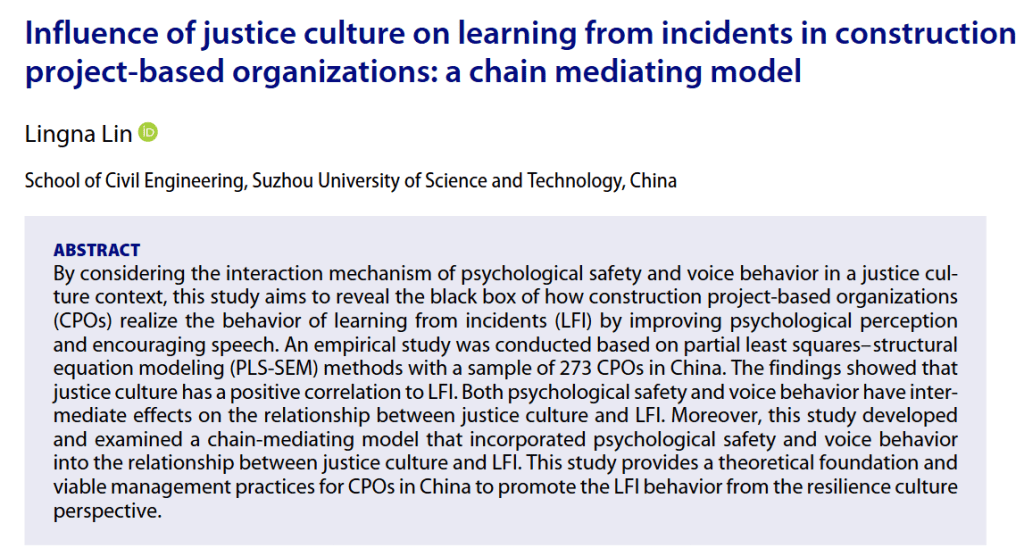
This study investigated the interaction mechanism of psychological safety and voice behaviour in a justice culture context.
Specifically they explored how construction project-based organisations (CPOs) can realise learning from incidents by improving psychological perception and encouraging voice.
273 CPOs in China were studied.
Background:
· Learning from incidents is often said to be an important goal within organisations
· However, by itself “dissemination of information about incidents neither prompts learning nor changes professional practice in ways needed to prevent future incidents”
· And learning From Incidents (LFI) “seems to be based on personal experience rather than covering the overall organization. Hence, it does not have an active and structured way of transferring information within or between organizations”
· Based on 38 major accident investigations from China between 2010-20, authors found that “the ultimate purpose of all accident investigations was to find the responsible person and punish them, while accident learning essentially did not happen”
· LFI often “emphasizes ‘people close to the core area of the incident”, and focuses on “individual responsibility logic (i.e., finding the person directly responsible for the incident) rather than to organizational functional logic (i.e., identifying underlying systemic factors)”
· Barriers to learning are said to run through the entire organisation, like “putting the organization’s safety goal first (i.e., the management claims that safety always comes first, but often refutes this statement with their own actions soon after)”
· Other barriers includes blame, while on the other end the “the absence of blame may lead to a lack of responsibility”
· Balancing the negative effects of blame and no blame requires a culture of justice
· [** Note that English isn’t likely these authors first language, so they may not directly mean ‘blame’ per se in the loaded way that a natural speaker may]
· Prior work has found that CPOs tend to use single-loop learning, which focuses on identifying and correcting existing issues without eliminating the underlying issues (double-loop learning)
· Organisations also struggle to identify inherent structural flaws within their knowledge systems
· LFI is hampered within construction industry, because it often needs to occur across organisational boundaries
· Moreover, “it is often restricted within the boundary of a project and rarely absorbed by other projects being delivered by a construction organization”
Results
Key findings were:
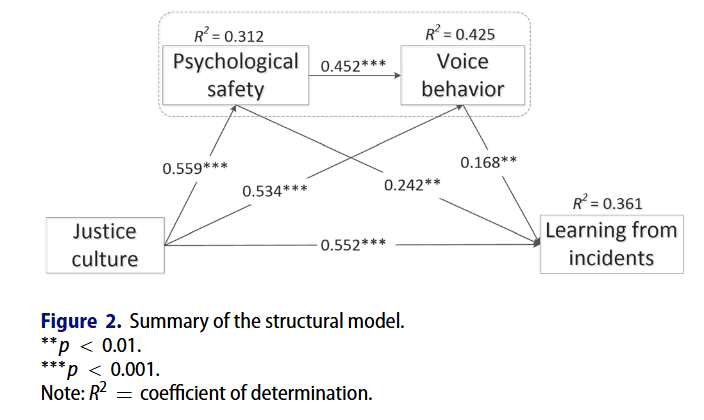
· “justice culture has a positive correlation to LFI”
· “Both psychological safety and voice behavior have intermediate effects on the relationship between justice culture and LFI”
· “In general, only when a culture of justice is psychologically and perceptually accepted can participants conform to the thought that it is worthy to keep to such culture and eventually be brave in discussing their experience of mistakes and tolerate the mistakes of others”
· “when participants detect justice culture from CPOs, they believe organizations are trustworthy and then stimulate themselves to discuss information related to incidents”
They say that the main bottleneck for organisations trying to learn from incidents comes at the reporting stage, where “safety culture is regarded as the most crucial element influencing the reporting of safety incidents” [** Meh…This term, in this context, obscures as much as it reveals, in my view]
Other work found that in some organisations, reporting incidents was “related to negative consequences (negative consequences occur when reporting incidents occur), such as shaming, blaming, punishment, scolding, threats of prosecution and extra work”
Hence, leaders in CPOs must create climates that “resonates with participants looking for common ground on LFI opportunities” and creates a psychologically safe environment to do so.
Ref: Lin, L. (2025). Influence of justice culture on learning from incidents in construction project-based organizations: a chain mediating model. International Journal of Occupational Safety and Ergonomics, 31(4), 1034-1044.
Study: https://doi.org/10.1080/10803548.2025.2472504
YouTube: https://youtube.com/@safe_as_pod?si=vXVlPyNCktHr70Xj
Shout a coffee: https://buymeacoffee.com/benhutchinson
LinkedIn post: https://www.linkedin.com/pulse/influence-justice-culture-learning-from-incidents-hutchinson-phd–0moec


