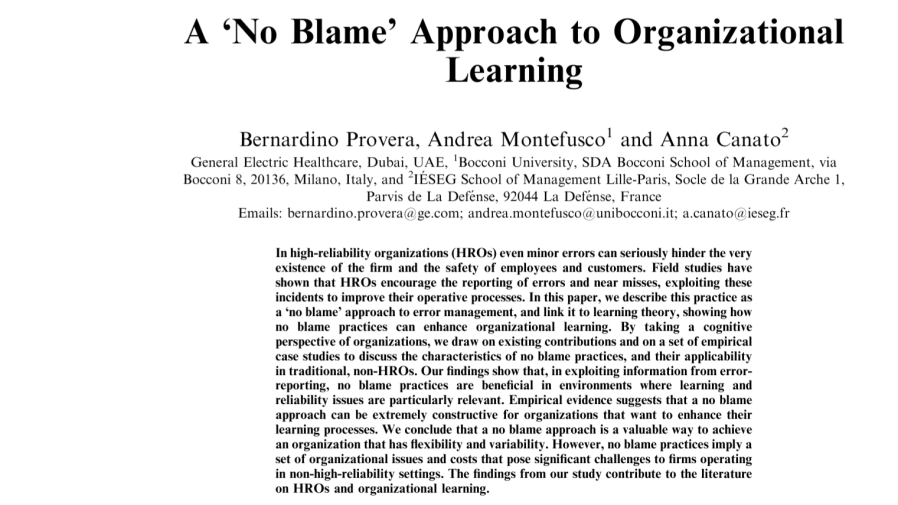
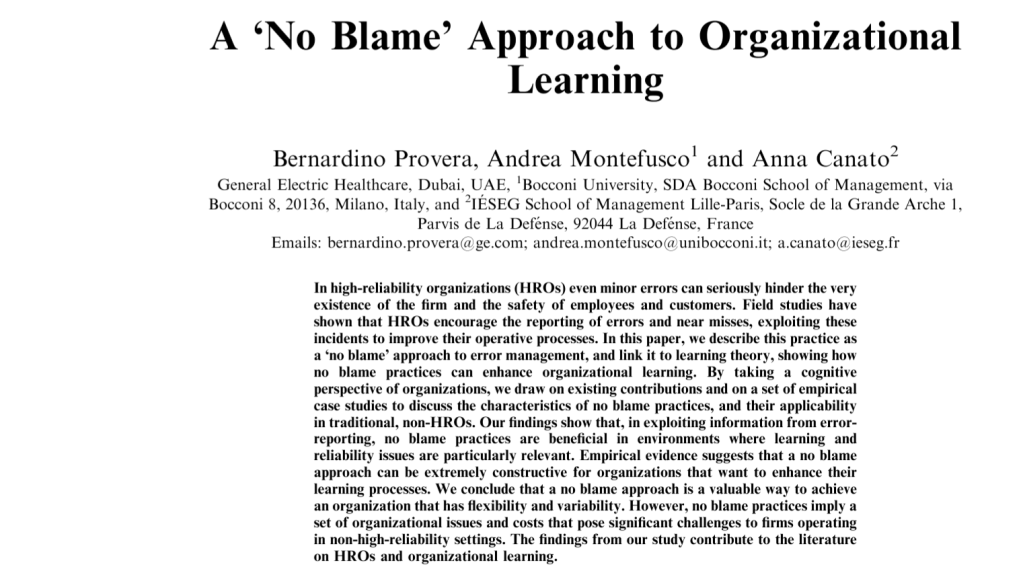
This paper studied a ‘no blame’ approach from a HRO lens, using case studies from a few different industries.
In part, they wanted to see how HRO principles translated into non-HRO industries.
[** Be good if we could move beyond the ‘no blame’ language to other more suitable, less-absolute terms, e.g. restorative justice and the like.]
For context:
· HROs are said to be high-risk firms that “remain basically ‘invisible’ until an error induces the collapse of the system in which they operate”
· HROs have a ‘peculiar’ approach to error management in that “they require, encourage and value the spontaneous reporting of errors and near misses”
· They define no blame as “an organizational approach characterized by a constructive attitude toward errors and near misses, based on the assumption that no system is entirely flawless”
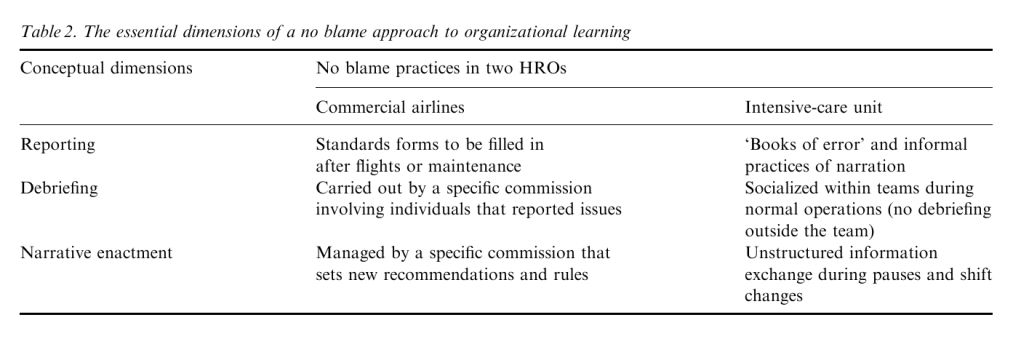
· Weick & Sutcliffe identified three components of no blame:
o reporting culture, where managers encourage and reward widespread reporting;
o debriefing processes, where individual error reports “trigger purposeful organizational analyses of possible explanations, based on the interrelations between different organizational elements”. People involved in the error are actively involved in this process
o narrative enactment, where the organisation’s logics shift to the future prevention of errors, and the communication and testing of response actions, e.g. “narrating the ‘story’ of the error, throughout the organization”.
· Systemic analyses move away from “simple ‘blame the operator” diagnoses, which triggers constructive conflict in groups for better sensemaking
· They talk about attribution biases, where investigators prefer to focus on individuals rather than on the situation as a whole, which further drives logics of blame
· HROs “rely on significant slack resources to cope with unexpected events. Consequently, high reliability theory tends to neglect the idea that organizational mechanisms must also balance costs and returns”
· “In situations of severe ambiguity, the risk of politicizing the causes of an error by deflecting blame toward other organizational units increases dramatically”
Results
They found that, perhaps unexpectedly, ‘no blame’ practices aren’t just applicable in HROs but also non-HROs.
All informants in the study discussed instances of blame and minimisation of blame. A difference they argue is that in HROs, “the issue of blame receives paramount attention and visibility, because concealing a mistake could provoke life-threatening situations”.
Blame is said to consistently impact efficiency and efficacy of organisational practices.
Their findings identify two areas where no blame practices may have significant positive benefits in organisations: SOPs and interdependent relationships.
SOPs
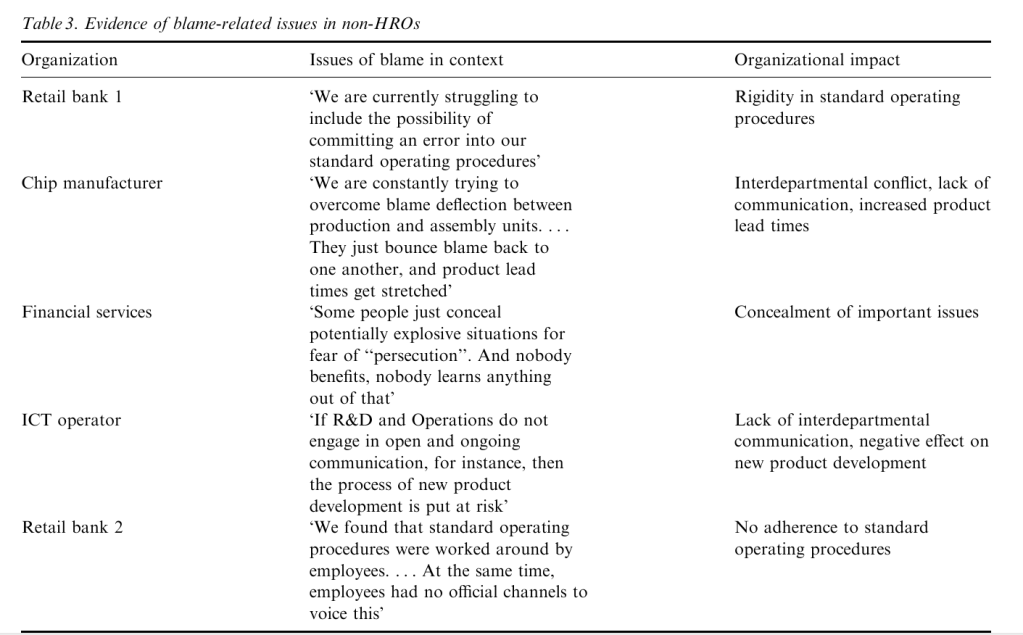
Despite all informants reporting the need to have SOPs, most “are more concerned over the behavioural distortions provoked by too much rigidity in their application and enforcement”.
Comments from the informants suggested a “widespread preoccupation with the negative impact of standard operating procedures on the organizational processes of learning from errors”.
Hence, no blame approaches were seen as valuable for counterbalancing the undesirable effects “on knowledge-diffusion processes of operating procedures”. No blame may also help introduce a little more flexibility into organisational norms, while also “respecting business requirements justifying the need for standard operating procedures”.
Interdepartmental Relations
This relates to the smoothness between different organisation departments/units etc. Tensions and silos may obstruct the flow of information, lead to goal conflicts and more.
Blame was found in these results to impact interdepartmental relations, impacting things like new product development. No blame approaches were seen to help organisations moderate some of the tensions regarding trust and communication.
Further, “diffusion of a reporting culture was seen as a key determinant of learning from errors”.
Four Parts to a Conducive No Blame Approach
Drawing on these results and literature, they consider the following elements as conducive to a no blame approach:
1) Loose hierarchy with specialization: This is where a formal hierarchy still exists, but it’s loose enough to permit shifting of operative responsibility for specific issues
2) Commitment to resilience: “Actors within a no blame approach do not assume their behaviour will be error free”, but instead recognise that performance variability is normal. No blame approaches, apparently, “enable individuals to recognize and to be constantly aware of the level of operational complexity”
3) Skills variety: This is about requisite variety of skills and capabilities, to allow different interpretations of signals
Barriers to No Blame
They note that competitive pressures may hamper the adoption or success of no blame approaches, since no blame “requires additional investments not immediately related to key productive activities and operations”.
Adopting a no blame approach also comes with cognitive demands, in order to learn new operating logics. There is also a challenge with a learning dilemma: the trade-off between the rewards of investing in learning, like a no blame approach, versus the costs of experimenting.
Cultural constraints also exist. They say “Knowledge is subject to segregation and, eventually, stagnation, for a wide variety of reasons”. They talk about culture and structures, and how some organisations are “extremely rigid and hierarchical”. In these environments, “communication flows only downwards”.
They say other organisations “lack what we define as a ‘culture of risk’, or an awareness of the potential fallibility of systems”. Lacking these logics means the organisation can end up passive, fatalistic or in a punitive attitude towards errors and mistakes.
Regulatory constraints may also act as barriers for no blame. They found evidence for how fear of legal repercussions may “impede relevant, yet self-interested interpretations” of risk and issues.
Further, they argue that “accountability leads to blame-deflecting strategies that occur via the filtering and manipulation of information communicated within the organization”.
Conclusion
They believe that a “no blame approach is a valuable way of ‘designing an organization for variability’. This approach “encompasses the nuances of complexity rather than the patterns of uniformity and standardization”.
They believe that no blame could help to “unlock schemata-reinforcing processes that ignore contradictory evidence and subvert the over-simplification of thinking practices”.
They think that no blame approaches may also help organisations to avoid the “root cause seduction” trap, or “preys to the assumption that one single cause justifies all problem-solving activities”.
Nevertheless, these findings suggest that the “application of a no blame approach as the ideal model might be too costly for traditional firms”.
Study: https://doi.org/10.1111/j.1467-8551.2008.00599.x
YouTube: https://youtube.com/@safe_as_pod?si=vXVlPyNCktHr70Xj
My Site with more reviews: SafetyInsights.Org
Shout a coffee: https://buymeacoffee.com/benhutchinson
LinkedIn post: https://www.linkedin.com/pulse/blame-approach-organizational-learning-ben-hutchinson-phd–jayac

 SafetyInsights.org