Did you check out my recent YT vid exploring Safety Culture (SC)? It covers several critiques and points from research: https://youtu.be/QBzOd-uejXg?si=rMbQgCRryXOYx3u0
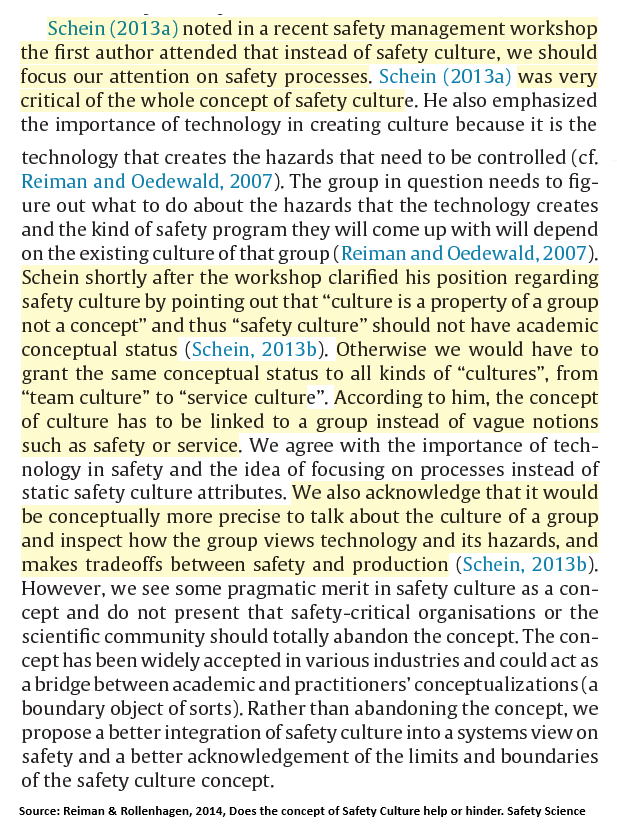
Here’s an extract I found interesting, discussing the late, great *Ed Schein’s view of SC (taken from Teemu Reiman & Carl Rollenhagen, 2014).
Schein was said to be critical of SC – believing that we should instead focus on the processes.
And if we afford conceptual status to SC, then we would “have to grant the same conceptual status to all kinds of “cultures”, from “team culture” to “service culture”.
And culture refers to properties of groups, rather than “vague notions such as safety or service”.
In any case, for these authors, while we may be better speaking of the “culture of a group and inspect how the group views technology and its hazards, and makes tradeoffs between safety and production”, SC may still be useful as a bridge between academic and practitioner conceptualisations of culture.
[* As always, we need to be cautious about ‘appeals to authority’, e.g. just because Schein believed/said something, that it lends credibility to the argument. But, still, pretty interesting.]


Hi Ben,
Do you know of any research on the epistemological basis and empirical reliability of the hierarchy of hazard controls (elimination, substitution, engineering, administrative, and PPE)?
Thanks,
Hayden Greenshields, CRSP, M.Sc. (T), (C)OHS, NCSO
<https://www.google.com/maps/search/2430+Ridgeview+Place+Prince+George,+BC+V 2K+3Z3+Office:+1?entry=gmail&source=g> 2430 Ridgeview Place
<https://www.google.com/maps/search/2430+Ridgeview+Place+Prince+George,+BC+V 2K+3Z3+Office:+1?entry=gmail&source=g> Prince George, BC <https://www.google.com/maps/search/2430+Ridgeview+Place+Prince+George,+BC+V 2K+3Z3+Office:+1?entry=gmail&source=g> V2K 3Z3
Phone: 250-960-9291
Email: hayden@safetypays.ca hayden@safetypays.ca
http://www.safetypays.ca/ http://www.safetypays.ca
“I have strived not to laugh at human actions, not to weep at them, not to hate them, but to understand them.” – Baruch Spinoza
LEGAL NOTICE: This e-mail, including any attached files, may contain confidential and privileged information for the sole use of the intended recipient. Any review, use, distribution, or disclosure to others is strictly prohibited. If you are not the intended recipient (or authorized to receive information for the intended recipient), please contact the sender by reply e-mail and delete all copies of this message.
LikeLike
Hi
I’ve not been able to find much work evaluating the validity or effectiveness of the HoC. I think the conceptual basis is pretty solid – we have several studies which have used the HoC to study improvements in design and risk reduction over time. And, it’s kind of hard to argue with the logic that eliminating a hazard is less ideal than whacking a hard hat on somebody’s noggin.
There is some limited evidence from process safety about inherent safety and minimisation that I’ve seen (reducing the total quantities of stored hazardous/flammable materials).
There is also some research in farming, and in healthcare showing that higher-order/engineering are more effective for infection control, and engineering and structural changes are more effective than interventions that rely on human action (e.g. needlestick injuries), see: https://onlinelibrary.wiley.com/doi/pdf/10.1002/cl2.1234 and my video of this study: https://www.youtube.com/watch?v=pr8f9fY4RFw
So, if there’s better evidence out there supporting the HoC I’d love to see it. Be great to share with our community.
LikeLike
Yeah, I agree. I was just curious on who had coined the HOHC and how far back it goes.
LikeLike
It’s said to go back to the 1950s – here’s an extract from the AIHS OHS article:
” The concept was developed in 1950’s by the US National Safety Council. Early versions did not
include “elimination”. Olishifski (1976, p.439), as did other writers of the time, identified the hierarchy
as: substitution, alteration of the workplace, isolation or enclosure, wet methods to reduce dust
exposure, local exhaust, general ventilation, personal protective devices, good housekeeping,
medical controls, and training.”
I’ve found several other articles also discussing its origins from the 1950s.
Link: https://www.ohsbok.org.au/wp-content/uploads/2019/10/34.1-Prevention-and-Intervention.pdf
LikeLike
Oh wow, fascinating. Thanks Ben for researching into this for me!
LikeLike