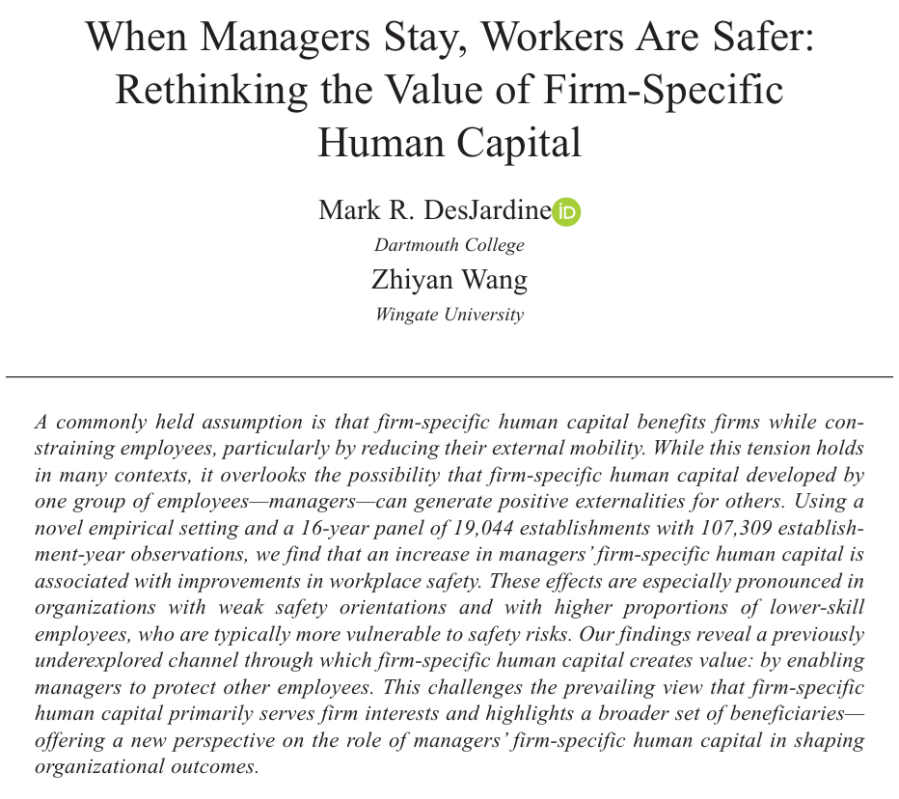
Does increasing manager retention and/or firm-specific capital improve reported incident data?
This study analysed 16 years of data from >19k US firms.
Note the various limitations, including human capital was evaluated indirectly via tenure, which was informed via some US law that aimed to limit managers changing companies, due to sharing company secrets.
PS. Check out my YouTube – link in comments.
Extracts:
· “Firm-specific human capital refers to skills, knowledge, and expertise acquired at a focal firm that are less valuable or transferable to other employers”
· “we find that an increase in managers’ firm-specific human capital is associated with improvements in workplace safety”
· “These effects are especially pronounced in organizations with weak safety orientations and with higher proportions of lower-skill employees, who are typically more vulnerable to safety risks.”
· “we found evidence of a 6% decrease in workplace injury rates in establishments located in states that had adopted the IDD” [IDD being the law that limited some managers from changing companies]
· “Together, our findings suggest that the accumulation of firm-specific knowledge among managers can play a crucial role in protecting workers who are most vulnerable to safety risks”
· “the costs borne by one group (managers, in the form of reduced mobility) can yield safety benefits for another group (frontline employees). This insight complicates the typical tradeoff logic by introducing a “horizontal” perspective: firm-specific human capital held by some employees can influence the well-being of others across the organizational hierarchy”
· “firm-specific human capital should also be examined as a source of interpersonal and cross-level spillovers within organizations”
· “Although managers’ firm-specific human capital may not improve outcomes for themselves, it enables them to design safer systems, respond to latent risks, and coordinate more effectively with employees—especially in contexts with weak formal safety structures. In this way, firm-specific knowledge among managers supports not just firm performance, but also organizational welfare”
Ref: DesJardine, M. R., & Wang, Z. (2025). When Managers Stay, Workers Are Safer: Rethinking the Value of Firm-Specific Human Capital. Journal of Management, 01492063251358215.
Study: https://doi.org/10.1177/01492063251358215
My YouTube: https://www.youtube.com/@safe_as_pod
My site with more reviews: SafetyInsights.org
Shout me a coffee: https://buymeacoffee.com/benhutchinson
Safe As LinkedIn group: https://www.linkedin.com/groups/14717868


