Does bullying impact Learning From Incidents (LFI) in construction?
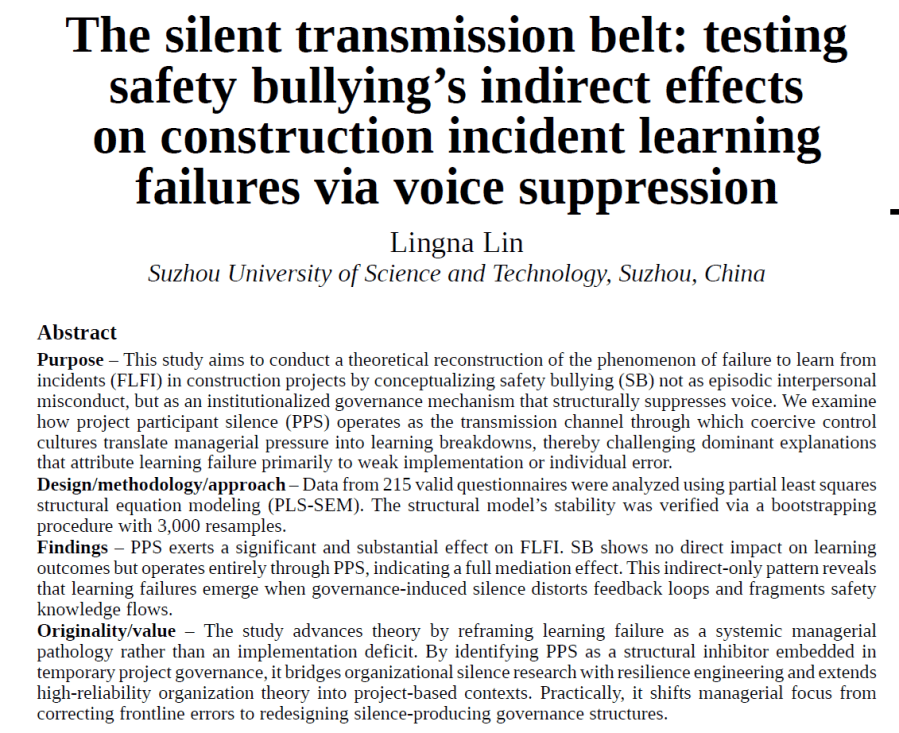
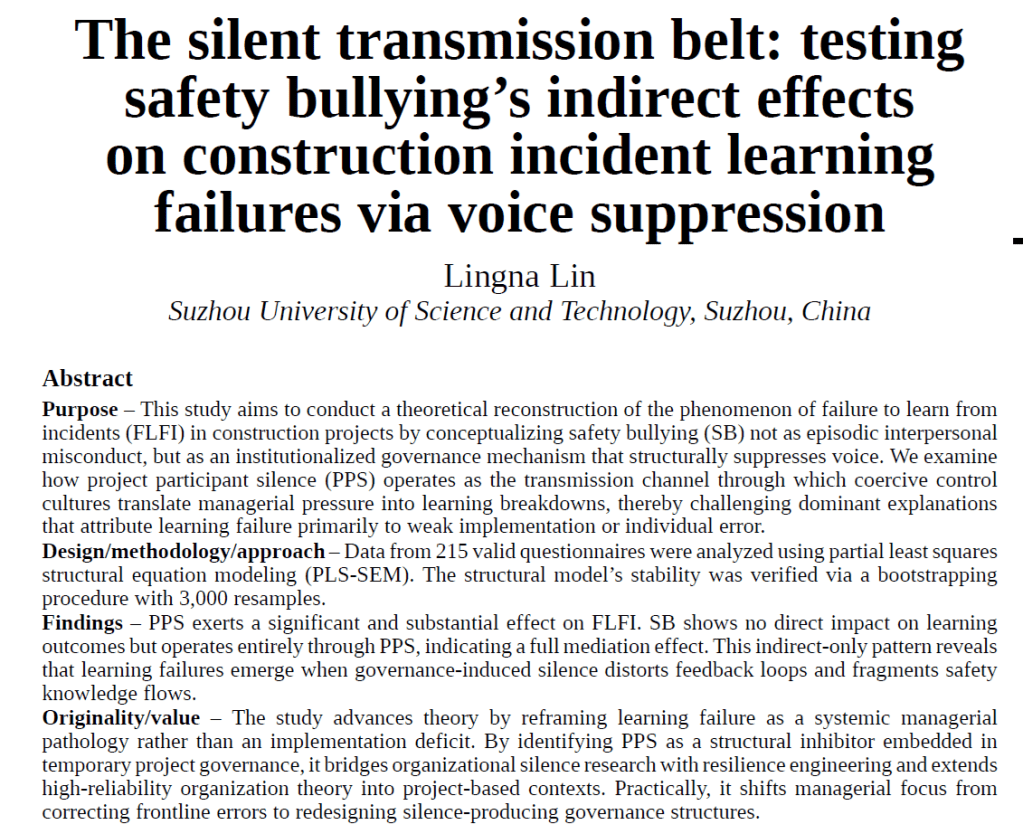
This interesting study explored bullying as an institutionalised governance mechanism, studying how it affects learning from incidents and safety voice.
A key concept is silence. Data was from 215 questionnaires.
PS. Check out my YouTube channel: https://www.youtube.com/@safe_as_pod.
Extracts:
· Studies show that LFI is “often constrained by organizational barriers, including weak feedback systems and punitive safety cultures … [shaped by] not only by technical limits but also by institutional pressures and everyday safety practices”
· Rather than SB being just interpersonal, in project-based environments it may be “an institutionalized practice, such as scapegoating workers, selective enforcement of … rules, and public shaming to preserve an image of flawless safety performance”, or use of “aggressive safety audits imposed by lead contractors”
· “managers may use accountability tools to protect project reputation and client relationships, creating pressure that discourages workers from speaking up”
· Project Participant Silence (PPS) “exerts a significant and substantial effect on FLFI”
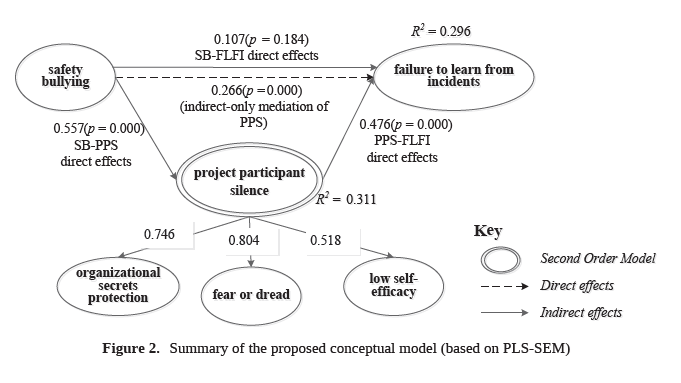
· Safety Bullying (SB) “shows no direct impact on learning outcomes but operates entirely through PPS, indicating a full mediation effect”
· “This indirect-only pattern reveals that learning failures emerge when governance-induced silence distorts feedback loops and fragments safety knowledge flows”
· “learning failures are not an immediate consequence of bullying behaviors themselves, but are closely tied to how such behaviors reshape communicative conditions within projects”
· “silence constitutes a proximal barrier to organizational learning. When safety concerns … are withheld, key learning inputs are distorted”
· “In construction settings, fear of blame, ambiguous incident definitions, and inconsistent post-report handling further intensify the disruptive role of silence … integrating Safety I and Safety II principles is particularly relevant …Safety II reframes human adaptability as a resource, shifting managerial attention from compliance enforcement to sense-making and learning in context”
· “hostile supervisory practices do not automatically translate into observable learning failures … [where] Fragmented supply chains and multilayered subcontracting can buffer the immediate impact of bullying on formal learning routines”
· And “aggressive supervision is often normalized as production pressure or site culture, reducing its visibility as a learning barrier”
· “SB undermines learning outcomes not by directly impairing cognition or procedures, but by fostering conditions in which safety-related voice is systematically suppressed”
· “PPS thus functions as the critical transmission channel linking interpersonal hostility to systemic learning”
· “Workers frequently adopt short-term self-protective strategies, tolerating SB while withholding information that could expose them to blame or retaliation”
· “Although PPS may function as an individual coping response, it simultaneously creates a collective knowledge vacuum that enables repeated safety failures”
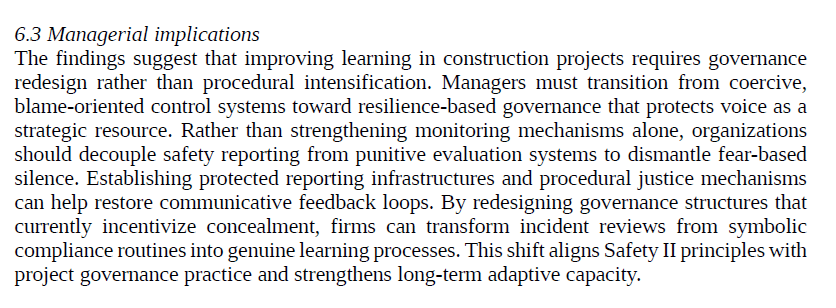
· “The findings suggest that improving learning in construction projects requires governance redesign rather than procedural intensification”
· “Managers must transition from coercive, blame-oriented control systems toward resilience-based governance that protects voice as a strategic resource
Study: https://doi.org/10.1108/ECAM-04-2025-0562
My YouTube: https://www.youtube.com/@safe_as_pod
My site with more reviews: SafetyInsights.org
Shout me a coffee: https://buymeacoffee.com/benhutchinson
Safe As LinkedIn group: https://www.linkedin.com/groups/14717868


