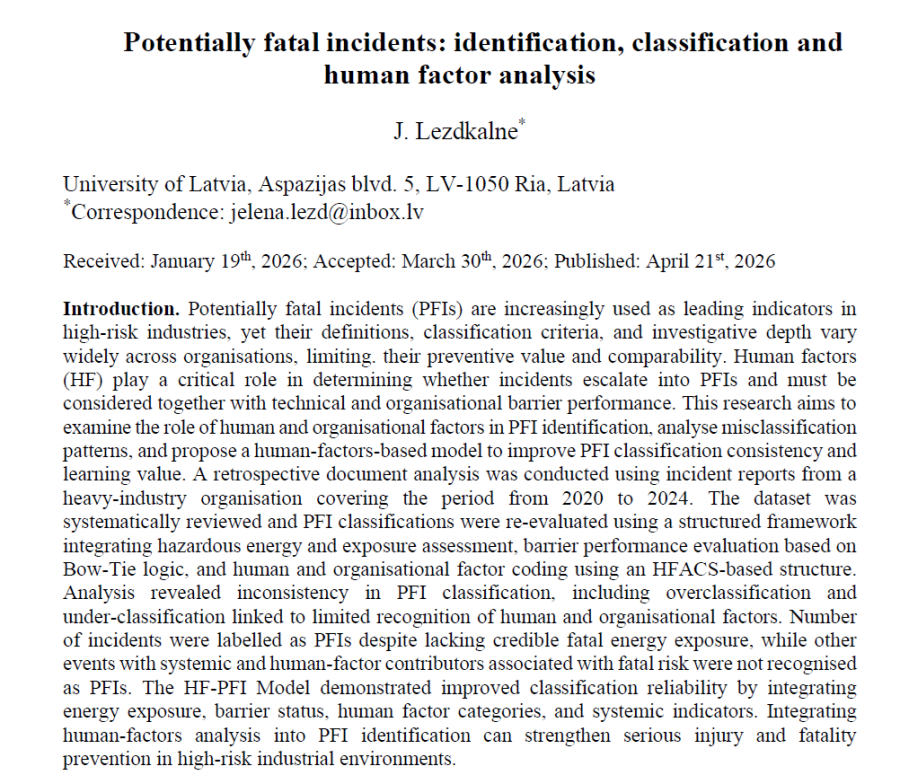
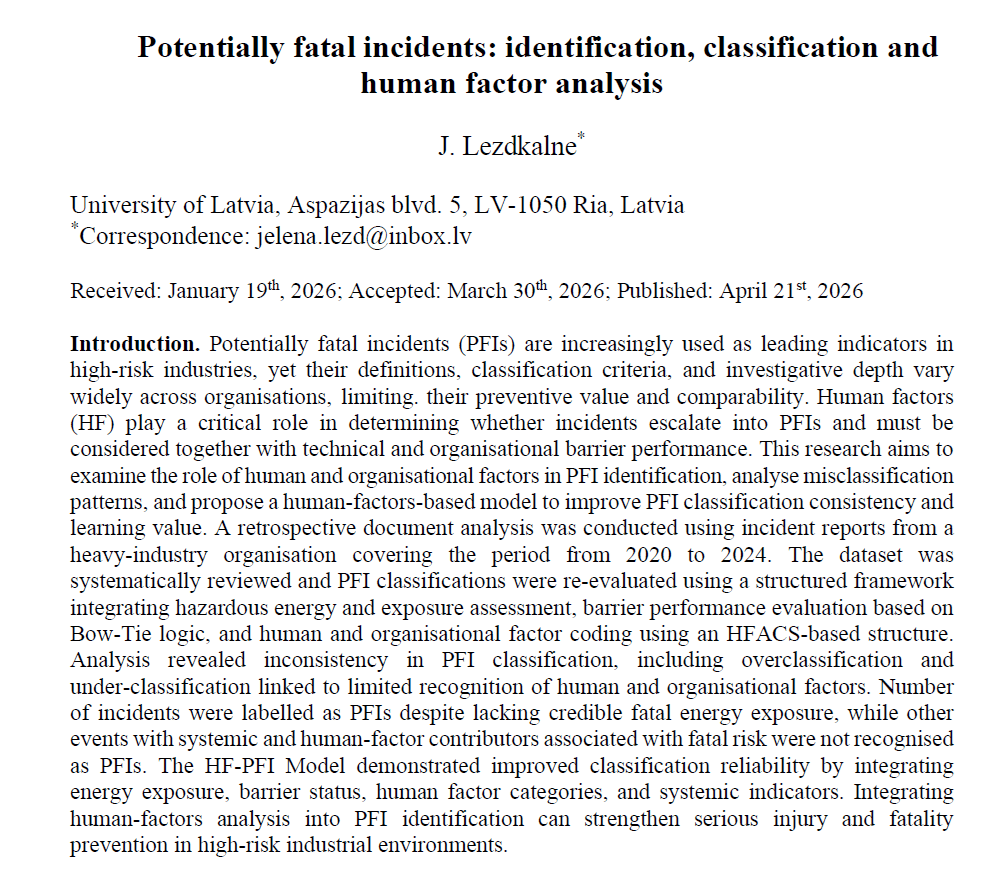
Are incident investigations underestimating the SIF potential? This study suggests Yes.
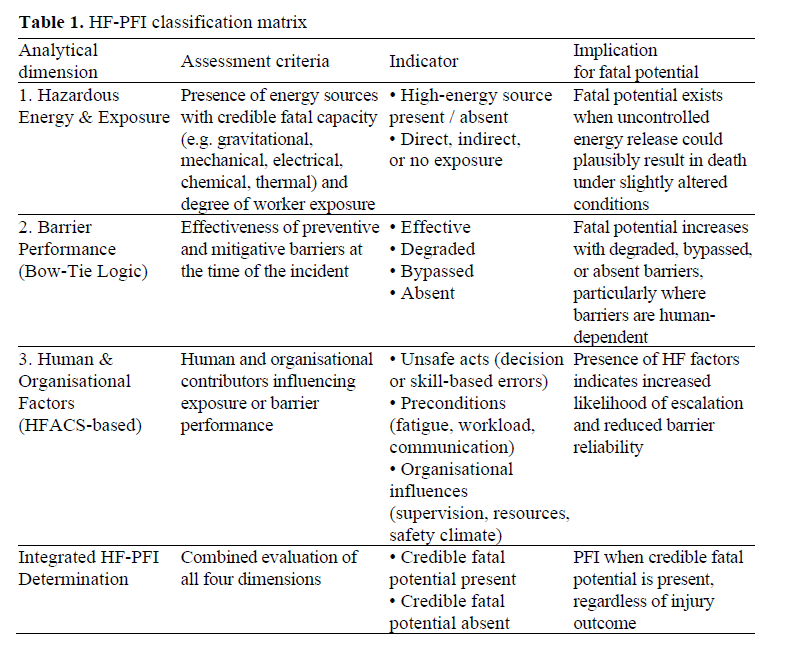
It reanalysed 62 investigation reports against a bespoke tool that incorporates energy thinking, barrier analysis and Human Factors/HFACS analysis.
PS. Check out my YouTube: https://youtube.com/@safe_as_pod?si=iUaDPJynPemQRZhY
Background:
· They use the term ‘Potentially fatal incidents (PFIs)’ to designate those that can kill
· “severity of an injury depends on circumstances, while potential for a fatal outcome is a property of the work system itself … prevention efforts increasingly focus on the identification and analysis of PFIs – events in which a fatal outcome was realistically possible, regardless of the actual injury sustained”
· [Some] …”Research shows that fatal accidents and minor injuries are driven by fundamentally different contributing factors”
· “Moreover, contemporary risk-reduction research in occupational safety and ergonomics emphasise the need to shift from outcome-based measurement toward analytical approaches that identify and reduce systemic risk”
· “Consistent with this, industry guidance indicates that the early warning signs of serious injuries and fatalities differ from those associated with minor accidents, supporting the use of PFIs as leading indicators”
· For challenges of identifying PFIs, some “events are labelled as PFIs despite lacking credible fatal potential, while others, involving substantial fatal risk, remain classified as minor accidents or near misses”
· “Misclassification is particularly problematic in complex, high-hazard industrial environments, where fatal outcomes typically result from the interaction of human performance, organisational conditions, and barrier degradation rather than from a single failure”
· “fatal outcomes were not explained by isolated unsafe acts or single technical failures, but by the interaction of hazardous energy, exposure conditions, barrier performance, and human-organisational context”
· Per other research, it’s suggested “that severity outcomes are not linearly related to accident frequency or injury rates. Seminal research highlights that fatalities and serious injuries are driven by different combinations of exposure, system conditions, and barrier failures, rather than by an accumulation of minor unsafe acts alone”
· “fatal risk is closely associated with exposure to high-energy sources, such as gravitational, mechanical, electrical, chemical, or thermal energy, combined with insufficient separation between workers and the hazard”
· “The literature emphasises that fatal potential exists even when no injury occurs, provided that energy transfer was fatal under slightly altered conditions”
· “Systems safety research shows that fatal accidents typically emerge from multiple barrier failures, including degraded, bypassed, or absent controls, rather than from the absence of controls alone”
· “Importantly, barriers are frequently human-dependent, relying on correct procedural execution, supervision, or decision-making”
Findings:
· “Across 62 analysed incident reports, nearly two-thirds were classified differently when evaluated against the HF-PFI criteria, with underclassification occurring more frequently than over-classification”
· “This indicates that fatal potential is most missed in events with minor or absent injury consequences, supporting the argument that realised severity does not reliably reflect escalation potential”
· “Of the 62 analysed cases, 39 incidents (63%) were identified as misclassified when compared with the HF-PFI determination. Among these, 25 incidents (40%) were classified as under-classified PFIs, having been originally recorded as minor accidents or near misses despite involving credible fatal potential”
· “In contrast, 14 incidents (23%) were identified as over-classified PFIs, where events were labelled as PFIs despite lacking sufficient hazardous energy exposure or escalation”
· “These findings demonstrate that current PFI identification practices do not consistently reflect fatal-risk factor”
· “Further analysis of the 39 misclassified incidents revealed clear patterns in the presence and treatment of human and organisational factors during investigation and classification”
· “over-classified PFIs showed substantially lower prevalence of HFACS-coded contributors, with unsafe acts identified in 4 cases (29%) and organisational influences in 3 cases (21%), suggesting that classification decisions in these cases were driven primarily by injury visibility or perceived severity rather than systemic risk assessment”
· “Barrier performance emerged as a central factor between under- and over-classified cases. Under-classified PFIs were characterised by degraded, bypassed, or human-dependent preventive controls and frequent procedure–practice gaps”
· Underestimation of PFIs appears widespread and is “systematic rather than incidental”
Overall, they say that using PFIs for leading/positive indicators stresses the point that “realised injury severity should be separated from fatal potential in PFIs”.
And, investigator training/competency/instruction etc. should emphasise that events with no injury “may still represent high fatal risk if energy exposure and barrier degradation are present”.
Study link: https://agronomy.emu.ee/wp-content/uploads/2026/04/Vol24No1_2026_Lezdkalne.pdf
My Youtube: https://youtube.com/@safe_as_pod?si=iUaDPJynPemQRZhY


