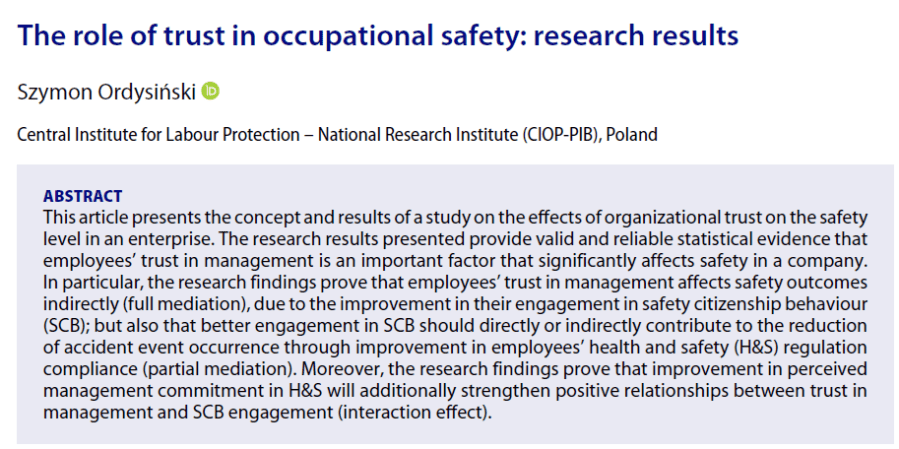
How does trust affect safety levels within organisations?
883 Polish industrial workers were surveyed.
Shared under open access licence.
PS. Check out my YouTube: https://youtube.com/@safe_as_pod?si=iUaDPJynPemQRZhY
Shout a coffee: https://buymeacoffee.com/benhutchinson
Extracts:
· “employees’ trust in management affects safety outcomes indirectly (full mediation), due to the improvement in their engagement in safety citizenship behaviour (SCB)”
· e.g. it works indirectly by influencing voluntary behaviour, which then influences safety compliance and outcomes
· “when management is trusted by employees and also perceived as committed to H&S issues, then employees are more likely to engage in SCB, compared with the situation where entrusted management is not committed or committed management is not trusted”
· Proactive behaviours, like reporting “exposes them to the risk that the information will be used negatively (to discipline rather than promote learning)”
· “asking employees directly whether they trust their superiors does not guarantee reliable and accurate measurement”
· Instead, we should focus on sources like ability, benevolence & integrity
· “the meta-analysis showed that integrity is the strongest predictor of employees’ trust in management”
· Integrity is defined as “the degree to which the value of life and health has been internalized in the trustee’s value system”
· Benevolence means “putting the safety and well-being of employees over their own profit or the profit of the organization”
· One can trust someone in certain aspects…and not trust at all in another”, e.g. workers may trust a manager’s competence but not their integrity
· However, a “certain degree of creative mistrust is necessary to maintain the desired team alertness in order to identify emerging hazards”
· They warn of “Captainitis”, being: “a tendency of team members to quit their responsibilities when their acts or opinions are contrary to their superior’s decisions, even when those decisions are clearly wrong and can cause catastrophic effects”
· “Although captainitis results primarily not from trust but from power distance, it is a certain exemplification of a negative impact of too much subordination of employees to their superiors’ orders”
PS. Have another post coming up on distrust and its differential effects.


