Are safety audits paperwork rituals disconnected from operational risks?
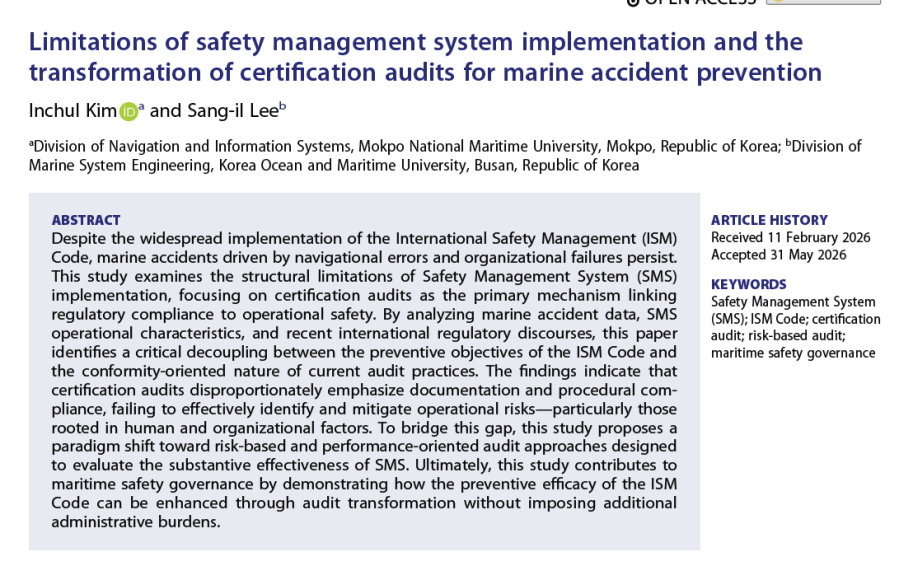
This article reviewed research, exploring the risk coupling of conformity-oriented maritime audits.
Shared under an open access licence.
PS. Check out my YouTube and recent Critical Control / barrier vid: https://youtube.com/@safe_as_pod?si=iUaDPJynPemQRZhY
Shout a coffee: https://buymeacoffee.com/benhutchinson
Extracts:
· “accidents tend to concentrate in areas that should be directly controlled by Safety Management Systems (SMS) … [Yet, this accident pattern] reveals a structural gap between formal regulatory compliance and actual safety performance”
· “ the persistence of marine accidents indicates that the problem does not stem from the absence of SMS or from insufficient institutionalization of the system, but rather from the fact that SMS does not function effectively in practice”
· “In other words, the limitations lie at the implementation stage, where structural weaknesses in the operation of safety management systems continue to be exposed”
· Findings “indicate that certification audits disproportionately emphasize documentation and procedural compliance, failing to effectively identify and mitigate operational risks—particularly those rooted in human and organizational factors”
· “Although SMS procedures are designed to encompass a wide range of operational situations, in practice they often fail to align with actual work processes on board ships. This misalignment arises as procedures added retrospectively in response to specific accidents or audit findings accumulate over time, resulting in procedures that do not reflect the realities of daily operations”
· “When non-compliance with procedures is perceived as likely to result in audit findings or accountability measures, seafarers are more inclined to conceal risks or rely on informal practices rather than report them”
· “certification audits function less as proactive mechanisms for accident prevention and more as retrospective instruments for verifying conformity with documented procedures and requirements”
· “the fact that the non-performance or merely formal execution of risk assessments is not treated as a critical issue during audits, but only problematized after accidents occur, clearly illustrates the limitations of the current audit framework”
· “Under such conditions, certification audits risk degenerating into tools that justify accountability after accidents rather than mechanisms that prevent accidents in advance”
· And the primary criterion of audit judgement seems to be “whether procedures addressing specific risks are documented, rather than whether those risks are effectively controlled in practice”
· “As a result, SMS tends to be perceived not as a tool for risk management, but as a documentation system designed to satisfy audit requirements”


