Have we engineered systems that exceed our capacity to intellectually manage them?
Some extracts from Leveson’s book ‘An Introduction to System Safety Engineering’.
PS. Check out my YouTube and recent Critical Control / barrier vid: https://youtube.com/@safe_as_pod?si=iUaDPJynPemQRZhY
Shout a coffee: https://buymeacoffee.com/benhutchinson
First she quotes Trevor Kletz where we’re seemingly ‘willing to spend money on complexity but not on simplicity’.
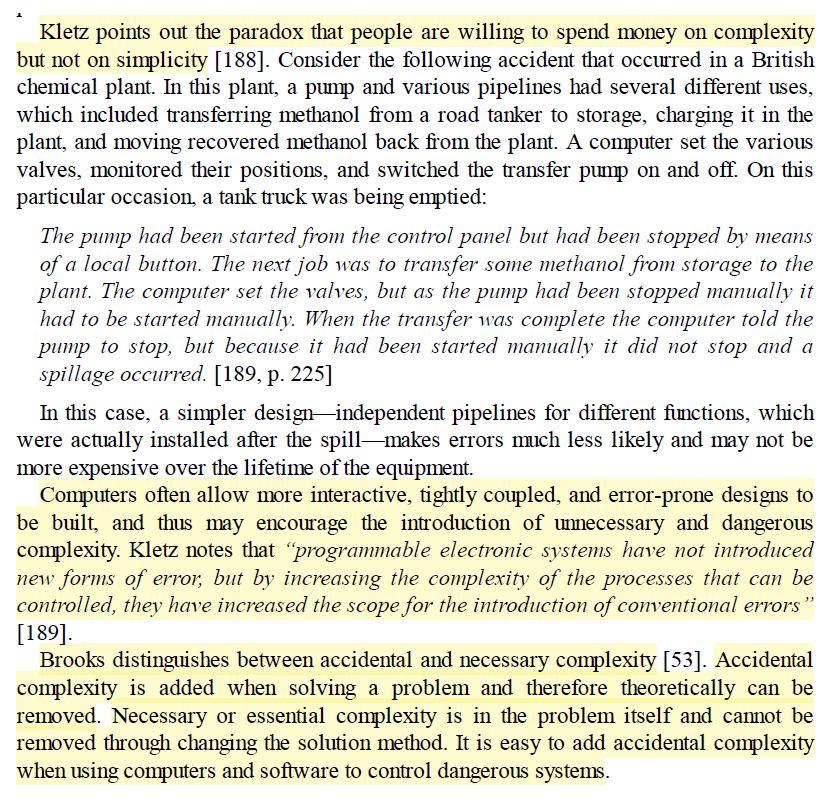
Also, computers allow more ‘interactive, tightly coupled, and error-prone designs to be built, and thus may encourage the introduction of unnecessary and dangerous complexity’.
On complexity – Leveson focuses on her particular angle from an engineering and cybernetics tradition (one among many views in complexity and systems perspectives but all with their own assumptions and boundary conditions).
Accidental and necessary complexity reflect spectrums where one type can, theoretically, be removed, whereas the other cannot be readily removed. Computers may add to accidental complexity.
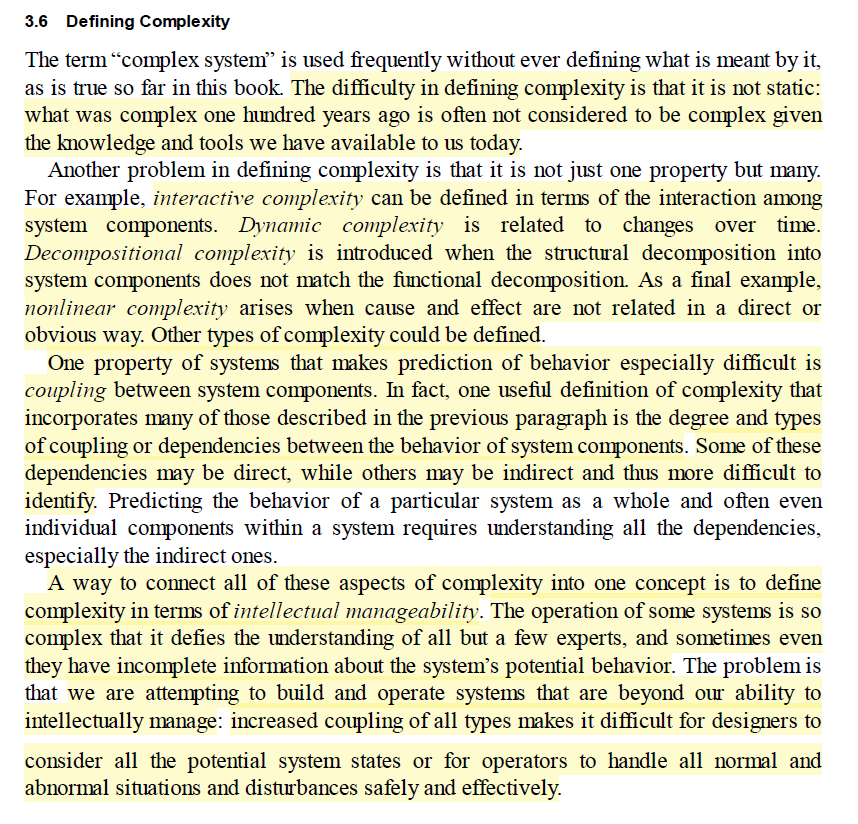
Next Leveson briefly unpacks different properties of complexity, including interactive and dynamic, to decompositional and non-linear. Coupling is also an important concept.
Finally, for Leveson, ‘intellectual manageability’ is a critical constraint for understanding complexity.
I’ll cover her perspectives on systems in another post (including ‘systems’ are just a human abstraction, and they don’t actually exist ‘out there’ in the world).
#safety #complexity #safetyscience #systemsthinking


