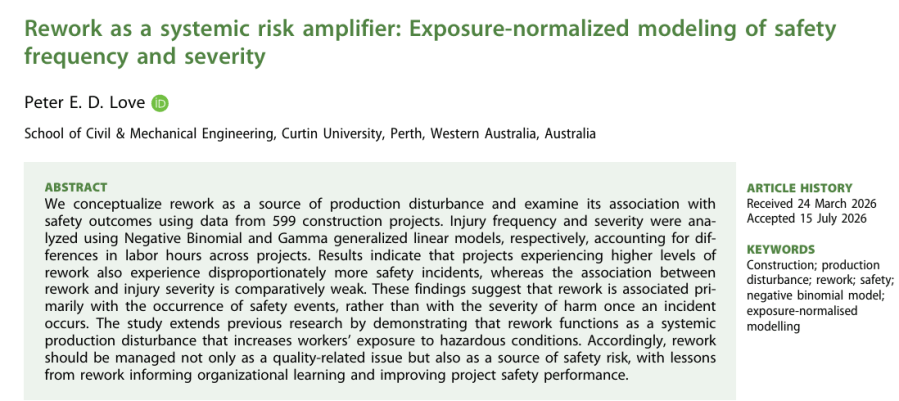
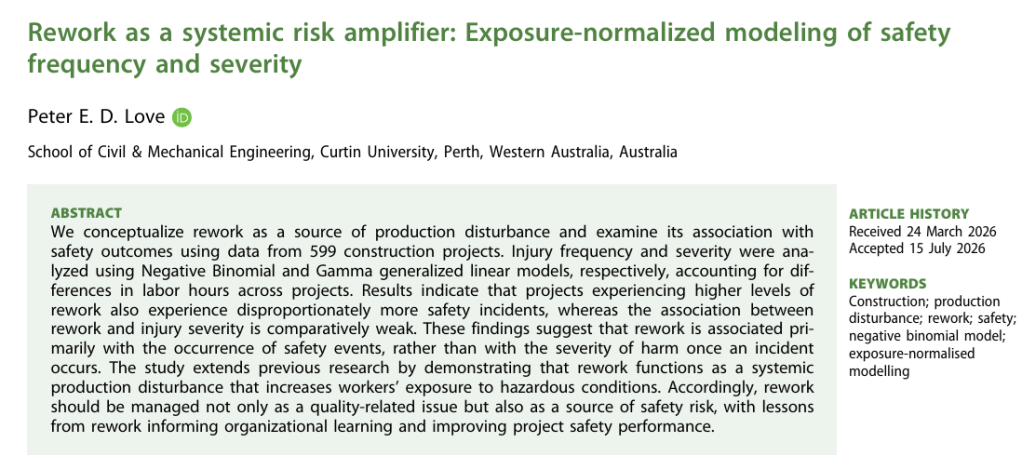
Does construction rework act as a safety risk amplifier?
This study from Peter E.D Love analysed data from 599 projects.
PS. Check out my YouTube and recent Critical Control / barrier vid: https://youtube.com/@safe_as_pod?si=iUaDPJynPemQRZhY
Shout a coffee: https://buymeacoffee.com/benhutchinson
Extracts:
· “Rework is not only a response to quality deviations but also an activity that alters task organisation and execution”
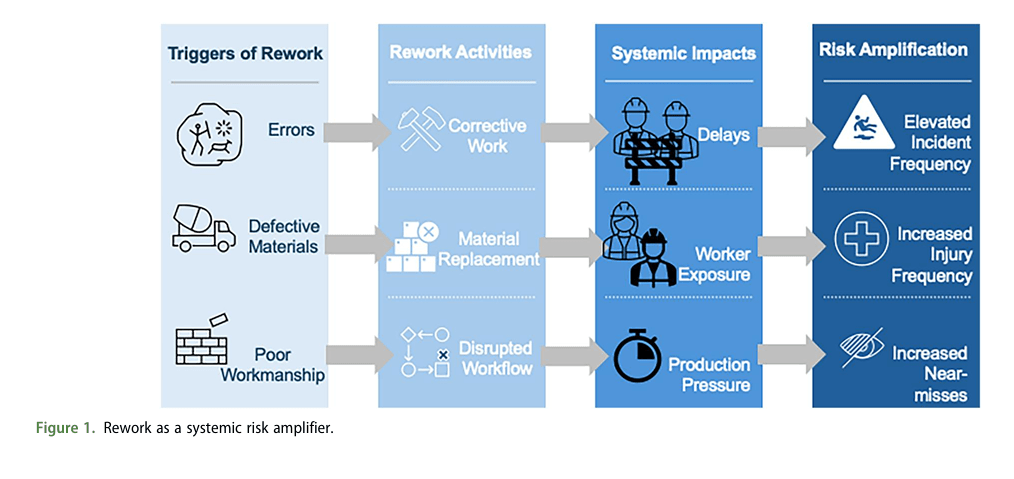
· “Rework can be understood as a systemic risk amplifier”
· “Corrective processes extend beyond quality outcomes. Remedial operations can intensify existing hazards, introduce new ones, and alter production dynamics”
· “Projects with higher rework density experience higher injury frequencies”
· “Injury frequency increases at an accelerating rate with rework”
· “Higher levels of rework are associated with disproportionately larger increases in injury occurrence”
· “Rework is more closely associated with the occurrence of injury outcomes than with the magnitude of lost-time injury severity”
· “Injury frequency is not simply linked to the presence of rework; it varies with the concentration of rework in the production environment”
· “Projects reporting no rework should not necessarily be interpreted as error-free environments, as non-conformances may remain undetected or go unreported”
· “Monitoring rework levels can help identify projects that may require additional oversight”
· “Preventing incidents and reducing injury severity require different management responses”
· “Part of the relationship between rework and injury frequency may reflect differences in reporting practices as well as the operational effects of rework itself”
· “Rework should therefore be treated not only as a quality-management issue but also as a safety concern”
· Drawing on Safety-II, “rework is not only a response to deviations but also a source of additional variability within production systems”
· Rework “introduces new tasks, alters sequencing, and increases interaction among trades, thereby changing the operating environment in which work proceed”
Study link: https://doi.org/10.1080/09537287.2026.2708092

 SafetyInsights.org