What does Resilience Engineering reveal about construction workers’ physical and psychological symptoms?
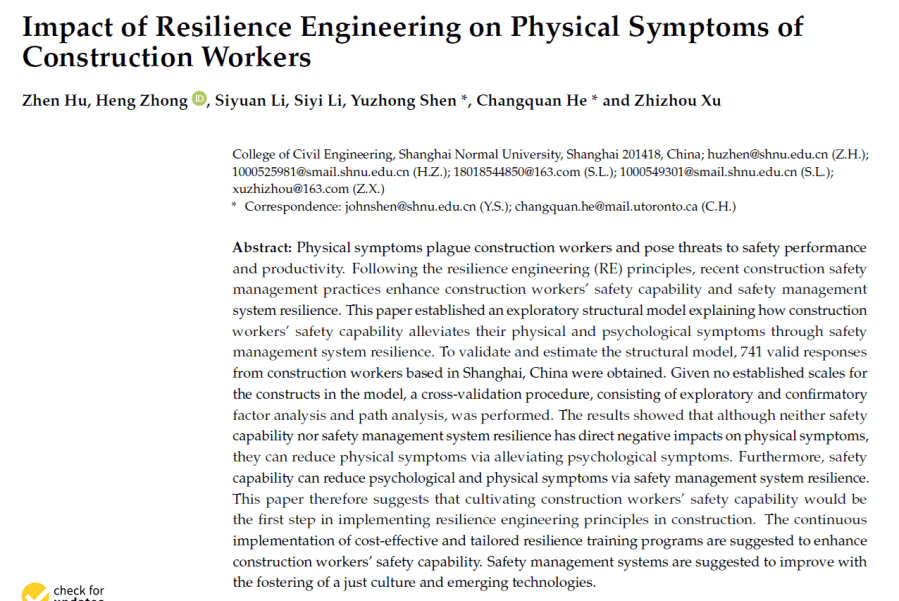
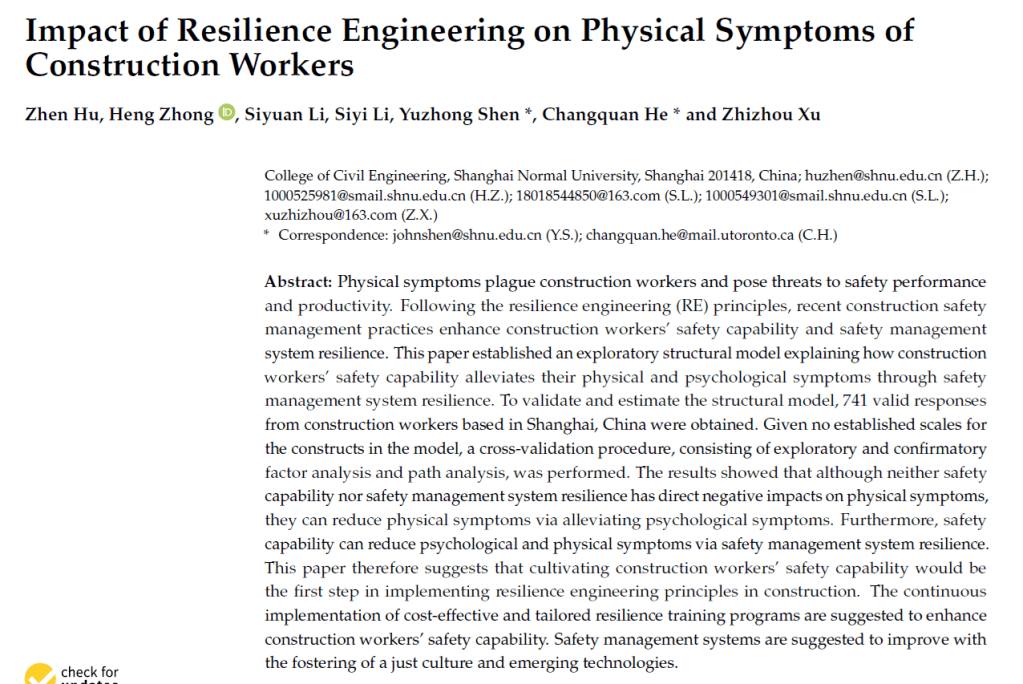
This study surveyed 741 workers from China exploring the above question.
PS. Check out my YouTube and recent Critical Control / barrier vid: https://youtu.be/Ly1mEn_KCLQ?si=yG3yRVOM0r2eyyKI
Shout a coffee: https://buymeacoffee.com/benhutchinson
Extracts:
· Dynamic safety capability refers to “an organization’s capacity to generate, reconfigure, and adapt operational routines to sustain high levels of safety performance in environments characterized by change and uncertainty”
· Individual safety capacity is their “capacity to sense risk and hazards, seize opportunities, and transform processes and procedures to tackle emerging risks on construction sites”
· Hence people can “scan and interpret the external environment for potential safety opportunities and threats. By seizing opportunities, the individual is capable of managing contradictions and competing goals related to safety”
· “While safety capability reflects a worker’s resilience in dealing with safety risks, safety management system resilience refers to the capacity of the safety management system instituted by an organization to respond to actual accidents, monitor critical threats, anticipate potential risks, and learn from factual evidence”
· An SMS “is designed to manage safety elements in the workplace, and these elements include policies, plans, procedures, objectives, responsibilities, etc. A resilient safety management system can make reactive, concurrent and proactive adjustments”
· They found that better worker safety capability and a more resilient safety management system capability weren’t directly associated with fewer physical symptoms
· However, they were associated with fewer psychological symptoms, like stress, anxiety, depression and sleep problems, and lower psychological distress was associated with fewer reported physical symptoms
· Said differently, safety capability and system resilience are associated with fewer reported psychological systems, which was associated with fewer reported physical symptoms
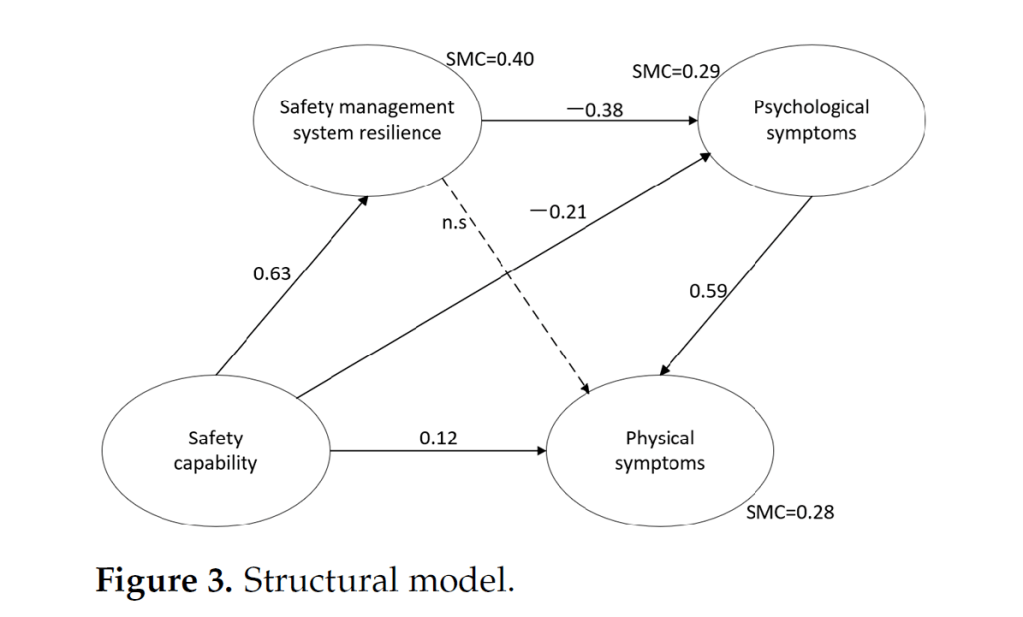
· Moreover “a simple linear relationship cannot capture the complex impact of resilience on physical symptoms. This is understandable. Just like the prolonged use of personal protective equipment can bring forth physical strain, there is probably an optimal level of resilience, be it at the individual level or system level, which can efficiently and effectively suppress physical symptoms”
· “the results suggest that safety capability and safety management system resilience can alleviate construction workers’ physical symptoms via psychological symptoms”
· “results suggest that in implementing resilience engineering in construction, a viable first step is to build up frontline workers’ safety capability”
· The authors suggest some mechanisms to build capability but these are, ahem, in my opinion, uninspired…so moving right along
And limitations, as always.


