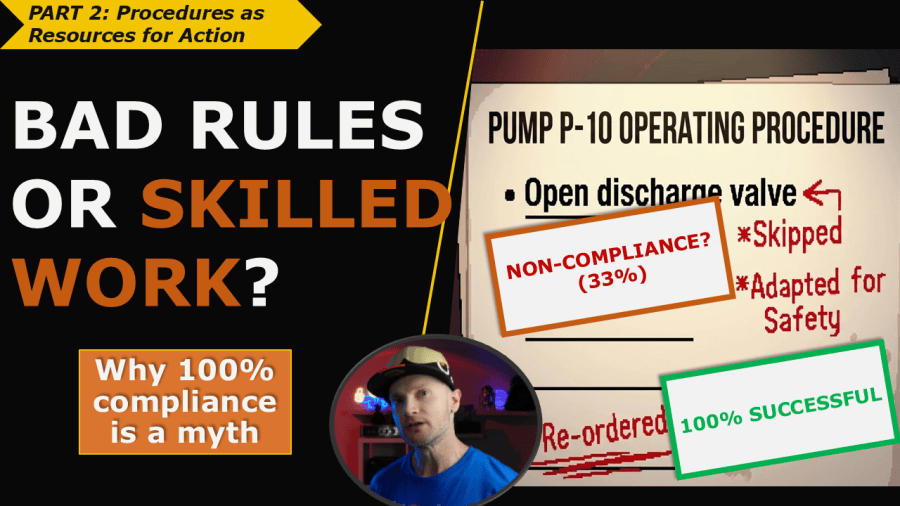
In a 5-year petrochemical study examining over 1,400 work steps, 1/3 were performed differently from what was written in the procedure, but every task was completed successfully.
Is this non-compliance or a display of worker aptitude and resilient skill?
In Part 2 of our series on procedures, we look beyond the “100% compliance” rhetoric and unpack the gap between work-as-imagined (WAI) and work-as-done (WAD).
We explore why workers adapt rules, how to categorise workarounds, and how to redesign safety procedures as resources for action rather than as tools for worker control.
We cover:
a. why procedures assume work is linear, predictable and controllable – and why real-world conditions constantly force adaptation
b. The RES framework which explores three drivers of procedural adaptation: Routine, Efficiency, and Safety
c. The difference between viewing procedures as top-down mandates (Model 1) vs localised, situated tools (Model 2)
d. The limits of compliance checks, and how ‘pencil whipping’ procedures fails to assure adequate rule following, and why procedure quality and safety climate may matter more
e. How airline pilots handle complex emergencies by drawing on fragments from checklists and SOPs rather than following linear scripts
f. The challenges of over-specification vs under-specification, and why cramming in more details forces workers into a ‘damned if you do, damned if you don’t’ trap
g. Using Scenario-Based Training (SBT) & Gary Klein’s ShadowBox approaches, and HPOG’s Walk-Through Talk-Through to build expertise & redesign work systems
Please like, comment, subscribe and help share 🙏
#safetyii #hop #SIF #resilienceengineering #ndm #safetydifferently #newview #humanfactors #ergonomics


