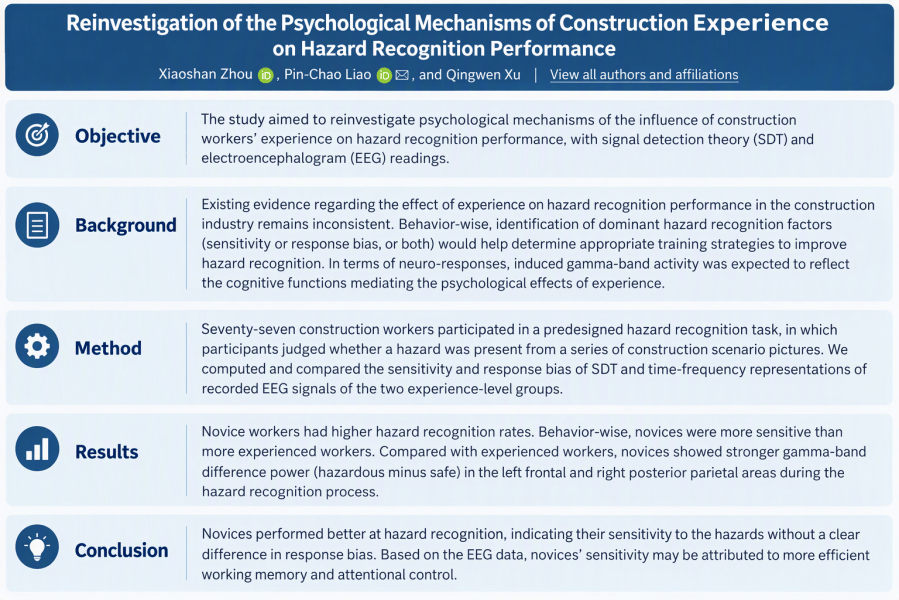
Are novices or experienced workers better at identifying hazards?
77 construction workers undertook a hazard recognition task via construction photos and EEG & signal detection measures.
PS. Check out my YouTube: https://youtube.com/@safe_as_pod?si=V2dbdmW–WbnhzA9
Shout a coffee: https://buymeacoffee.com/benhutchinson
Extracts:
· “To date, the majority of previous studies have shown that experienced workers possess better hazard recognition performance [than novices]”
· However one study found that “experienced workers did not perform significantly better than novices in identifying hazards”
· They found “experienced workers (>10 years’ work experience) showed poorer hazard recognition performance than their younger counterparts”
· And “Enhanced gamma-band activation in the left prefrontal and right posterior parietal cortex constitutes a neural basis for increased hazard recognition performance in construction workers, suggesting better working memory and attentional control in novices”
· Hence “Novices identified hazards more accurately and demonstrated higher sensitivity than experienced workers”
· And “Novices showed stronger gamma-band difference power in the left frontal and right posterior parietal areas, indicating more efficient working memory and attentional control when compared with experienced workers”
· “novices were better at discriminating between potentially hazardous scenes, while experienced workers were more likely to confuse sensory cues, leading them to misclassify hazards”
· No difference in response bias was found, i.e. “their subjective definition of what accident likelihood counted as a “hazard.”
* Limitations as always – e.g. construction images and not real-world settings.
(NB. Abstract reformatted with AI since the original wasn’t suitable as an image)
Study link: 1066666 1..13


