Has WHS harmonisation impacted traumatic digit amputation rates?
This new study statistically analysed the 2012/13 WHS harmonised adoption cohorts vs Victoria (non-harmonised) to evaluate any impacts from harmonisation.
Note – IRR = incidence-rate ratio (IRR). It’s a way to express a relative difference between two groups, where 1 is no difference, 1.2 is 20% higher or 0.8 is 20% lower etc.
PS. Check out my YouTube: https://youtube.com/@safe_as_pod?si=V2dbdmW–WbnhzA9
Shout a coffee: https://buymeacoffee.com/benhutchinson
Extracts:
· “Traumatic amputation of the fingers or thumb is a common, disabling, and mechanistically well-understood form of occupational hand trauma”
· Some global data modelling suggests 1.86 million thumb amputations & 4.3 million non-thumb digit amputations worldwide in 2017 alone
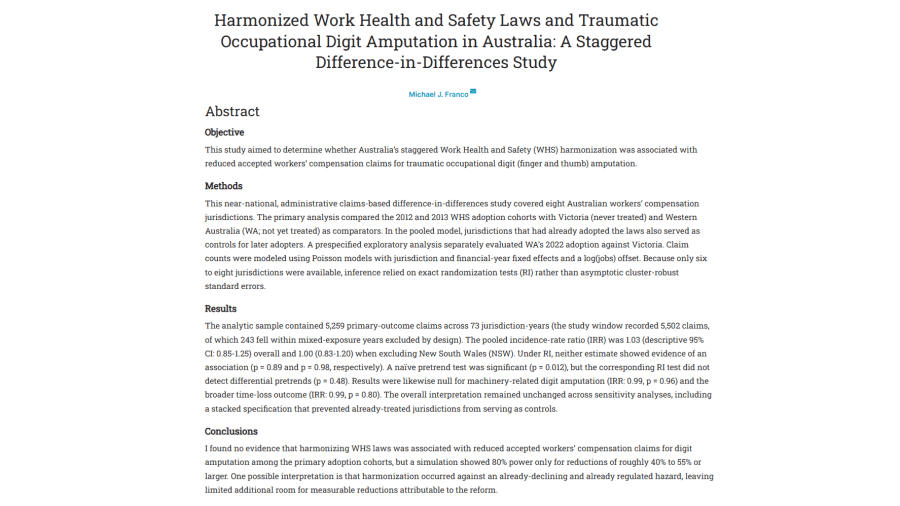
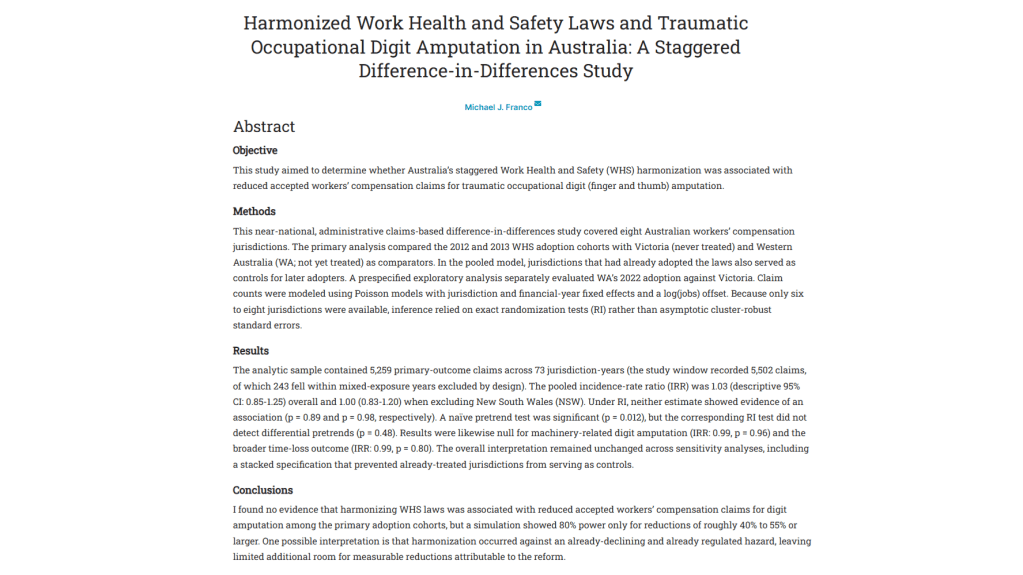
· The author “found no evidence that harmonizing WHS laws was associated with reduced accepted workers’ compensation claims for digit amputation among the primary adoption cohorts”
· Namely, the “primary IRR was 1.03 (descriptive 95% CI: 0.85-1.25) across all jurisdictions and 1.00 (0.83-1.20) excluding NSW, with no evidence of an association under exact randomization inference (RI-β p = 0.89 overall and p = 0.98 excluding NSW)”
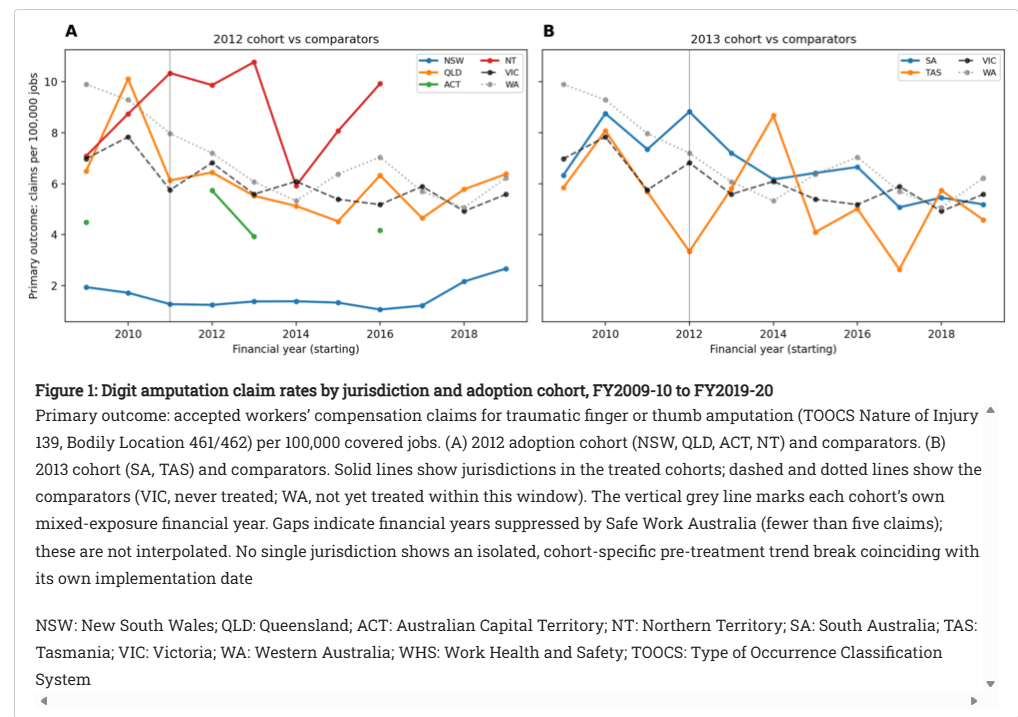
· It’s argued that perhaps “One possible interpretation is that harmonization occurred against an already-declining and already regulated hazard, leaving limited additional room for measurable reductions attributable to the reform”
· E.g. harmonisation wasn’t introduced into the wild west – an existing legal framework was also in place
· And “Digit amputation was also already declining. Victoria never adopted the model WHS laws, yet its own age standardized hospital admission rate for work-related digit amputation fell from 12.54 to 4.71 per 100,000 employed persons between 2005/06 and 2022/23”
· “Machinery-related outcomes were likewise null (IRR: 0.99, p = 0.96; broader time-loss IRR: 0.99, p = 0.80)”
· The author notes that this doesn’t indicate that regulation is ineffective (at least on claims data), but it had limited statistical power to detect only a modest effect
As always several limitations which are described in the article.


