
Post 2 from ch.11 of the Foundations of Safety Science, exploring Resilience Engineering (RE) and the adaptive perspectives.
Some extracts:
· RE sees failures not necessarily as breakdowns or malfunctioning of normal functions, but “the converse of the adaptations necessary to cope with the real world complexity”
· Performance of individuals and organisations across all level “must always adjust their performance to varying conditions”, but these adjustments are approximate due to resource limitations
· “Success can be ascribed to the ability of groups, individuals, and organizations to anticipate the changing shape of risk before damage occurs; failure is the result of a temporary or permanent disruption of that capacity”
· RE “reminds us that we are not custodians of already safe systems”

· Complex systems operating under competitive pressure always have to juggle opposing goals, and often with limited resources
· “It is only people who can reconcile these conflicting demands, who can hold together such inherently imperfect systems”
· Complex systems don’t fare well under central authorities – notably, “That would make the authority as complex as the system itself”
· “Complexity does not lead to anarchy and disorder”; typically “they lead to repeated patterns, to other kinds of order, and to new ways of working. Complexity tends to produce and encourage horizontal, reciprocal self-organization”
· Feedback loops are emergent aspects of complex systems, and subsystems in complex systems are not “entirely free to do what they want. In fact, because of their coupling and reciprocity, they are really quite constrained by each other”

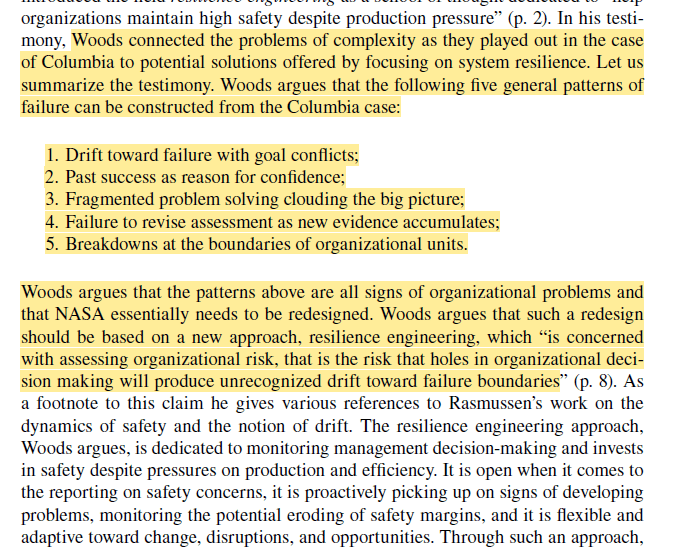
· Drawing on Woods’ work, some general patterns of failure relating to operating in complex environment with multiple pressures was evident with the NASA Columbia accident
· This included a drift toward failure with goal conflicts, fragmented problem solving clouding the big picture, failure to revise assessment as new evidence accumulates, breakdowns at the boundaries of organizational units
Part 3 covering some ‘traps’ of RE next week…probably.
Ref: Dekker, S. (2019). Foundations of safety science. Routledge.
My site with more reviews: https://safety177496371.wordpress.com

 SafetyInsights.org
One thought on “Foundation of Safety Science: Resilience Engineering and complex systems pt2”