Post 3 from ch.11 of the Foundations of Safety Science, exploring Resilience Engineering (RE) and the adaptive perspectives.
This part focuses on 3 analytical traps for resilience practitioners/scholars to be cognisant of (you may recognise these from Johan Bergstrom’s youtube vid – link in comments).
Extracts:
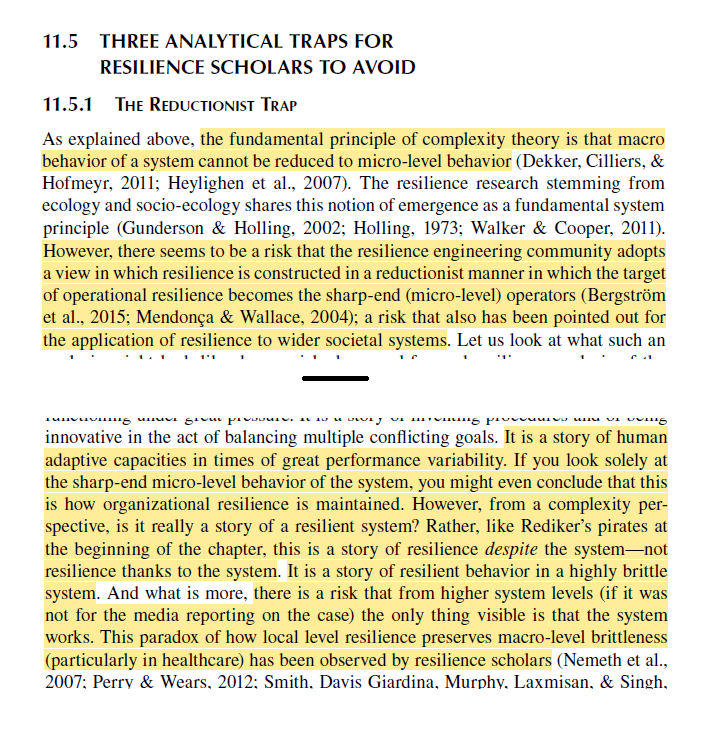
· The first trap is the reductionist trap
· Whereas “the fundamental principle of complexity theory is that macro behavior of a system cannot be reduced to micro-level behavior”, there may be a risk in the RE community of adopting a reductionist view of resilience
· That is, “the target of operational resilience becomes the sharp-end (micro-level) operators”
· They provide an example of human adaptive capacities – which, on the surface, may lead one to conclude that “this is how organizational resilience is maintained”
· But they question whether this is truly a story of a resilient system? Instead, it is “a story of resilience despite the system—not resilience thanks to the system” … and a “story of resilient behavior in a highly brittle system”
· “So although resilience appears at first sight as a systems theory, its main effect is to emphasize the need for adaptability at the unit level”
· A risk is that, from this vantage point, “the only thing visible is that the system works”
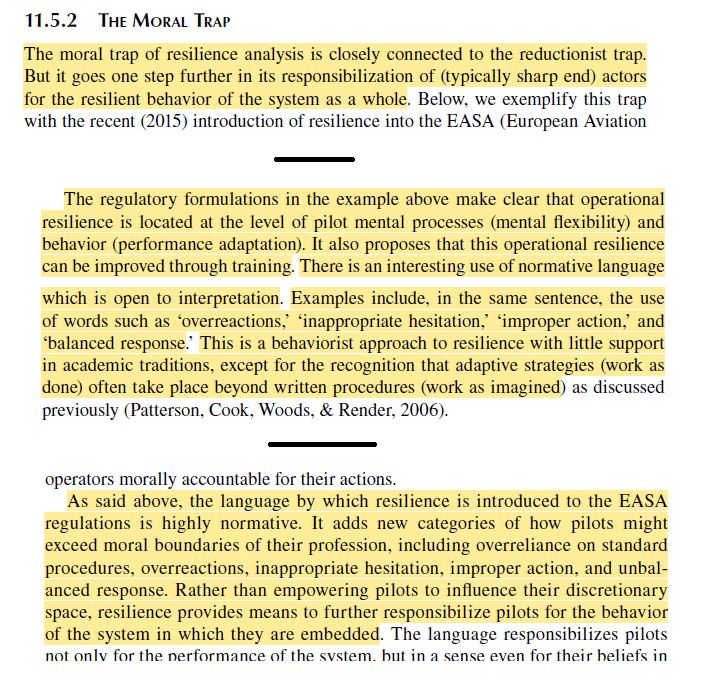
· Next is a moral trap – which pinpoints the “responsibilization of (typically sharp end) actors for the resilient behavior of the system as a whole”
· They draw on an example of CRM in aviation, which in their example “make clear that operational resilience is located at the level of pilot mental processes … and behavior”
· “CRM training has the unfortunate history of seeing its training categories turned into moral categories of accountability”
· Language of resilience in some examples is highly normative, adding “new categories of how pilots might exceed moral boundaries of their profession”
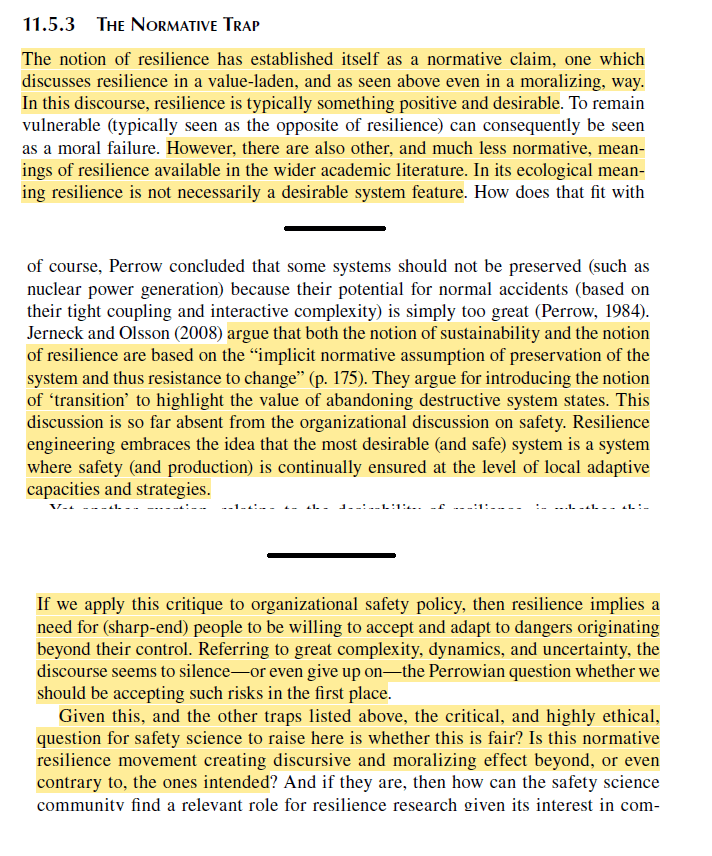
· The third trap is a normative trap – where “The notion of resilience has established itself as a normative claim, one which discusses resilience in a value-laden, and as seen above even in a moralizing, way”
· Normally, resilience then is seen as something positive and desirable to seek; but in other domains, resilience isn’t necessarily a desirable system feature
· Skipping a bit of context in the chapter, but it’s argued “ If we apply this critique to organizational safety policy, then resilience implies a need for (sharp-end) people to be willing to accept and adapt to dangers originating beyond their control”
· “Referring to great complexity, dynamics, and uncertainty, the discourse seems to silence—or even give up on—the Perrowian question whether we should be accepting such risks in the first place”
Ref: Dekker, S. (2019). Foundations of safety science. Routledge.
Bergstrom’s video: https://safety177496371.wordpress.com/2022/05/06/analytical-traps-in-accident-investigations/
My site with more reviews: https://safety177496371.wordpress.com

 SafetyInsights.org