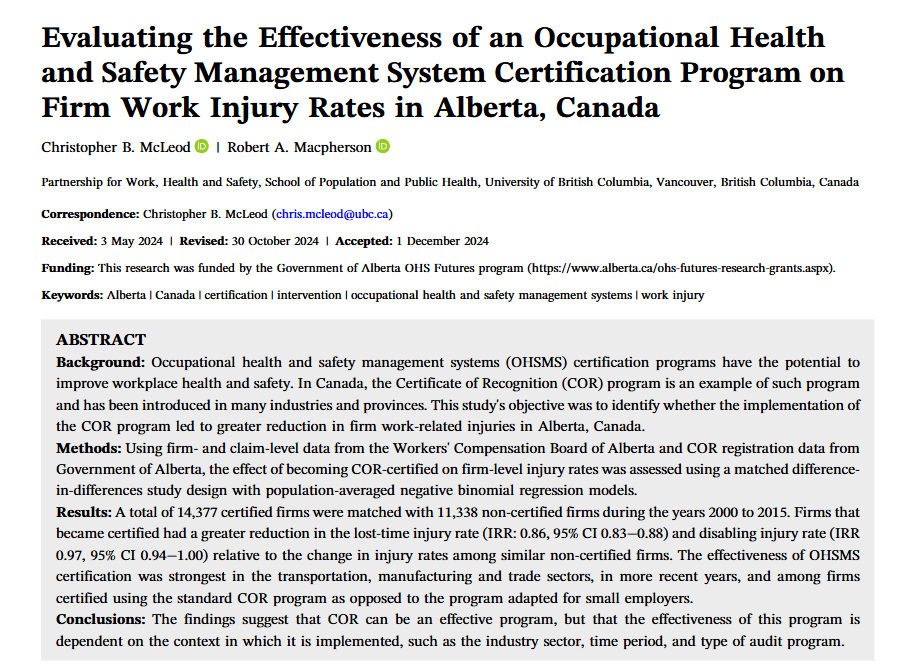
This study explored the effects of Alberta’s Certificate of Recognition (COR) and SECOR program on reported firm-related injuries.
(Yes, another that’s relying on incident data…)
>14k certified firms were matched with >11k non-certified firms from 2000-2015.
They note:
“In a systematic review on the effectiveness of OHSMSs, Robson et al. [6] found that although most studies identified positive changes resulting from OHSMS adoption, there was insufficient evidence to conclude that OHSMS implementation led to a reduction in work injuries”.
Newer works have found both positive effects from implementation of OHSMSs but also null effects.
Findings:
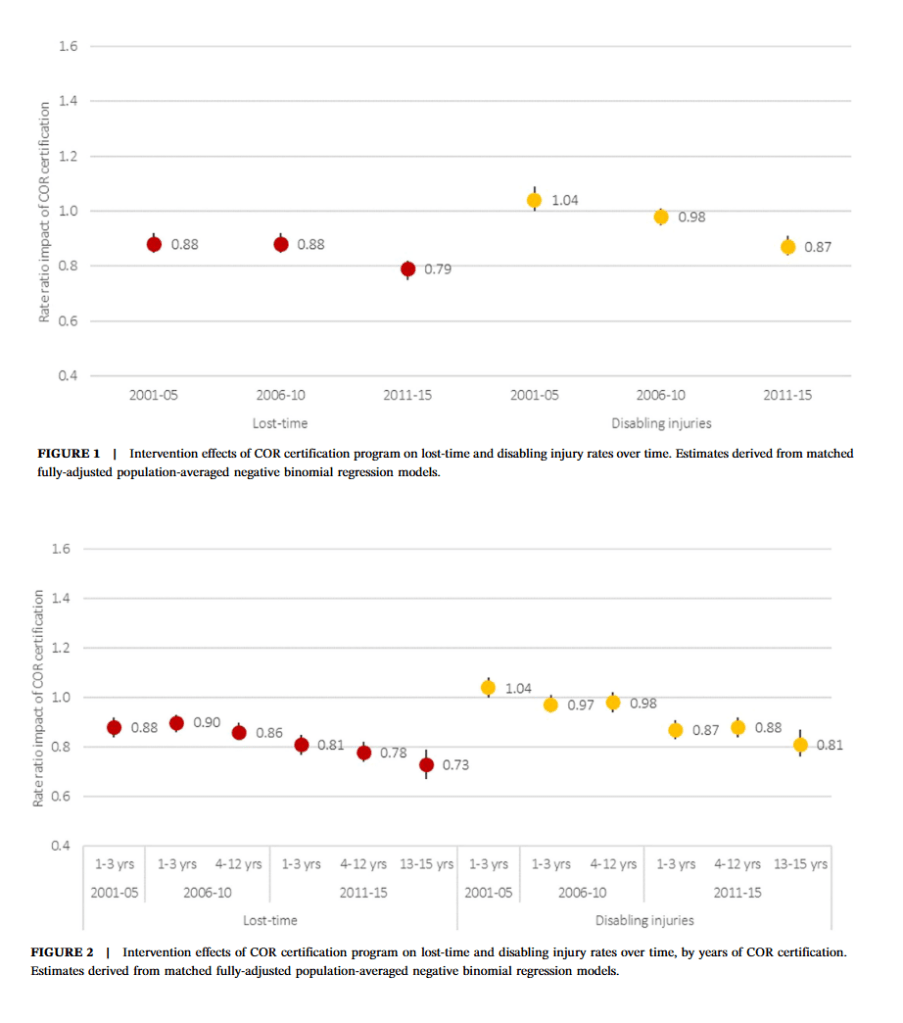
· “Firms that became certified had a greater reduction in the lost-time injury rate (IRR: 0.86, 95% CI 0.83−0.88) and disabling injury rate (IRR 0.97, 95% CI 0.94−1.00) relative to the change in injury rates among similar non-certified firms”
· Hence, “On average, in any given year, COR certification was associated with a 14% reduction in the lost-time injury rate and a 3% reduction in the disabling injury rate, relative to the change in matched non-COR firms”
· “effectiveness of OHSMS certification was strongest in the transportation, manufacturing and trade sectors, in more recent years, and among firms certified using the standard COR program as opposed to the program adapted for small employers”
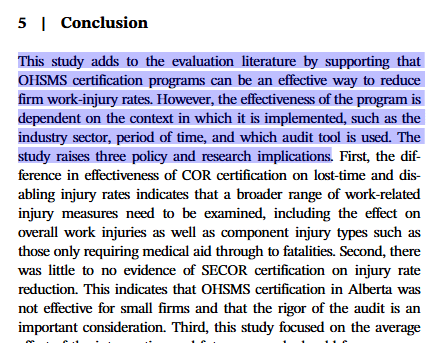
· “OHSMS certification in Alberta was not effective for small firms and that the rigor of the audit is an important consideration“
· “The findings suggest that COR can be an effective program, but that the effectiveness of this program is dependent on the context in which it is implemented, such as the industry sector, time period, and type of audit program”
Of course, several limitations were present. One is that what were lost-time injuries prior to certification, became modified work duties after certification, rather than actually preventing the injury.
Also, workers comp data may underestimate the true extent of work injuries, as found in coronial and hospital reports.
Nevertheless, on this they say “for underreporting to bias the results away from a null effect (or no effect of COR certification on injury rate reduction), COR firms, while certified, would need to have had a greater underreporting rate than when not certified”.
Ref: McLeod, C. B., & Macpherson, R. A. (2024). Evaluating the Effectiveness of an Occupational Health and Safety Management System Certification Program on Firm Work Injury Rates in Alberta, Canada. American Journal of Industrial Medicine.
Study link: https://doi.org/10.1002/ajim.23690
My site with more reviews: https://safety177496371.wordpress.com

 SafetyInsights.org
One thought on “Evaluating the Effectiveness of an Occupational Health and Safety Management System Certification Program on Firm Work Injury Rates in Alberta, Canada”