This Safe Work Australia report mentioned yesterday, authored by O’Neill & Wolfe, discussed measuring & reporting on WHS.
One section dived into the limits of injury measures.
Some highlights:
· “a single injury number or frequency rate is too aggregated to provide meaningful information to guide business decisions”

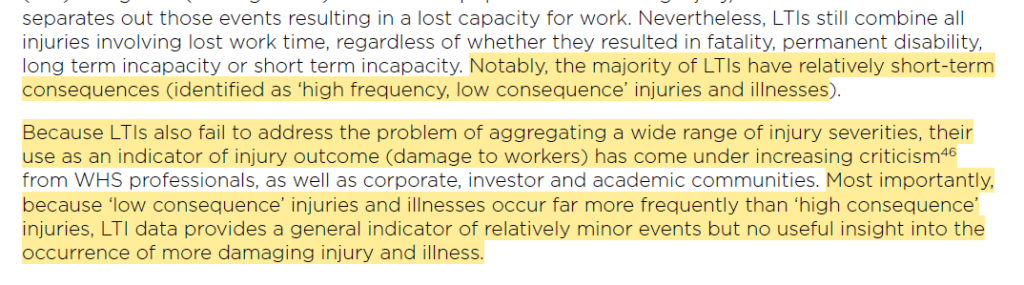
· “the majority of LTIs have relatively short-term consequences (identified as ‘high frequency, low consequence’ injuries and illnesses)”
· “Because LTIs also fail to address the problem of aggregating a wide range of injury severities, their use as an indicator of injury outcome (damage to workers) has come under increasing criticism”
· “because ‘low consequence’ injuries and illnesses occur far more frequently than ‘high consequence’ injuries, LTI data provides a general indicator of relatively minor events but no useful insight into the occurrence of more damaging injury and illness”
· “LTIs reflect high-frequency, low-consequence injuries but provide little insight into disabling injury or illness”
· Image below provides data from >400k work-related injuries – panel A are the trends over 10 years for LTIs or fatalities, and panel B is the same data but classified as permanently disabling (class 1) or temporarily incapacitating (class 2)
· “The results illustrate that a steadily decreasing trend in LTIs over time can hide a significant increase in the most damaging (and costly) group of non-fatal injury over the same period”
· And a “ board receiving only Panel A would be likely to draw very different conclusions as to the success of past WHS efforts and the appropriate focus of future WHS attention than those receiving only Panel B in their board report”

Next they unpack whether LTI, LTIFR etc. are still useful?
· They believe that “The short answer is… yes, but not for making decisions about WHS”
· LTIs may confirm the presence of some hazards and uncontrolled risks, but “an absence of LTIs or a reduction in LTIs does not necessarily mean risks are now controlled, or that WHS is improving”
· Instead, “LTI KPIs are metrics that help understand lost productivity. They provide insight into the impact of poor WHS on business productivity”
· Instead, LTIs have been “incorrectly presented as evidence of the success of WHS even though it fails to measure WHS at all (does not assess either risks, or the effectiveness of controls). Nor does it even capture reliably the frequency or severity of work-related injury and illness”

· And while “LTI data can confirm in hindsight the presence of a risk”, it does not “provide information to management on where to address resources or provide assurance that appropriate controls are in place”
Next week I’ll cover another report from these authors that further unpack injury measures.
Ref: O’Neill, S., & Wolfe, K. (2017). Measuring and Reporting on Work Health and Safety: Report. Safe Work Australia.

My site with more reviews: https://safety177496371.wordpress.com

 SafetyInsights.org