Another interesting report from Safe Work Australia, authored by O’Neill, Wolfe & Holley, which explored performance measurement & CEO/executive incentives.

Too much to cover, so just a few points on injury measures:
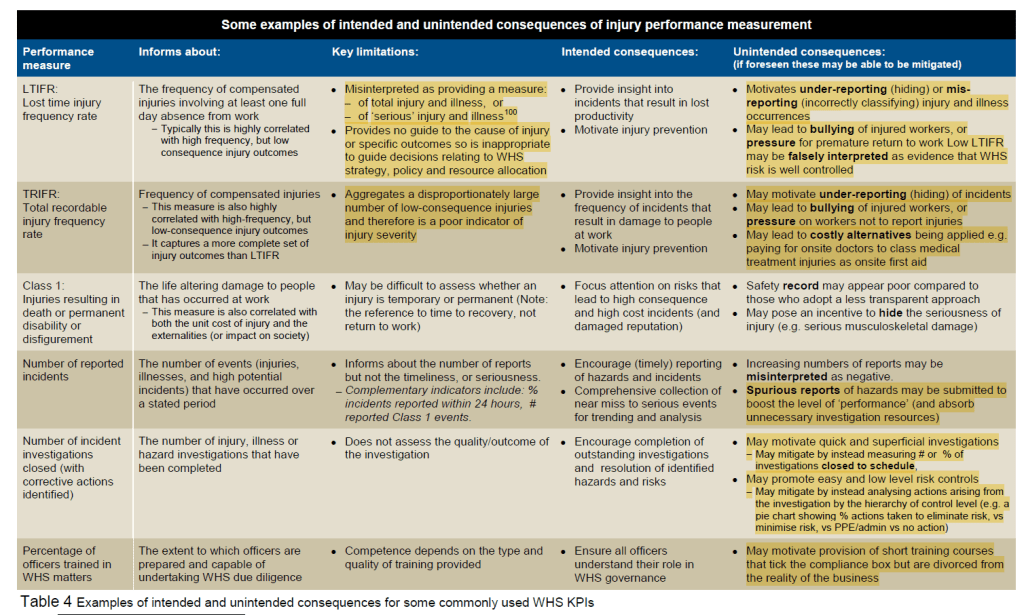
· They highlight the limits of a “single injury rate as a generic, all-purpose indicator of WHS performance”, relating to data quality and the “poor nexus between the injury rates and managerial decisions”
· “In the absence of a reporting culture, focusing on injury results is likely to drive people to ‘manage the measure’”, like “concealing or reclassifying injuries so results improve, on paper, even though actual performance remains unchanged”
· They point to issues with injury measures and how they can motivate under-reporting and hiding or misreporting of incidents
· “May lead to bullying of injured workers, or pressure for premature return to work Low LTIFR may be falsely interpreted as evidence that WHS risk is well controlled”
· LTIFR “Provides no guide to the cause of injury or specific outcomes so is inappropriate to guide decisions relating to WHS strategy, policy and resource allocation”
· TRIFR “Aggregates a disproportionately large number of low-consequence injuries and therefore is a poor indicator of injury severity”
And on incentives:
· “employee incentive schemes based around reductions in injury rates are inherently flawed since many causal factors are not within the employees’ control”
· “Where operated as collective arrangements, they can lead to peer pressure for under reporting, and to injured workers being blamed and bullied for the team’s lost reward or bonus”
· A 2009 OSHA audit found 2/3 of all workplace injuries and illnesses were unreported
· They talk about the conflicting interests with CEO & executive bonuses and counterproductive organisational behaviour
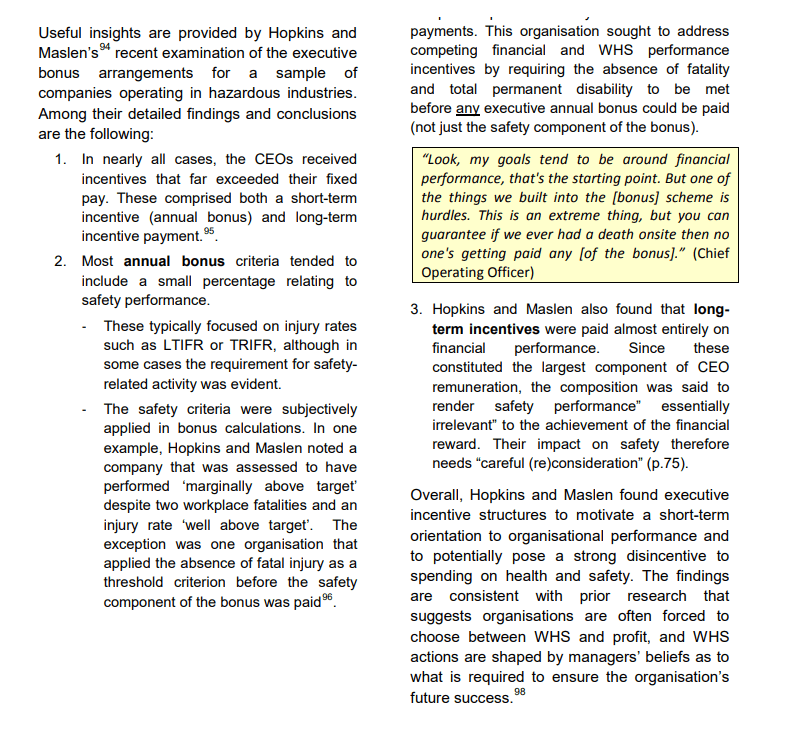
· Some data found CEO bonuses far exceeded their fixed pay, and were made up of short-term and long-term incentives
· Most only included a small percentage relating to safety performance – mostly focused on LTIFR & TRIFR
· “Hopkins and Maslen noted a company that was assessed to have performed ‘marginally above target’ despite two workplace fatalities and an injury rate ‘well above target’”
· “Hopkins and Maslen also found that long-term incentives were paid almost entirely on financial performance”
· “Hopkins and Maslen found executive incentive structures to motivate a short-term orientation to organisational performance and to potentially pose a strong disincentive to spending on health and safety”
· “organisations are often forced to choose between WHS and profit, and WHS actions are shaped by managers’ beliefs as to what is required to ensure the organisation’s future success”
Ref: O’Neill, S., Wolfe, K., & Holley, S. (2015). Performance measurement, incentives and organisational culture: Implications for leading safe and healthy work

My site with more reviews: https://safety177496371.wordpress.com

 SafetyInsights.org
One thought on “Cooking the books: how injury measures and Executive incentives (can) lead to ruin”