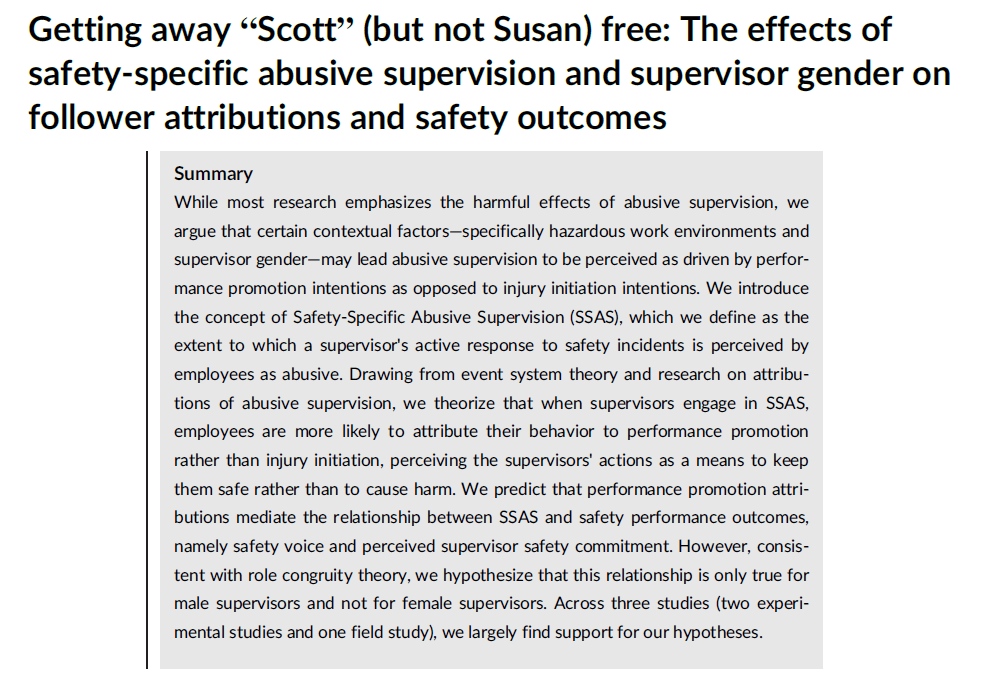
This study explored how workers perceive and rationalise abusive supervision, and how gender influences the relationship.
3 studies were utilised – 2 experimental and 1 field study.
For background:
· Abusive supervision “may not always be perceived as harmful, as employees’ perceptions of abusive supervision are subjective (Tepper, 2000), including their evaluations of supervisors’ intentions behind the behavior”
· If workers see the supervisor’s intentions as well-meaning, then the abusive behaviour might not be perceived as harmful, but even beneficial
· “Abusive supervision is defined as the extent to which subordinates evaluate their supervisor’s display of hostile verbal and nonverbal behaviors as abusive”
· It has two dimensions, 1) active aggression: overtly hostile actions, and 2) passive aggression: subtle undermining behaviours
· They introduce the concept of safety-specific abusive supervision (SSAS), defined as “the degree to which a supervisor’s active response to safety events is perceived as abusive”
· This reflects intention, as in – if a supervisor is hostile towards a worker because the worker exceeded a workplace norm or safety protocol, then the hostility may be ‘justified’
· They cite the example of Tom Cruise who yelled at some employees on set, because they didn’t maintain COVID separation protocol; they note “while many criticized his overtly aggressive behavior, others applauded the seriousness with which he dealt with the situation and his adherence to safety protocols”
· They also outline how attributions of supervisors abusive supervision may be influenced by the supervisor’s gender
· Gender stereotypes “can be both descriptive (i.e., how men and women typically behave) and prescriptive (i.e., how men and women are expected to behave) (Heilman, 2001)”
· Gender stereotypes are also divided into agency and communion categories – men are typically associated with agentic qualities, e.g. assertiveness, dominance, self-confidence, whereas women are associated with communal qualities like kindness and naturing behaviours
· They highlight how if “women violate gender stereotypes by acting in an agentic manner at work, they are often penalized in evaluations (Balachandra et al., 2019; Correll et al., 2020), promotion opportunities (Lyness & Heilman, 2006; Ma et al., 2022), and hiring decisions”
· And that the “prejudice against female leaders is especially strong when they violate agency proscriptions—behaviors that reflect more overt forms of agency, such as being dominant and forceful—because these behaviors contradict the communal behaviors expected of female leaders”
Results
Key findings were that:
· As expected, SSAS (e.g. how workers rationalise and explain a supervisor’s abusive behaviour) depends on the context – highlighting how abusive supervision isn’t unilaterally seen as negative
· Instead, some saw abusive supervision as justified, and helping to “achieve desired outcomes”
· Gender also shaped the relationship: “male supervisors engage in SSAS, followers are more likely to attribute the abusive behavior to performance promotion intentions”
· But for women, workers “perceive events through a gendered lens, focusing on the incongruence between the leader’s gender and their violation of agency proscriptions (Scott & Brown, 2006), impeding observers from attributing the action to performance-promoting intentions”

They found that employees sought explanations for their supervisors’ abusive supervision, depending on context. When abusive supervision related to safety-specific abuse, e.g. SSAS, workers were more likely to rationalise the abusive behaviour and the leaders’ motives.
They found that while workers may perceive harmful supervisor interactions as justifiable, “this allowance is only granted when the supervisor does not violate gender expectations”.
That is, when “female supervisors engage in SSAS, observers are more likely to penalize female leaders for violating agency proscriptions, while providing greater leniency for male supervisors who engaged in the same behavior”.
Again quoting the paper, “when male supervisors engage in SSAS, employees report higher levels of perceived supervisor safety commitment via performance promotion attributions; this is not the case, however, for female supervisors.
In other words, male supervisors are not only more likely to be perceived as trying to improve employee performance when they engage in SSAS, they are also able to increase individual perceptions of supervisor safety commitment driven by performance promotion attributions”.
The study samples included pretty balanced 50/50 male and female participants; but I’m not sure if male or females judged female supervisors any more harshly than the other group (e.g. are male participants more likely to judge behaviour based on gender stereotypes or are females just as likely to judge fellow female supervisors).
If the paper explained this relationship, then I may have missed it (but I don’t think it did). Is this even particularly relevant? I don’t know.
Ref: Fiset, J., & Byrne, A. (2024). Getting away “Scott”(but not Susan) free: The effects of safety‐specific abusive supervision and supervisor gender on follower attributions and safety outcomes. Journal of Organizational Behavior.

 SafetyInsights.org