
This paper from Elliot Wolf-Stokes and Rob Fisher may interest peeps – around orientating towards operational excellence.
Covers a lot of ground – systemic drivers to procedural departures, error drivers in written guidance, mental models, enablers of human reliability and more.
I’ve skipped HEAPS, so just a few extracts (link to full paper in comments):
· “many companies thought that their procedures were good; they just needed people to follow them. We now have enough science that proves that this notion is simply not true”
· “We need to understand why people do things for reasons that make sense to them at the time and how procedure usability fits into that characteristic of human nature”
· They cover the five popularised principles of human performance—
1) Error is normal: “error is not a cause but a consequence of the system. Discovering errors that trigger events are the beginning of analysis, not the end”
o They argue that some struggle with the idea that error is normal, but “simply replacing the word “error” with “variability” in this context, consensus goes up because generally most would agree that variability is a normal phenomenon”
2) Blame fixes nothing: Blame manifests in retrospect, often by assigning labels to human error such as complacency, lack of awareness, and lack of operational discipline. Blaming individuals can be emotionally more satisfying than targeting organizational systems, but it is remedially useless”
o And, “We should not, however, confuse blame with accountability”
3) Systems drive behaviour: “People can never outperform the system that bounds and constrains them. Human error is not random; it is predictable and systematically connected to the work environment”
4) Learning and improvement is vital: “Learning through analysis must be deliberate and proactive to drive continual improvement”
5) Leader response matters: “intentional leadership and error reduction is about making good people excellent. In response to an incident, the first thing you can do is learn to listen, reserve judgment, and resist the temptation to find a simple explanation”
· They discuss performance error modes, highlighting “One of the most powerful ideas about performance modes is that they apply to THIS PERSON on THIS TASK at THIS TIME”
· E.g. even a ‘routine’ task may only be performed by an operator once every 5 weeks or more
· They also cover agile, some definitions of concepts like errors (active & latent), critical steps and risk-important actions (RIA)
· They argue: “Most organizations refer to critical tasks generically. The CRITICAL STEP terminology discussed here is specific and enables frontline personnel to slow down (fast brain/System 1 to slow brain/System 2 thinking), verify RIAs were properly completed, confirm what must go right, anticipate what could go wrong, and maintain control of hazardous materials or energy”
Next, they cover 5 systemic drivers to procedure departures:
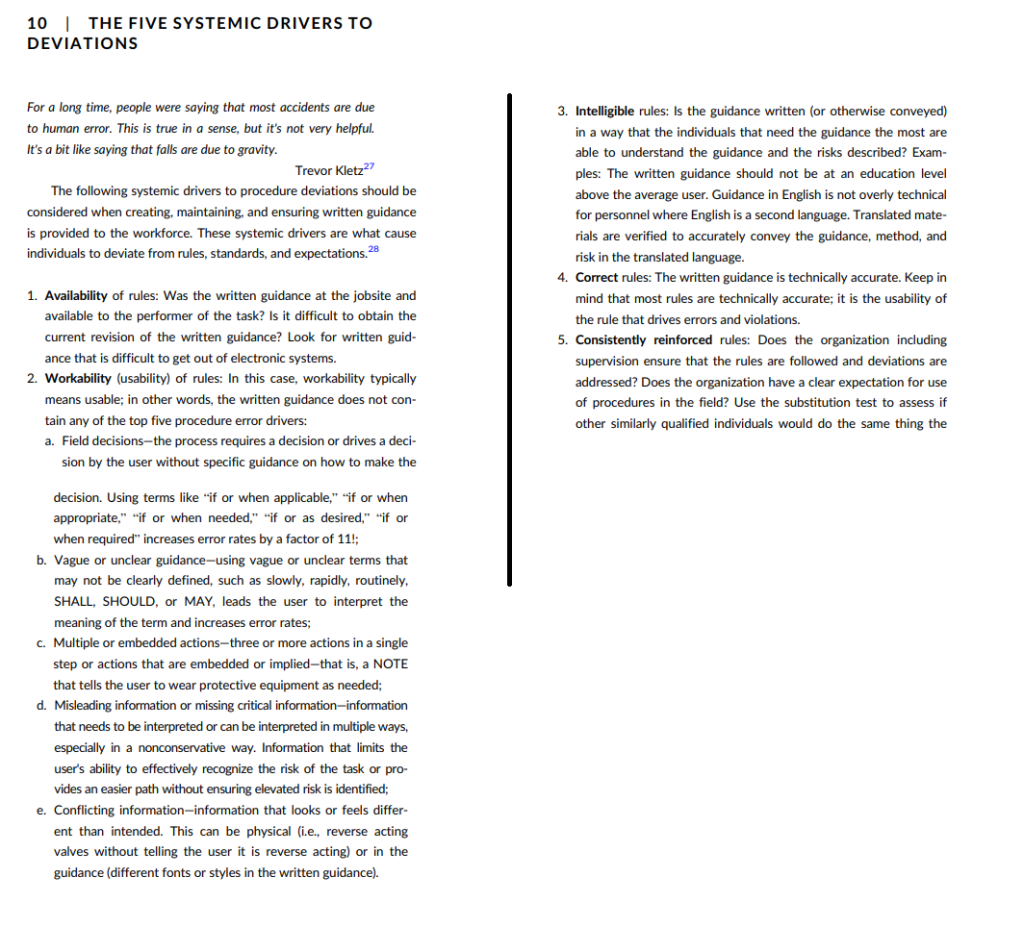
- Availability of rules – e.g. was the procedure available to the operator, is it hard to obtain
- Workability (useability of rules) – e.g. does it guide the user to make better decisions, does it have vague terms, multiple embedded actions or misleading/conflicting info?
- Intelligible rules: e.g. is the guidance written for the audience and their comprehension?
- Correct rules: technically accurate
- Consistently reinforced
- Next they cover questions for error-proofing procedures, which includes action failures (too fast/slow), check failures (some check or action was omitted or incorrect), info failures (info not retrieved or wrong info selected), selection failures (selection omitted or incorrect)

Ref: Wolf‐Stokes, E., & Fisher, R. (2024). Procedure excellence: Changing paradigms to enable human reliability. Process Safety Progress, 43(3), 523-535.
My site with more reviews: https://safety177496371.wordpress.com

 SafetyInsights.org
2 thoughts on “Procedure excellence: Changing paradigms to enable human reliability”