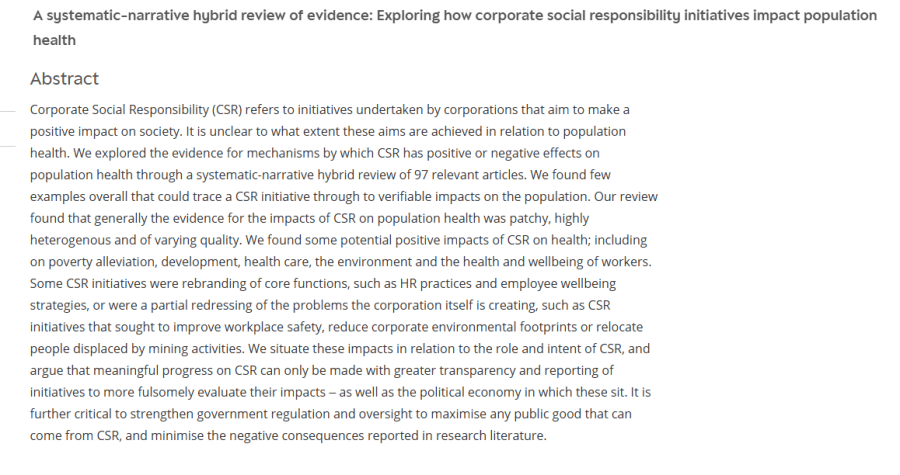
Do Corporate Social Responsibility (CSR) initiatives impact population health? This systematic review evaluated 97 studies to unpack the question.
Tl;dr: Yes, CSR might positively impact some elements of health, poverty alleviation and the environment, but also lead to some negative impacts.
Evidence, overall, isn’t strong.
Extracts:
· They “found evidence for positive impacts of CSR activities on people’s health in relation to: poverty alleviation and development; environmental impact; health and wellbeing of employees and health care”
· CSR may improve health and wellbeing of employees – framed in some studies as “charitable output by corporations”
· Some data found voluntary payments of a living wage as a form of CSR, and a Korean study found that companies with “better CSR performance … was associated with less workplace injury”
· CSRs were used by organisations as a signal that they care for employees [** and sometimes used as an empty slogan]
· CSR was found in some work to be associated with “increased organisational trust and psychological empowerment (Memon et al., 2021), satisfaction with the company’s COVID-19 response, and hope, optimism, resilience and self-efficacy”
· An Australian study found no significant improvement of CSR over existing traditional HR practices for employee engagement
· CSR may improve healthcare access in some areas (mostly developing regions), as with hospital facilities and training of healthcare workers
· Interestingly, regarding safety and worker health, they argue that “Some CSR initiatives were rebranding of core functions, such as HR practices and employee wellbeing strategies, or were a partial redressing of the problems the corporation itself is creating, such as CSR initiatives that sought to improve workplace safety, reduce corporate environmental footprints”
They also covered some negative/null impacts of CSR:
· They found evidence for “negative CSR impacts on population health and wellbeing, in terms of its use by health-harming corporations, by co-opting existing initiatives, and through having negative consequences for workplace safety”
· CSR initiatives by health-harming companies were viewed critically, like tobacco
· They argue “ these companies intentionally pursued CSR on underage smoking and vaping using methods they knew were ineffective in reducing use, solely to boost public relations”
· CSR in extractive and mining companies was also more negative, particularly in developing world
· They found CSRs in some oil companies in the Niger delta created “greater divisions and inequalities in and between communities”
· Other data found that only a fraction of households displaced by mining companies were relocated, and environmental pollution was rife
· They also found issues with safety, where corporation CSR codes of conduct have seen only marginal improvements over the years for the working conditions in supply chains of low income countries – they cite an example of Reebok
· While Reebok improved their codes of conduct and reduced the most egregious working conditions (child labour), and “gained the social benefits of these actions as the last part of the supply chain, they did not contribute materially to implementing better labour standards”
· Power and CSR is also an important issue – organisations generally set their own CSR agendas and these may not be aligned with government and other important trends
· And “mining company CSR initiatives are ‘rarely effective’ (p. 1) in part because of the imbalance of power between the actors”
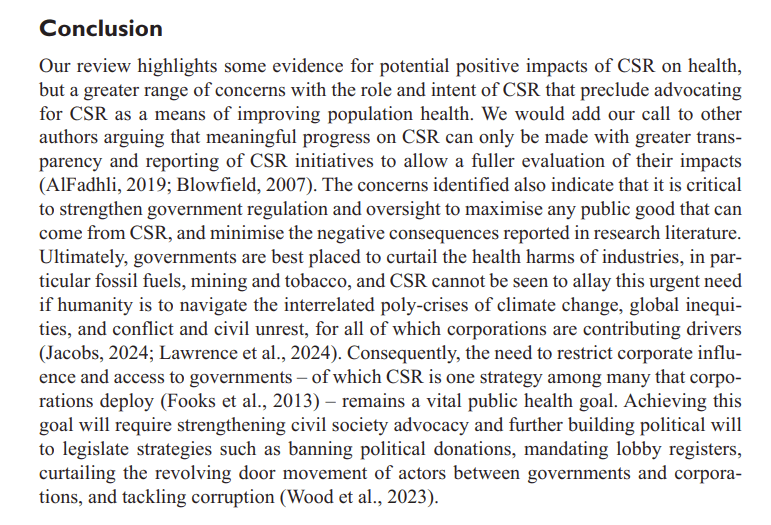
Study link: https://journals.sagepub.com/doi/pdf/10.1177/13634593241313433
My site with more reviews: https://safety177496371.wordpress.com


 SafetyInsights.org