
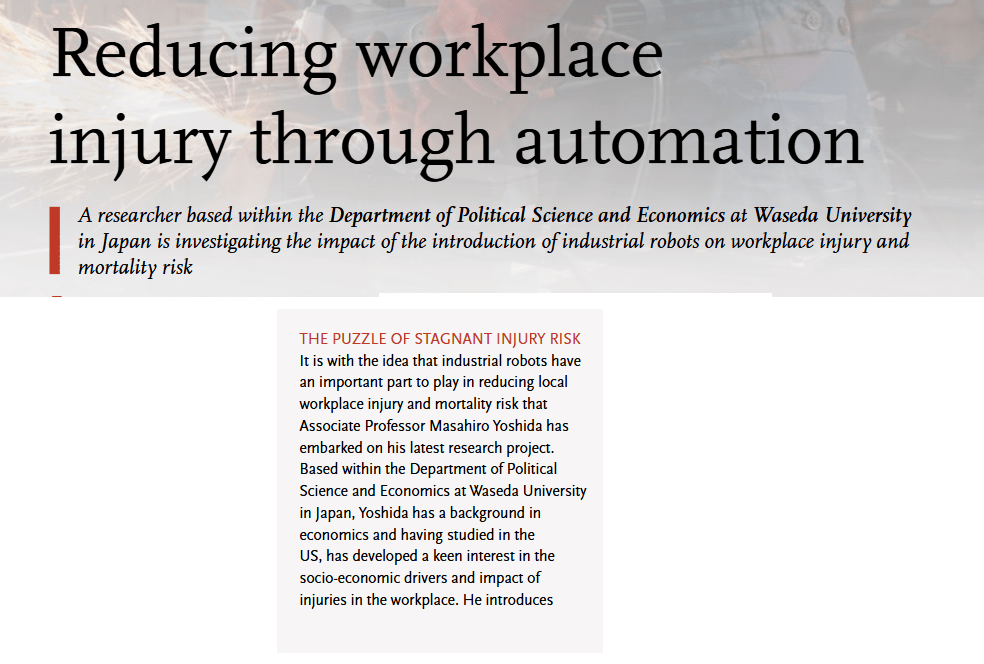
REALLY interesting findings from Associate Professor Masahiro Yoshida.
It suggests that automation over a historical context didn’t really drive down workplace injuries since it tended to be employed in already mature industries.
And, ready access to cheap migrant workforces may hinder broader industrial risk reduction due to a negative correlation with automation investment.
And the traumatic injuries rather than being eliminated simply shift from local residents to immigrants.
Just a few extracts from this article “The socio-economic drivers of automation”:
· “It is with the idea that industrial robots have an important part to play in reducing local workplace injury and mortality risk that Associate Professor Masahiro Yoshida has embarked on”
· “He introduces an alarming contextual background in the US – the nationwide injury rate had been improving before the Great Recession but after that the injury rate had become virtually stagnant”, and this was puzzling because this was also the period of accelerated investment in industrial robots
· “he discovered that most industrial robots are implemented in innately safe sectors, such as automotive, electronics and warehouses, as opposed to riskier sectors, such as agriculture, mining and construction”
· “The overall investments to robots appear to be profit-seeking and not for workplace safety”
· “Intriguingly, these riskier sectors typically have higher dependency on immigrants – both legal and illegal”
· “in the 2019 American Community Survey, the immigrant share has already exceeded 40 percent and 30 per cent in the riskiest sectors of agriculture and construction”
· “Clearly, if an employer can obtain cheap labour from immigrants, they will be less inclined to invest in automated technology. ‘I have found that dependency on immigrants is negatively correlated with the progress of robot adoption across industries”
· “This is because abundant inflow of cheaper labour hinders incentives for investments in robots”
· “an increase in the immigrant dependency rate reduces the number of industrial accidents, including injuries and deaths of native workers”
· “From this it appears that the people being injured and killed simply moved from native workers to immigrant workers”
· “At this stage, he cannot say that immigration causally heightens workplace injury risk, but he believes this current research will demonstrate this”
Ref: Yoshida, M. (2025). The impact of the introduction of industrial robots on workplace injury risk and mortality. Impact, 2025(1), 48-51.

Article link: https://www.ingentaconnect.com/contentone/sil/impact/2025/00002025/00000001/art00018?crawler=true&mimetype=application/pdf

 SafetyInsights.org