
An interesting critique of Scientific Management approach from 1912.
Great title – ‘fetishism of scientific management’.
The author argues that:
· Scientific Management isn’t even that ‘new’, and is kind of what they’ve always done (…where have we heard that argument before?)
· Says it takes away from the craftsmanship of people and that people are the core source of success and agility
· Doesn’t add a lot to the broader economy since people learn how to pull a lever but not upskill them
· The industry trend of trying to scale back paperwork is at odds with scientific management’s overburdening paperwork (decluttering?)
· And talks of safety/production trade-offs
Some extracts:
· “During the past two decades a considerable number of aggressive engineering experts have proclaimed the doctrine that with the adoption of scientific methods”
· “It is a doctrine rich in promises, prolific in fancies and such general attractive character as to appeal to the personal interests of the many”
· But, “There is nothing fundamentally new in this method”
· “The underlying principle is used today to a greater or less extent in all industries and … been used at all times in the past”
· “The subject is then a familiar one to all of us; the problem presented is not the adoption of something entirely new; but rather the extension to every detail of our work of something which we have already tried”

· “A very simple case will illustrate how efficiency in one direction may conflict with efficiency in another”, and says a locomotive has three duties: 1) safety of the train and its contents, 2) maintenance of schedules 3) operation at the lowest possible cost
· “Let us suppose the railroad is making a special effort to improve fuel economy. The locomotive crew became very is interested in the matter and the first year they succeeded in saving several hundred dollars worth of coal”
· Over the next few years they become increasingly efficient at saving money and “one day when they are trying to make a particularly good coal record they run by a signal, wreck the train and kill a dozen passengers”
· “How shall we measure efficiency in this case? Coal efficiency is high, accident efficiency is low : the two are always somewhat in conflict. It would have been much better for this road to have burned a little more coal and avoided the accident”
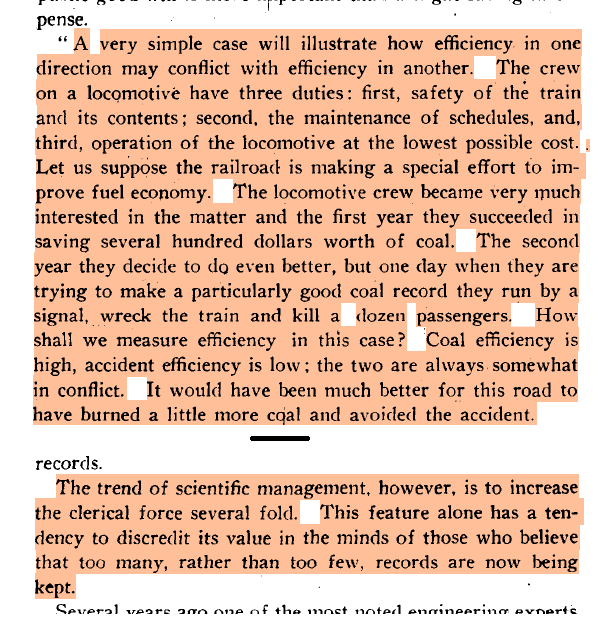
· “The trend of scientific management, however, is to increase the clerical force several fold. This feature alone has a tendency to discredit its value in the minds of those who believe that too many, rather than too few, records are now being kept”
- “The engineering expert found so many records and card indexes that he epigrammatically stated that it appeared to him as if the man who had designed such a cost accounting system must have had a personal interest in some stationery establishment”
- “The average worker wants to do right, and he is more content to have his work judged by competent antd conscientious supervisors than by intricate records compiled and tabulated by clerks in the planning or auditing offices who can have no conception of his technical skill, experience and resourcefulness”
- “The fact seems to be overlooked that the distinctive features of modern industrial advance have been the resourcefulness and observing talent of the individual. Any attempt to dispense with the experience and originality of the artisan is marked retrogression”
- He challenges the idea of trying to standardise human work and the successful adaptation and judgements needed by people
- “The minute subdivision of operations and the speeding-up of machines constitute two of the basic principles of scientific management. Such practice does not make for the training of high-grade artisans”
- “It is not difficult to train common labor and boys to operate some special machines with rapidity and skill, Such training, however, is neither of permanent benefit to the nation nor the individual, for after the labor is detailed to such work”

Ref: Edwards, J. R. (1912). The fetishism of scientific management. Journal of the American Society for Naval Engineers, 24(2), 355-416.

Study link: https://doi.org/10.1111/j.1559-3584.1912.tb03547.x

 SafetyInsights.org