In the lead up to next week’s compendium on systems thinking, here’s a banger from Donella Meadows.
She explores system leverage points.
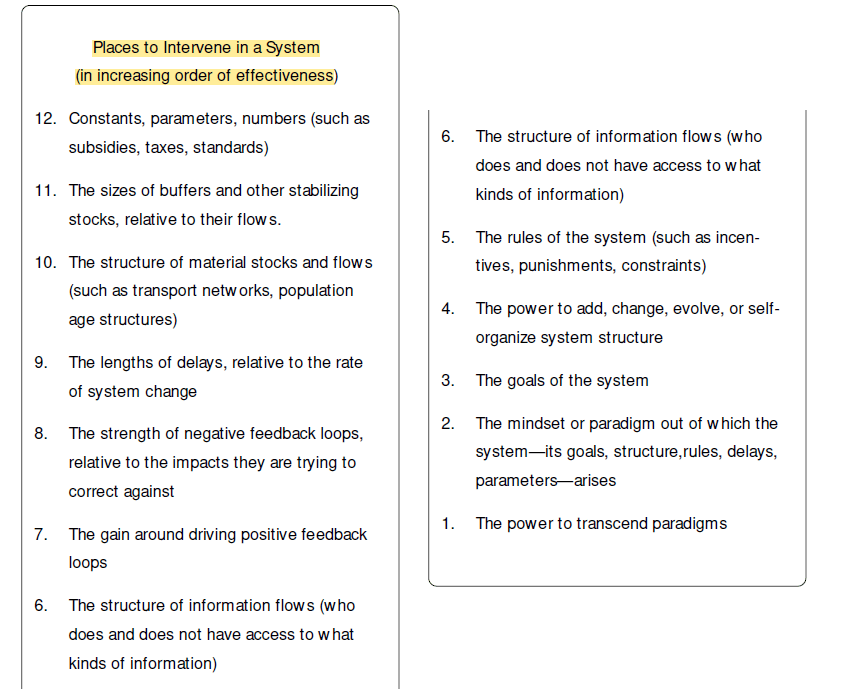
Not a summary, but some extracts:
· Leverage points are “places within a complex system .. where a small shift in one thing can produce big changes in everything”
· The “state of the system” is whatever stocks are of importance (stock can be anything, money, goods, info etc.) and their quantities, relationships
· Inflows and outflows adjust the stock, and the flow/rates can be adjusted in some ways
· Negative feedback looks and positive feedback loops-correcting loops-adjust the inflow and outflow
· Parameters are the numbers in a system which create a discrepancy in the flow rates; they’re “the points of least leverage”, and despite “99 percent of our attention [going to] parameters. There’s not a lot of leverage in them”
· “People care deeply about parameters .. But they rarely change behavior”, and parameters rarely kickstart stagnant systems, nor stabilise wild systems
· Stabilising stocks are known as buffers – and is why people keep money in a bank; increasing buffers can stabilise systems, but too much buffer makes a system inflexible, slow to react and expensive
· The structure of systems, and materials and stocks are critically important, but not great leverage after the fact; e.g. “The only way to fix a system that is laid out wrong is to rebuild it, if you can”
· Changing structures are rarely a leverage point because their change is “rarely simple”, and instead “The leverage point is in proper design in the first place”
· Delays in feedback loops are also causes of oscillations, leading to overshooting and undershooting
· Altering the strength of negative feedback loops is moving from physical parts of systems to the immaterial and info parts, where “more leverage can be found”
· Negative feedback loops have volved throughout nature, and engineered by humans; they “keep important system states within safe bounds”
· Feedback loops need goals, and responses, and “A complex system usually has numerous negative feedback loops that it can bring into play, so it can self-correct under different conditions”
· Feedback loop strength depends on parameters, links, monitoring, flows and more
· While “negative feedback loop is self-correcting; a positive feedback loop is self-reinforcing”
· “The more it works, the more it gains power to work some more”
· Positive feedback loops are sources of growth, explosion, erosion and collapse
· A system with unchecked positive loop “ultimately will destroy itself”
· “Reducing the gain around a positive loop—slowing the growth—is usually a more powerful leverage point in systems than strengthening negative loops”
· “The most interesting behavior that rapidly turning positive loops can trigger is chaos. This wild, unpredict able, unreplicable, and yet bounded behavior happens when a system starts changing much, much faster than its negative loops can react to it”
· “Missing feedback is one of the most common causes of system malfunction” and it’s important to restore feedback “to the right place and in compelling form”
· Rules of a system define its scope, boundaries, degrees of freedom
· E.g. “Constitutions are strong social rules. Physical laws … are absolute rules … Laws, punishments … and informal social agreements are progressively weaker rules”
· These are all “high leverage points. Power over the rules is real power”
· “If you want to understand the deepest malfunctions of systems, pay attention to the rules, and to who has power over them”
· Self-organising is another powerful aspect of social systems, and means “changing any aspect of a system lower on this list”
· “The ability to self-organize is the strongest form of system resilience”
· “The goal of a system is a leverage point superior to the self-organizing ability of a system”
· And feedback loops, info flows etc. within a system “will be twisted to conform to that goal”
· Nevertheless, “Whole system goals are not what we think of as goals in the human-motivational sense”
· “Paradigms are the sources of systems. From them, from shared social agreements about the nature of reality, come systemgoals and information flows, feedbacks, stocks, flows and everything else about systems”
· “There is yet one leverage point that is even higher than changing a paradigm. That is to keep oneself unattached in the arena of paradigms, to stay flexible, to realize that no paradigm is “true”
Ref: Meadows, D. (1999). Leverage Points. Sustainability Institute


 SafetyInsights.org