
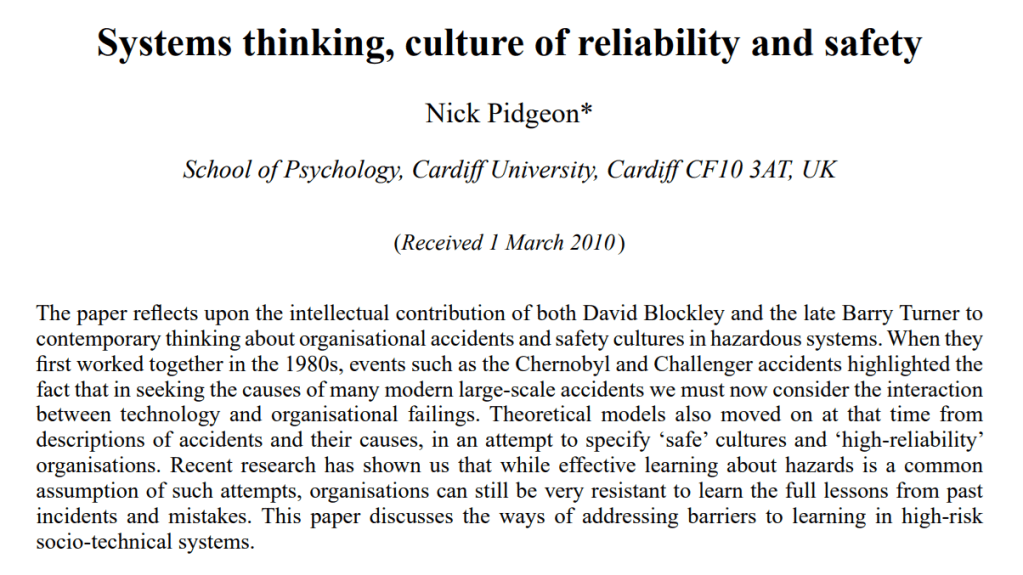
Fantastic read from Nick Pidgeon on how systems approaches, Turner’s MMD, sensemaking, failure and learning intersect to create or mask ‘safety’.
Can’t do it justice, so just a few extracts:
· “By 1990, it was clear that the .. intellectual focus was less on analysing how past accidents had occurred .. and more towards .. how safe organisations might be encouraged or even designed – under the rubric of work on safety culture”
· “But it was also clear even then that understanding how vulnerability to failures and accidents arises does not automatically confer predictive knowledge to prevent future catastrophes”
· “By Turners’s account, organisational and professional cultures lie at the core of the failure issue – in effect our cultures (in groups, professions, organisations or nations) help us to see the world in a certain way but often also blind us to emerging hazards that are at the margins of our expertise”
· “Implicit in the man-made disasters model was a view of culture in terms of the exploration of meaning and the symbols and systems of meaning through which a given group or profession (including that of engineers) understands the world“
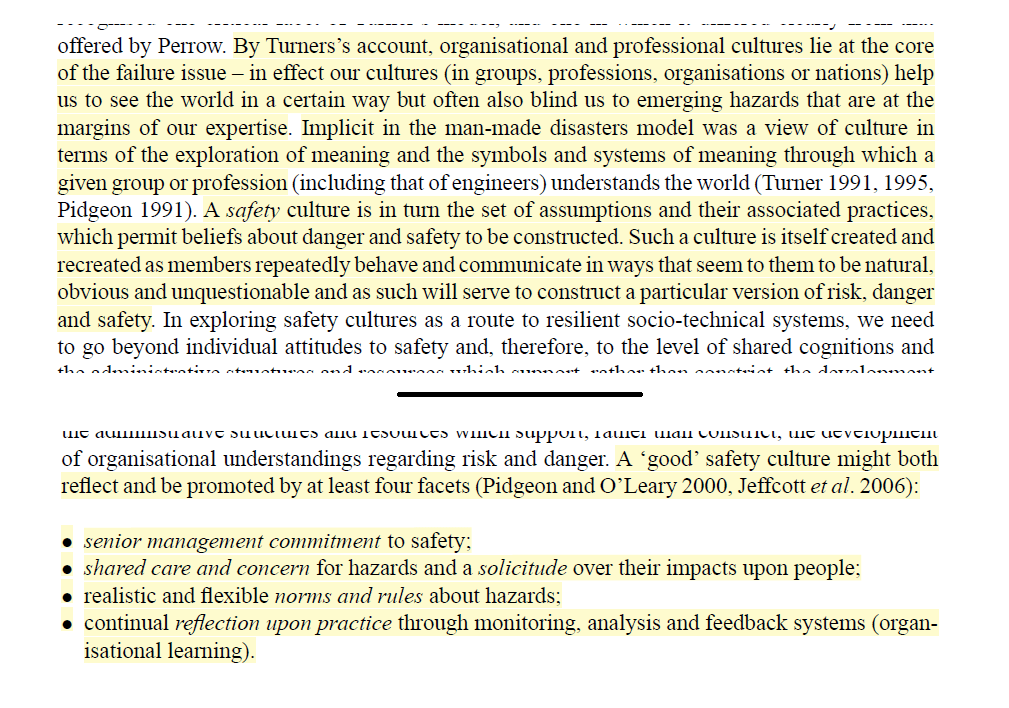
· “A safety culture is in turn the set of assumptions and their associated practices, which permit beliefs about danger and safety to be constructed” and these beliefs “serve to construct a particular version of risk, danger and safety”
· “In exploring safety cultures as a route to resilient socio-technical systems, we need to go beyond individual attitudes to safety and, therefore, to the level of shared cognitions and the administrative structures and resources which support, rather than constrict, the development of organisational understandings regarding risk and danger”
· Ideal belief systems to nurture might be: senior management commitment to safety (decisions/trade-offs, structures, resources etc.), shared concern for danger and “solicitude over their impacts upon people”, realistic and flexible norms and rules about hazards, continual reflection upon practice and learning
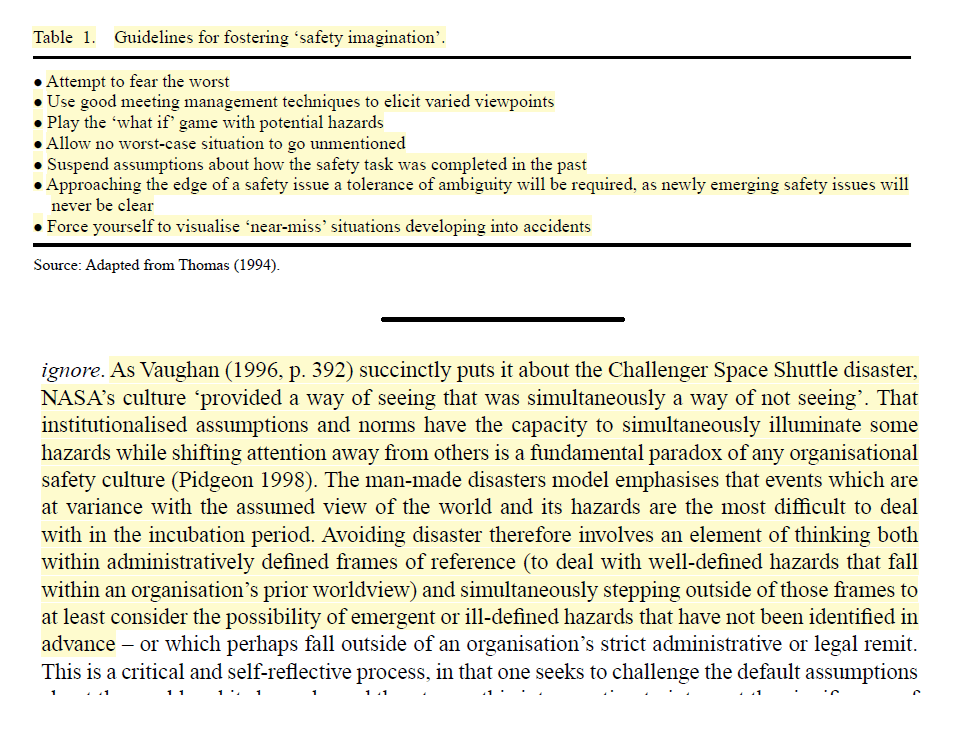
· Sensemaking is an important but underrecognised process within organisational work, which can “counter the barrier to learning of information difficulties – for example, through argument and logical analysis of competing accounts, arbitration of power struggles within organisations (which might serve to conceal ‘bad news’) and psychological strategies to counter overly rigid problem-solving through the exercise of what might be termed safety imagination”
· “safety imagination is based upon the principle that our understanding and analysis of events should not become overly fixed within prescribed patterns of thinking, particularly when faced with an ill-structured incubation period”
· “Prescribed patterns of thinking about hazards are, of course, critically important for safety much of the time in that they define ways of dealing with anticipated or well-understood hazards [but] an organisation is of necessity defined not so much by what its members attend to but by what they choose to ignore”
· “As Vaughan (1996, p. 392) succinctly puts it about the Challenger Space Shuttle disaster, NASA’s culture ‘provided a way of seeing that was simultaneously a way of not seeing”
· “safety imagination will not always in and of itself ensure that effective learning takes place … active learning”
· To achieve active learning, organisational power and politics must also”
· E.g. “Ironically, the concern with risk management and its assessment also brings with it new possibilities for blaming, for despite the inherent complexity and ambiguity of the environments within which large-scale hazards arise, and the systemic nature of breakdowns in safety, myths stressing our ability to control affairs ensures that a culprit must be found after a disaster or crisis has unfolded”

Study link: https://citeseerx.ist.psu.edu/document?repid=rep1&type=pdf&doi=c5da7ef221fd649591b0c2d5b810b7dec3a3ec3a

 SafetyInsights.org