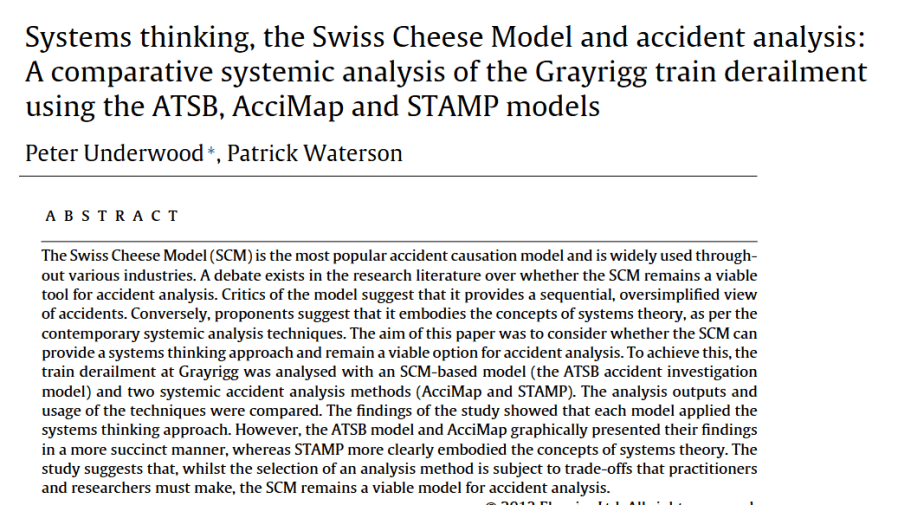
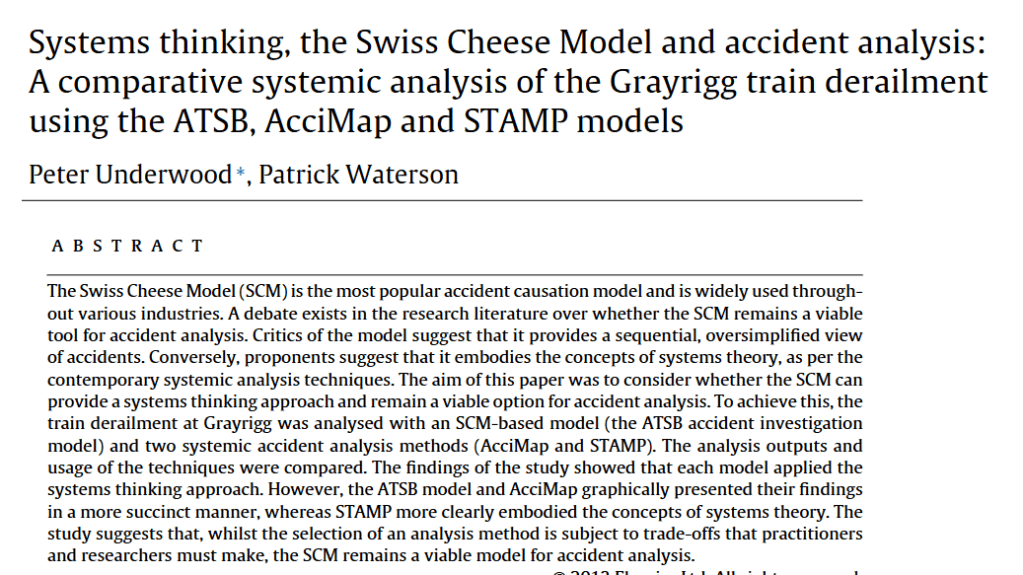
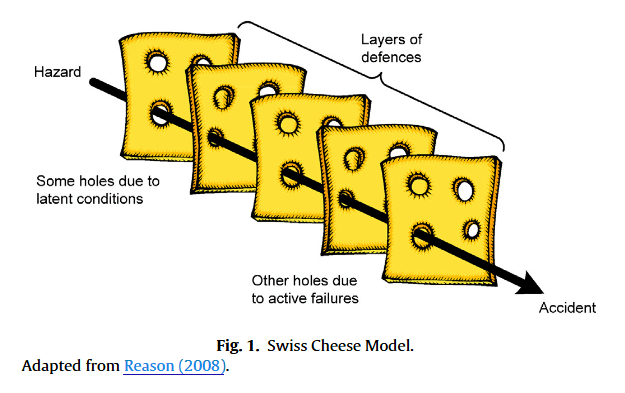
Does the Swiss Cheese metaphor hold its own against systemic accident models? Yes, according to this study.
Seems topical to share this paper, comparing the ATSB variant of a Swiss Cheese accident model vs AcciMap and CAST (i.e. STAMP).
They found:
· “each model applied the systems thinking approach”
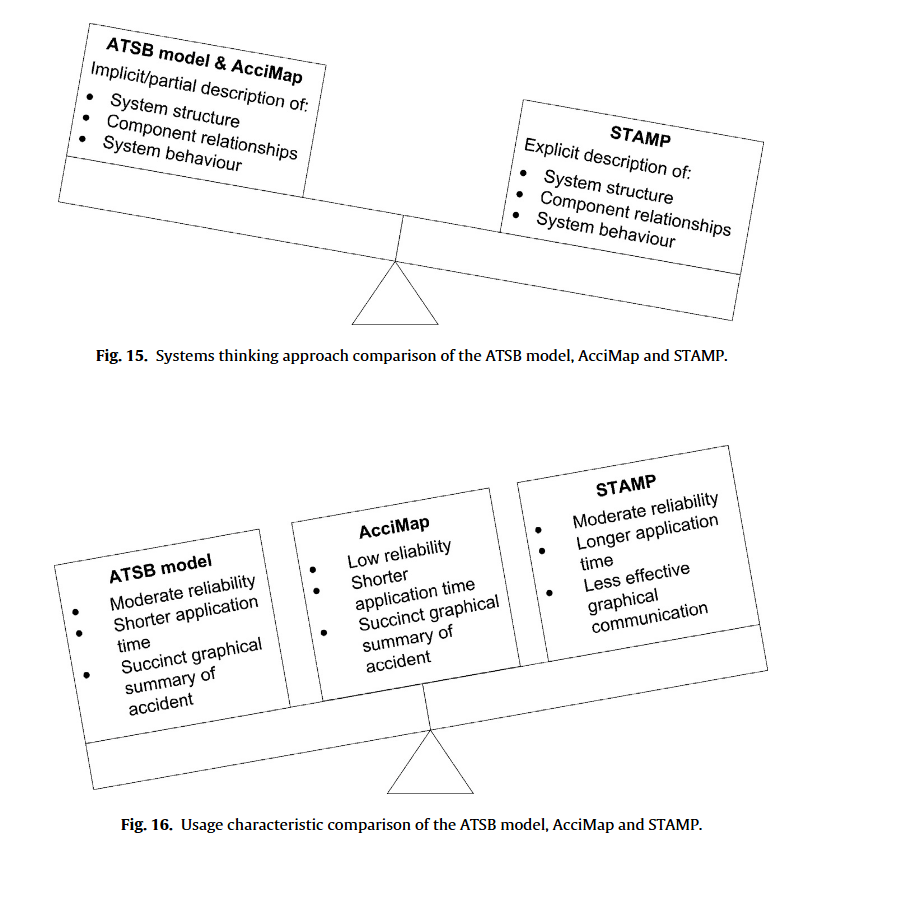
· “However, the ATSB model and AcciMap graphically presented their findings in a more succinct manner, whereas STAMP more clearly embodied the concepts of systems theory”
· “The study suggests that, whilst the selection of an analysis method is subject to trade-offs that practitioners and researchers must make, the SCM remains a viable model for accident analysis”
· “Therefore, when considering how much of the systems thinking approach could be applied during a live investigation, the difference between the models seems to be a small one”
· “the trade-offs associated with method selection suggest that ATSB model provides a suitable option for practitioners. Conversely, STAMP maybe better suited for use within research”
· Finally, “the AcciMap method may more easily meet the needs of both parties”
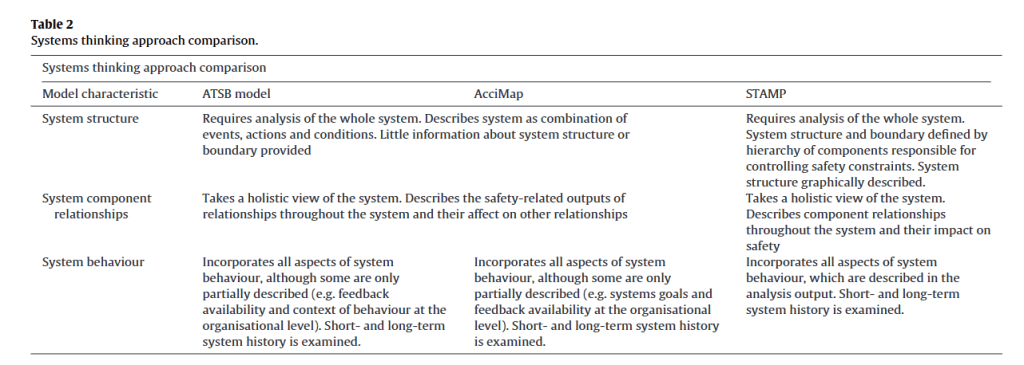
· Each model applies its own logics of system analysis, e.g. “they require the analysis of a system’s structure, the relationship of its components and its behaviour”
· As recognised by ATSB, their model “does not fully explain the complex, dynamic nature of accident development. Therefore, strict adherence to the format of the ATSB model may result in an incomplete application of the systems thinking approach”
· Nevertheless, while mechanistic application of the model may interfere with a thorough analysis of system complexity, nothing inherent to the model precludes that analysis
· That is, “If investigators understand and apply the systems theory concepts during an investigation then the ATSB model can fulfil its intended role as a framework for analysis activities and act as a gateway to [systemic system analysis]”
· “Similarly to the ATSB model, AcciMap implicitly or partially describes the system structure, its boundary and the impact of missing/inadequate feedback”
· In contrast to the ATSB model, AcciMap provides” a clearer representation of the context in which managerial decisions and activities took place”
· Likewise, mechanistic application may also preclude thorough systemic accident analysis
· STAMP “more clearly embodies the core components of systems theory”, which is unsurprising because “it was specifically designed to employ a systems thinking approach to accident analysis”
· “Furthermore, the structured process for applying STAMP deliberately guides the analyst to consider these core components. By doing so, STAMP arguably provides a more effective means of applying the systems thinking approach”
Ref: Underwood, P., & Waterson, P. (2014). Systems thinking, the Swiss Cheese Model and accident analysis: A comparative systemic analysis of the Grayrigg train derailment using the ATSB, AcciMap and STAMP models. Accident Analysis & Prevention, 68, 75-94.

Study link: https://doi.org/10.1016/j.aap.2013.07.027

 SafetyInsights.org