Understanding work-as-done seen as critical for PCBUs and CEOs/Officers, according to this prosecution of a CEO who failed to exercise due diligence relating to a work-related fatality (Ports of Auckland Limited (POAL).
Extracts:
· “[234] “Work as done” is the reality of work as it is actually carried out by the workers on the shop floor. This is in contrast to “work as planned”, “work as intended” or “work as imagined”, that is, methods of work designed, understood or expected by management and other staff who do not actually undertake the work”
· “There is no dispute in the present case as to the central importance of any PCBU gaining an understanding of work as done”
· “ Professor Dekker highlighted the efforts required to close gaps between work as designed versus work as done” or from Kahler “you’ve got to understand work as done because the ultimate test of your system is what is happening”
· Marriott framed it as an “organisation needs to understand work as done to understand the effectiveness of its systems. Mr Marriott equated the concept of understanding work as done to “learning from normal operations”
· “Structured observation processes are a means by which a PCBU can acquire insight into work as done”
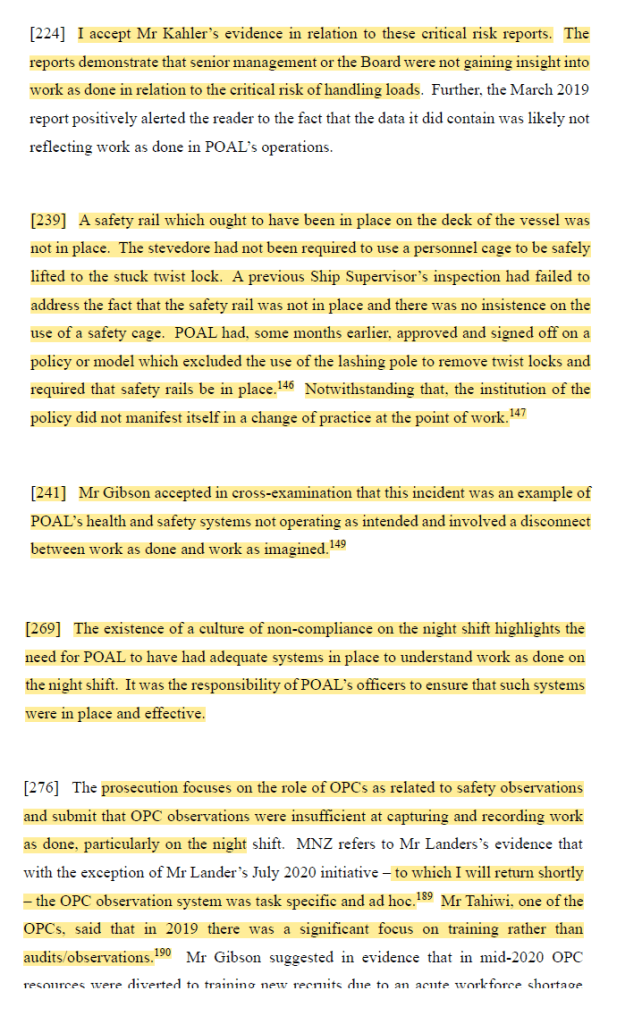
· Based on a prior serious injury, POAL “approved and signed off on [a revised work process]”, which in part required safety rails to be in place
· However, “the institution of the policy did not manifest itself in a change of practice at the point of work”
· “[The CEO] accepted in cross-examination that this incident was an example of POAL’s health and safety systems not operating as intended and involved a disconnect between work as done and work as imagined”
· An informal rule was in place called the three-container width rule, which was “a behavioural control which requires workers to always be at least three-container widths (24 feet or approximately 7.3 metres) away from an operating crane”
· It was commonly accepted as a minimum control, but “POAL’s training materials and documentation in relation to three-container width rule were confusing and, often, inconsistent, and that workers had different understandings of the operation of the rule”
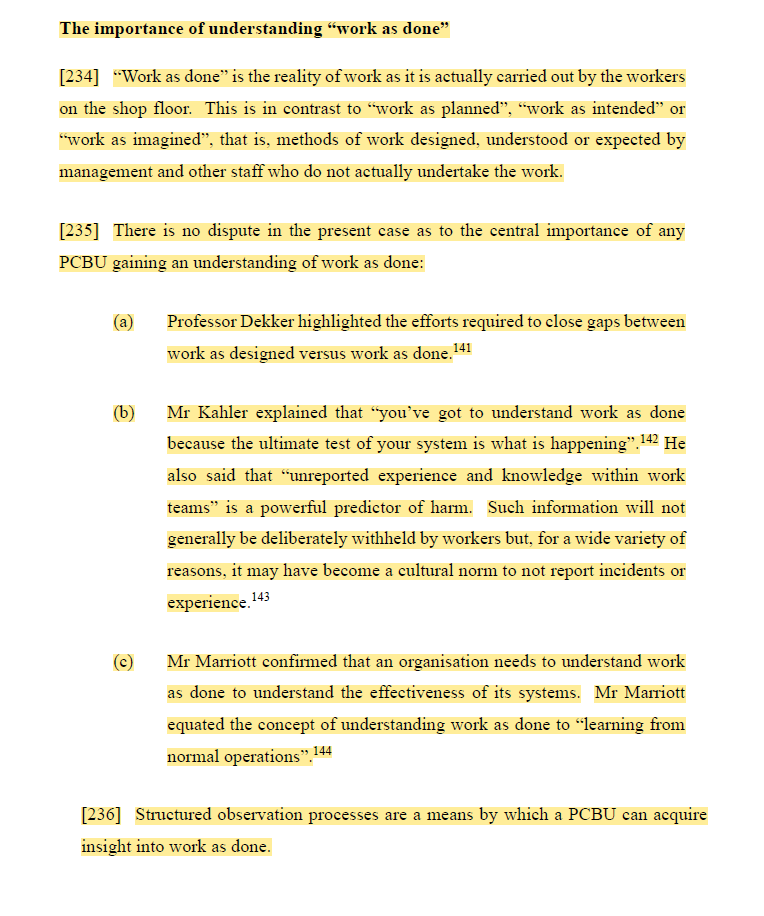
· “Further, and in any event, it is also clear that there was significant non-compliance with the rule, particularly on the night shift” [I’ll cover nightshift in another post]
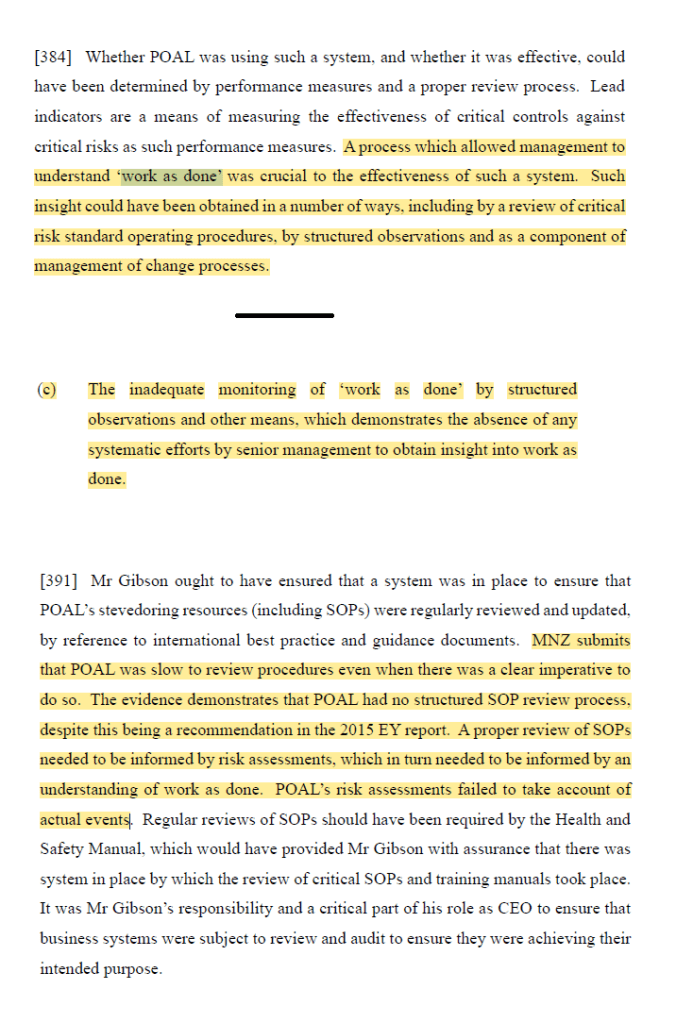
· “The inadequate monitoring of ‘work as done’ by structured observations and other means, which demonstrates the absence of any systematic efforts by senior management to obtain insight into work as done”
Ref: Nicholson v GCMR Project Services Pty Ltd [2024] QDC 58

Report link: https://www.transporting.nz/wp-content/uploads/2025/01/MARITIME-NEW-ZEALAND-v-GIBSON-BC202464396.pdf

 SafetyInsights.org