
Andrew Hopkins in this article defends Reason’s Swiss Cheese Metaphor (SCM) from critiques from both Nancy Leveson and Sid Dekker.
Just a few extracts. [** Be on the lookout for next week’s compendium dedicated to Hopkins & Hale]
I’m taking no sides – just reporting what’s in the paper:
· He selects criticisms of Reason’s work from Leveson & Dekker as both are influential
· Leveson’s systems approach is said to be “very similar to Reason’s. However, she seeks to differentiate her work from his by criticising it harshly, and in the process, she gets many things wrong”
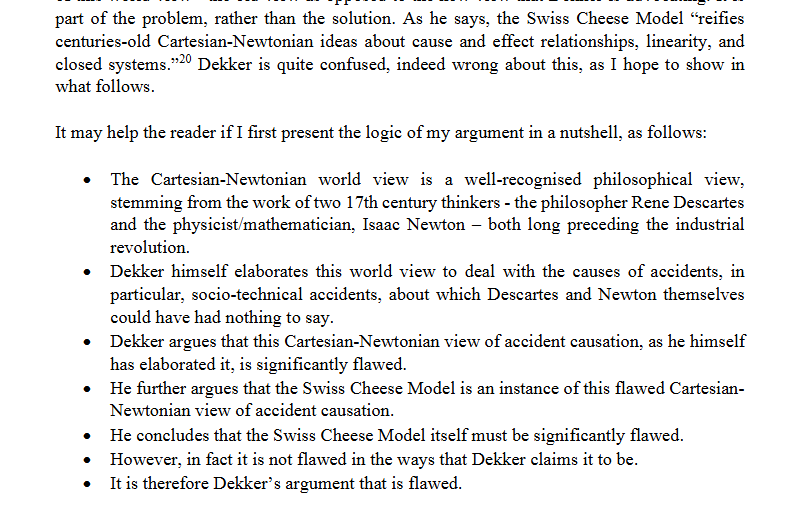
· Dekker has many arguments, but of particular focus in this article is the broader rejection of Cartesian-Newtonian worldview
· For Leveson, she apparently “asserts that Reason’s Swiss Cheese Model is a re-invention of the domino model”, but Swiss cheese substituted for the dominos
· Hopkins points out that it’s not a repeat of dominos, and in any case, he points out how Heinrich’s work was misconstrued
· For one, “Heinrich unashamedly admits that his own theory does not conform to the logic of the domino model” and instead, “It is a metaphorical introduction to his book which he rapidly leaves behind”
· “Heinrich’s domino model is no more than a thought bubble, to use a modern-day expression, and would have gone the way of all bubbles, except that Leveson has resurrected it as a way of criticising Reason’s model of accident causation”
· In image 2, Leveson’s criticisms are reported – focusing on the SCM being fixated on a single ‘root cause’, focusing on human error, discounting systemic factors and more
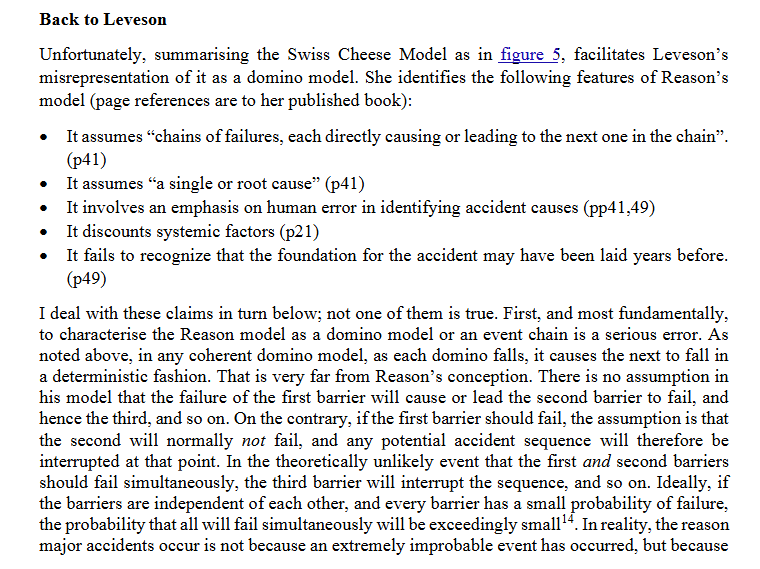
· He addresses each of these, but for one, Hopkins says “most fundamentally, to characterise the Reason model as a domino model or an event chain is a serious error”
· And “There is no assumption in his model that the failure of the first barrier will cause or lead the second barrier to fail … and so on”
· “Leveson claims that the model discounts systemic factors. But organisational factors are systemic factors. This fourth claim is therefore wrong”
· “It is hard to understand how someone reading Reason’s 1997 book, as Leveson has done, could get his theory so entirely wrong”
· He covers a few more points and then moves onto Dekker – I’ve skipped a lot of this due to space
· But, he describes Dekker as a “theorist who has misrepresented Reason, perhaps without realising it, in the process of advancing his own theoretical position”
· And while “It is relatively easy to see how Leveson misrepresents Reason, but it is more difficult to see how Dekker does, because his arguments are deeply embedded in a more general critique of what he calls the Cartesian-Newtonian world view”
· Hopkins takes aim at the focus on hindsight bias etc.
· In his view, while investigations after the fact can “easily be contaminated with hindsight bias”, there is still value when “the purpose of the retrospective analysis is to draw lessons for accident prevention, we can rightly speak of the “wisdom of hindsight”
· Hence, “Hindsight in this context is an aid to understanding, not a source of bias”
· He talks about an argument that the SCM “will treat human error as an ultimate explanation” due to Newtonian determism, which, in his view, “is patently wrong”
· “The Swiss Cheese Model involves an explicit search for the causes of human error, starting with local workplace factors”
· “In fact, the Swiss Cheese Model displays none of the characteristics which Dekker attributes to Cartesian dualism”

Article: https://openresearch-repository.anu.edu.au/items/9e13c903-974f-4df9-8bb0-b64feb0f7d51

 SafetyInsights.org
The link to the paper returns “Whitelabel Error Page”, at least in my case.
LikeLike
Thanks for the heads-up. Fixed, I think!
LikeLike
yep, it works
LikeLike
ehh no sorry, I think there is an error at https://openresearch-repository.anu.edu.au/items/9e13c903-974f-4df9-8bb0-b64feb0f7d51/full
LikeLike