
An interesting read from David Woods discussing four resilience concepts.
Extracts:
· While networks of interdependencies have created new value for stakeholders, it has “also created unanticipated side effects and sudden dramatic failures”
· The first concept used to describe resilience is rebounding
· Rebounding “begins with the question: why do some communities, groups, or individuals recover from traumatic disrupting events or repeated stressors better than others to resume previous normal functioning”
· “the focus is not on the period of rebound but on what capabilities and resources were present before the rebound period”
· “First, it is not what happens after a surprise that affects ability to recover; it is what capacities are present before the surprise that can be deployed or mobilized to deal with the surprise”
· A paradox with resilience is covered: “To overcome the risk of brittleness in the face of surprising disruptions requires a system with the potential for adaptive action in the future when [facing change]”
· “However, the data to measure resilience as this potential comes from observing/analyzing how the system has adapted to disrupting events and changes in the past”
· Next there’s resilience as robustness, being “increased ability to absorb perturbations”, and a conflation between these has confounded research
· “An increase in robustness expands the set of disturbances the system can respond to effectively”
· But, “if the system cannot continue to respond to demands and meet some of its goals to some degree, then the system will experience a sudden failure or collapse [brittleness] … [hence] resilience comes to the fore when the set disturbances is not well modeled and when this set is changing”
· A “fundamental trade-off for complex adaptive systems[is] where becoming more optimal with respect to some variations, constraints, and disturbances increases brittleness in the face of variations”
· “The search for good system architectures studies how some systems are able to continue to solve the trade-off as load increase”
· Next is resilience as graceful extensibility, seeing “resilience as the opposite of brittleness, or, how to extend adaptive capacity in the face of surprise”

· “Rather than asking the question how or why do people, systems, organizations bounce back, this line of approach asks: how do systems stretch to handle surprises?“
· “Systems with low graceful extensibility risk collapse at the boundaries. But surprise has regular characteristics as many classes of challenge re-cur (e.g., [30]) which can be tracked and used as signals for adaptation”
· “graceful extensibility is a dynamic capability [and is a] play on the traditional term – graceful degradation. However, graceful degradation only refers to breakdowns”
· “Woods [45] uses graceful extensibility because adaptation at the boundaries can be very positive and lead to success”
· “Systems with high graceful extensibility have capabilities to anticipate bottlenecks ahead, to learn about the changing shape of disturbances and possess the readiness-to-respond to adjust responses to fit the challenges”
· Finally, there is resilience as sustained adaptability, being “the ability manage/regulate adaptive capacities of systems that are layered networks”
· Central is “identifying what basic architectural principles are preserved over these changes and provide the needed flexibility to continue to adapt over long scales”
· In sum, Woods argues that “through overuse, the label resilience only functions as a general pointer to one or another of the four concepts”, and one needs to be “explicit about which of the four senses of resilience is meant when studying or modeling adaptive capacities”
· “The yield from .. rebound and robustness, has been low. Resilience as rebound misdirects inquiry to reactive phases and restoration or return to previous states”
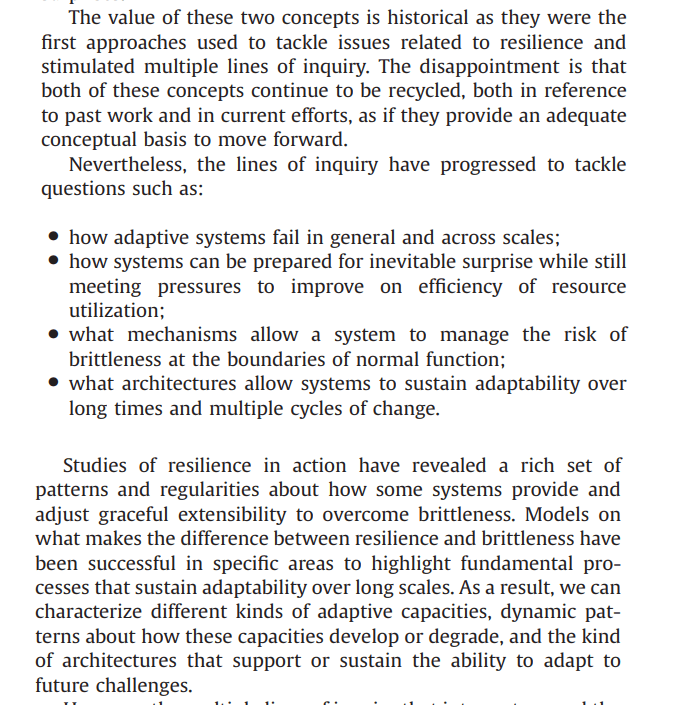
· As seen in the final image, other resilience streams have revealed insightful yields

Study link: https://resilientvi.org/s/4sensesofresiliencepublic.pdf

 SafetyInsights.org