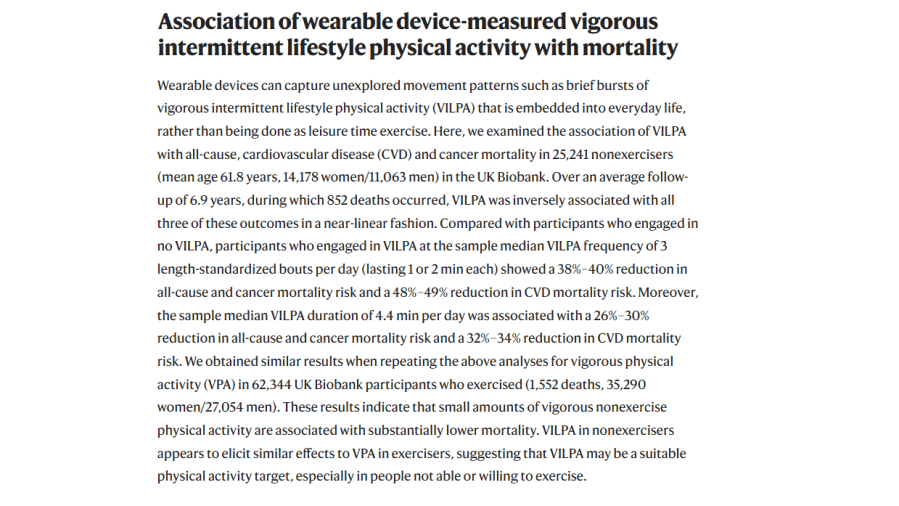

Can brief bursts of vigorous activity, like running up stairs, or walking quickly through the shops, reduce all-cause mortality? Yes according to this study.
This paper was discussed on a YT channel I follow called Physionic (link to YT and paper in comments).
Physical activity was measured via wearables from 25k non-exercisers (UK Biobank data) over a 7 year period.
Extracts:
· Vigorous bursts of activity during daily life, like running up stairs, power walking through shops etc. is called VILPA (vigorous intermittent lifestyle physical activity)
· This isn’t exercise but normal daily activities done in higher bursts of effort
· Over 7 years, they found that “Compared with participants who engaged in no VILPA, participants who engaged in VILPA at the sample median VILPA frequency of 3 length standardized bouts per day (lasting 1 or 2 min each) showed a 38%–40% reduction in all-cause and cancer mortality risk and a 48%–49% reduction in CVD mortality risk”
· “the sample median VILPA duration of 4.4 min per day was associated with a 26%–30% reduction in all-cause and cancer mortality risk and a 32%–34% reduction in CVD mortality risk”
· “These results indicate that small amounts of vigorous nonexercise physical activity are associated with substantially lower mortality”
· “VILPA in nonexercisers appears to elicit similar effects to VPA in exercisers, suggesting that VILPA may be a suitable physical activity target, especially in people not able or willing to exercise”
· Interestingly, steep mortality risk reductions occurred at the lower ends of VILPA distributions, e.g. as little as vigorous bouts of up to 1 or 2 min reduced risk similarly to 4-5m per day
· “In terms of minimum daily frequency dose, fewer than two VILPA bouts (lasting 1 or 2 min) were associated with 24%–26% reduction in all-cause and cancer, and a 33% reduction in CVD mortality risk”
· “The median VILPA frequency of 3 length-standardized bouts per day was associated with a 38%–40% reduction in all-cause and cancer mortality and a 48%–49% reduction in CVD mortality risk
“Proof-of-concept trials 39 have shown that very small doses of exercise-based intermittent VPA can have rapid and measurable effects on cardiorespiratory fitness, a key causal determinant of CVD”
· “High-intensity interval training 40 and studies of intermittent stair climbing 39 have shown that VPA bursts lasting 20 s to a few minutes, performed three to five times a day, can result in substantial improvements in cardiorespiratory fitness in previously inactive adults within a few weeks”
Ref: Stamatakis, E., Ahmadi, M. N., Gill, J. M., Thøgersen-Ntoumani, C., Gibala, M. J., Doherty, A., & Hamer, M. (2022). Association of wearable device-measured vigorous intermittent lifestyle physical activity with mortality. Nature medicine, 28(12), 2521-2529.


Shout me a coffee (one-off or recurring monthly)
Study link: https://www.nature.com/articles/s41591-022-02100-x
Physionic YT vid: https://youtu.be/w5IN0WrPEHw?si=K9Rn1gyVU3v0n9CY

 SafetyInsights.org