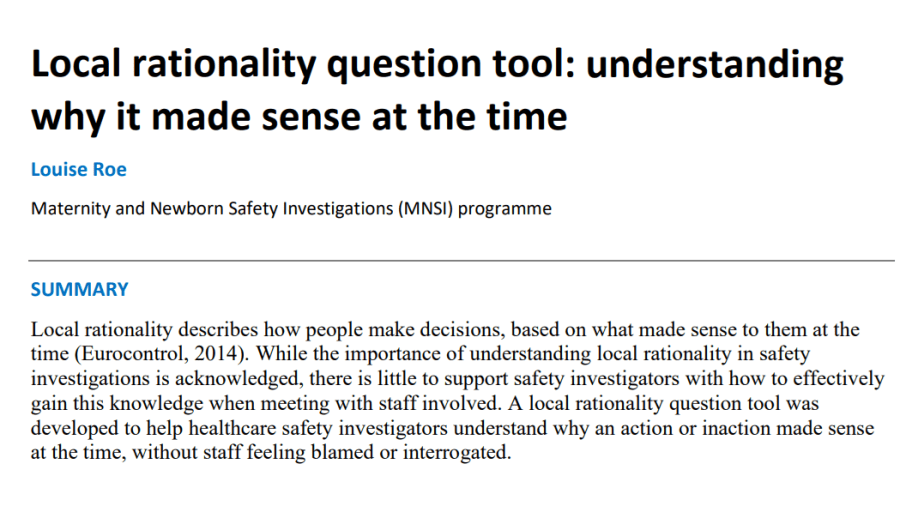
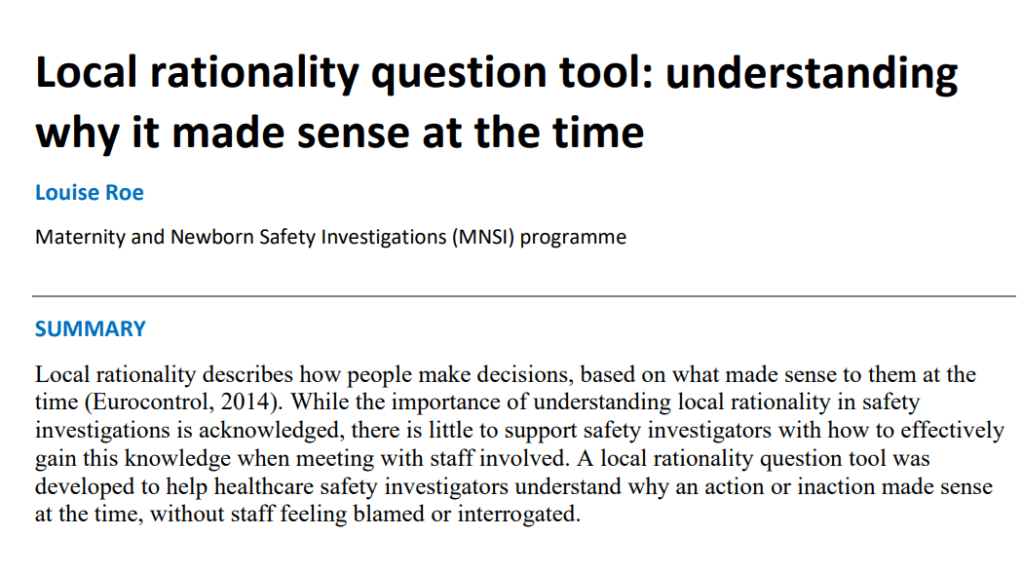
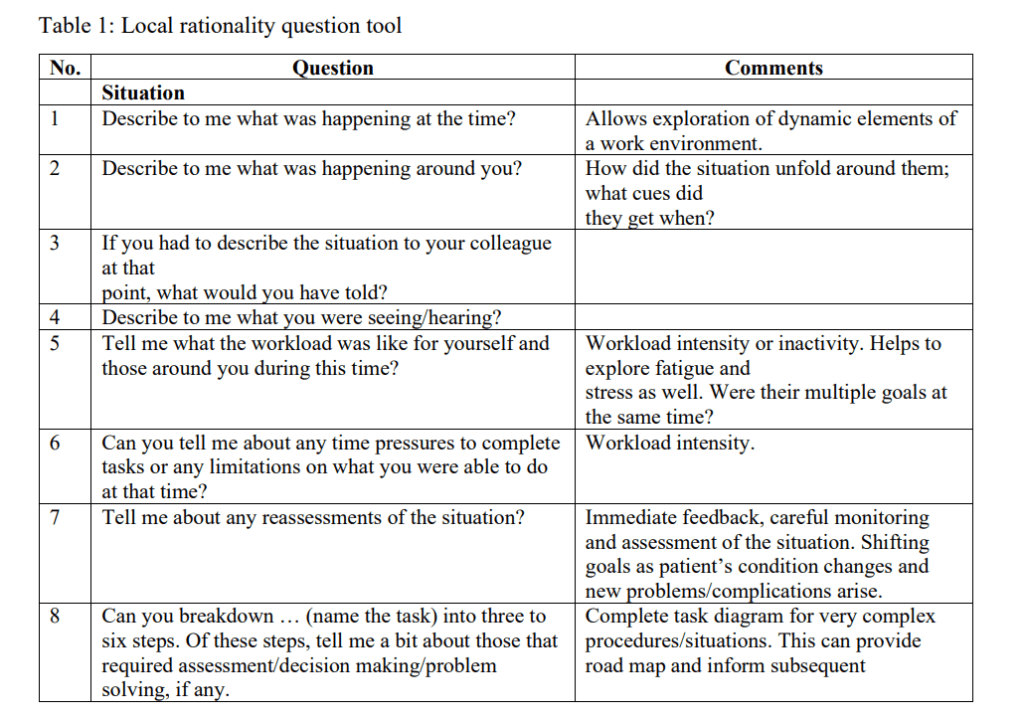
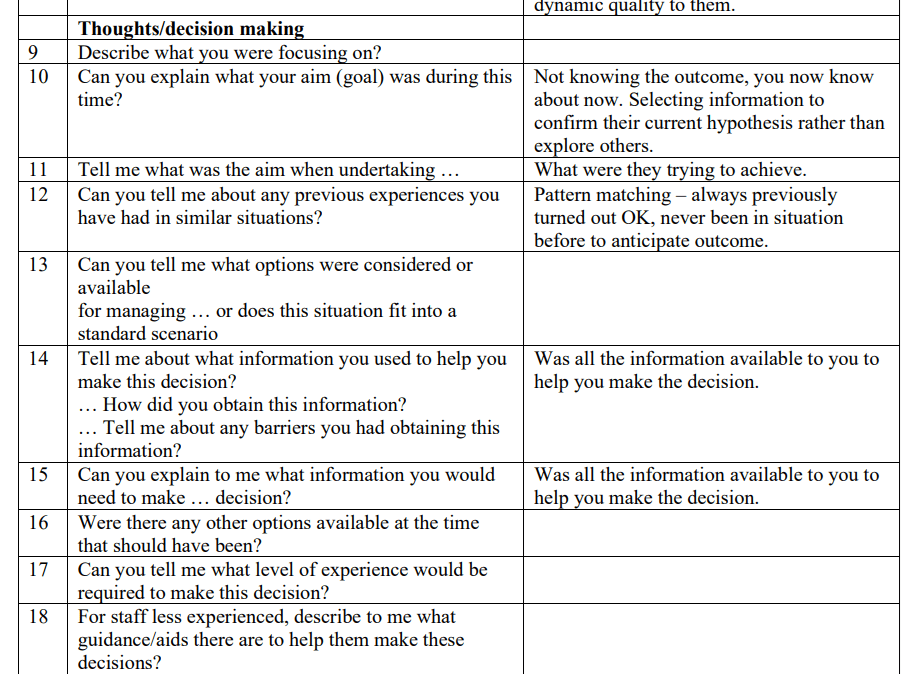
An interesting tool for exploring a local rationality question tool (LRQ) in practice from Louise Roe, based on her conference paper.
The tool has 25 items across situation, thoughts / decision making, preparedness, communication and anticipation. I’ve just covered a couple of sections (images 1 & 2).
Extracts:
· This tool has been used by the author in healthcare for 4 years
· The LRQ tool “encouraged investigators to maintain an open-ended questioning approach, using an inquisitive non-blame approach that identified system issues and barriers”
· “Investigators were able to explore nuanced information that may not have been obvious from other sources of information collected during the investigation”
· “Using questions from the tool that explored staff’s past experiences, prevented investigators from making assumptions based on staff’s role or seniority”
· “The LQR tool is designed for ‘pick and mix’ use and inspiration, rather than a script, which is not recommended”
· “Once investigators become more familiar with the LRQ tool, they will be able to integrate it into real-time staff discussions as needed, as well as use it to plan for these conversations”
· “the LRQ tool will work well alongside any investigation analysis model that allows for the ‘whys’ to be explored” and is hence “transferable to any safety investigation”
· “Human factors specialists have fed back that the tool has been positively received by investigators within the mining industry and is being shared within UK civil aviation”
· “In healthcare, patient safety teams have fed back how the tool supports their investigations and where information obtained has led to significant changes to departmental processes and equipment”
· “The LRQ tool can help safety investigators ask the right questions in a way that promotes psychological safety”
Ref: Roe, L. (2025). Local rationality question tool: understanding why it made sense at the time. In Golightly, Dave, Balfe, Nora, & Charles, Rebecca (Eds.) Contemporary Ergonomics and Human Factors 2025: Proceedings of the Chartered Institute of Ergonomics and Human Factors Annual Conference. Chartered Institute of Ergonomics and Human Factors, United Kingdom, pp. 360-362.

Conference: https://ergonomics.org.uk/events-calendar/ergonomics-human-factors-2025.html

 SafetyInsights.org