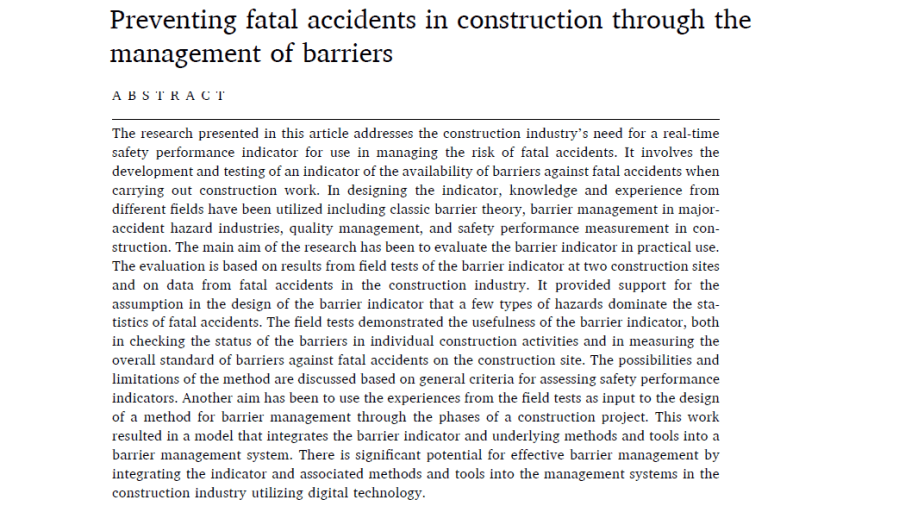
This paper explored a (close-to) real-time safety performance indicator for barriers (sometimes called ‘controls’, although other typologies place barriers and safeguards under the broader category of ‘barriers’).
The author developed and tested an indicator for the availability of barriers against fatal accidents during construction work.
I’ve skipped a lot – but it’s open access, so you can read it yourself.
For background:
· The author discusses the legacy issues with injury and incident measures, like LTI or Fatal Accident Rate (FAR)
· One issue is it requires the aggregation of a sufficient number of reports, and “will result in feedback with significant delay”
· E.g., “For a medium-sized construction site of e.g., 100 employees and an LTI-rate around 20, a reporting periodicity of less than 12 months will be meaningless due to statistical fluctuations”
· Fatal or severe accidents are “even less suited than the LTI rate for use as a basis for feedback control at the individual construction site due to a much lower frequency of fatal accidents”
· This study focuses on barrier systems, being “coherent sets of system elements in a production system that provide types of barrier functions”, and barrier functions as what barriers do/achieve, or precisely “to intervene in the energy flow in different stages of the accident sequence to prevent or reduce a loss”
· Relevantly, “In construction, workers are to a much larger extent involved in the hands-on control of large amounts of energy than is the case in major-accident hazard industries”
· And, “Technology-driven monitoring thus must be replaced by a strategy for safety performance measurement based on auditing of construction work” [** Note, they take a broader view of ‘auditing’, which is more akin to inspection/monitoring]
· Their barrier indicator is rooted in the energy model derived from Gibson and Haddon
· Injury result “from an unwanted energy transfer to the human body above the body-injury threshold” and in construction, “the energy flow may be the same as that under controlled conditions is essential for the execution of work”
· They take a classical view of barriers – being directly involved in the transfer of energy (relying on laws of physics), rather than the “more radical interpretations of barriers such as those including human, technical/physical, or organizational measures or combinations of these at different system levels that can reduce the probability and/or consequence of accidents”


· They adopt Haddon’s 10 energy countermeasures, minus strategy 10
· Barrier functions are performed by barrier systems, and made up of barrier elements, which may be a combination of human, technical and/or organisational barrier elements
· Barriers can be passive or active, where passive is “independent of any operational control system to execute the barrier function” (e.g. guardrail or bunding), whereas active requires detecting, diagnosing and responding
The author adopts Rockwell’s criteria for assessing indicators – see below:

Results
There’s no simple way to report the findings, since this describes the development of a field assessment technique and then its tested results. However, overall the author observed that this technique:

Below is an example of one of the barrier indicator checklists. He discusses being struck by mobile plant, where two barrier elements are checked (which have different functions): preventing uncontrolled realise of energy and separating people from the danger zone of plant in motion.
Checks are specified as either O for observation, meaning it’s possible to directly observe the activity, and T means Triangulation, meaning the answer must be based on independent information sources. For instance, you may need to have respectful dialogue with people, review documents and more to form a judgement.
The checklist was compared to Norwegian workplace fatal accident data. Found is that the checklist accounted for 78% of fatalities in the assessed period, and was 77% for the second time period, indicating that the items that the checklist assesses are reasonably stable.
Based on the collected data of barrier “deviations”, a “large majority (91 %) of the identified deviations involved inadequate documentation. This result is in line with the important role of document checks in the checklists, which is required where observations and interviews are insufficient to judge whether barrier elements are adequate or not”. [** I’m less convinced about the centrality of paperwork but recognise it does have a place].
General Discussion
The author notes that while the Norwegian construction industry previously introduced “life-saving rules”, the accident data presented in this paper “indicate that such initiatives have been insufficient in changing the distribution of fatal accidents at the national level significantly”
Further, “Neither do the national fatal accident statistics for construction indicate any significant improvement in the overall safety performance during 2012–2021”. As such, a different approach is warranted according to the author, of which real-time barrier monitoring seems logical.
This barrier indicator is based on barrier theory, measuring compliance against established barrier element performance. Drawing on an example, these elements “in combination form at least two barriers that simultaneously must fail for fatal loss to occur due to the specified hazard”.
Notably, a score of 100% on the barrier index, doesn’t, of course, “guarantee fully satisfactory barrier performance when needed due to intrinsic variability in the performance of certain barrier elements”.
People make mistakes, things don’t always work when and where expected, nor how expected. However, the “residual uncertainty is compensated for by barrier redundancy”.
In the author’s view, the “Simultaneous failure of two barriers scoring 100 % in the barrier index is regarded as unlikely” [** I disagree, because this seems to assume barrier independence, which is a big assumption].
The author also discusses the importance of both scheduled inspections and also ad hoc inspections. It’s also said that “The barrier management system must cover early planning and design, contracting, and production, and needs to be specified in the contract between the Client and the Main contractor”.
Further, systematic barrier management in construction “must address “cultural issues”, including acceptance of the legitimacy of compliance checking at the site, and the ability of OHS advisors to engage in a respectful dialogue during audit activities”.
Ref: Kjellén, U. (2023). Preventing fatal accidents in construction through the management of barriers. Heliyon, 9(11).

Shout me a coffee (one-off or monthly recurring)
Study link: https://www.cell.com/heliyon/fulltext/S2405-8440(23)08923-5
LinkedIn post: https://www.linkedin.com/pulse/preventing-fatal-accidents-construction-through-ben-hutchinson-yn9vc

 SafetyInsights.org