

This paper explored the barrier system (e.g. controls) performance in the genesis of the 2005 BP Texas City disaster.
Not much to say – the images say enough.
Some extracts:
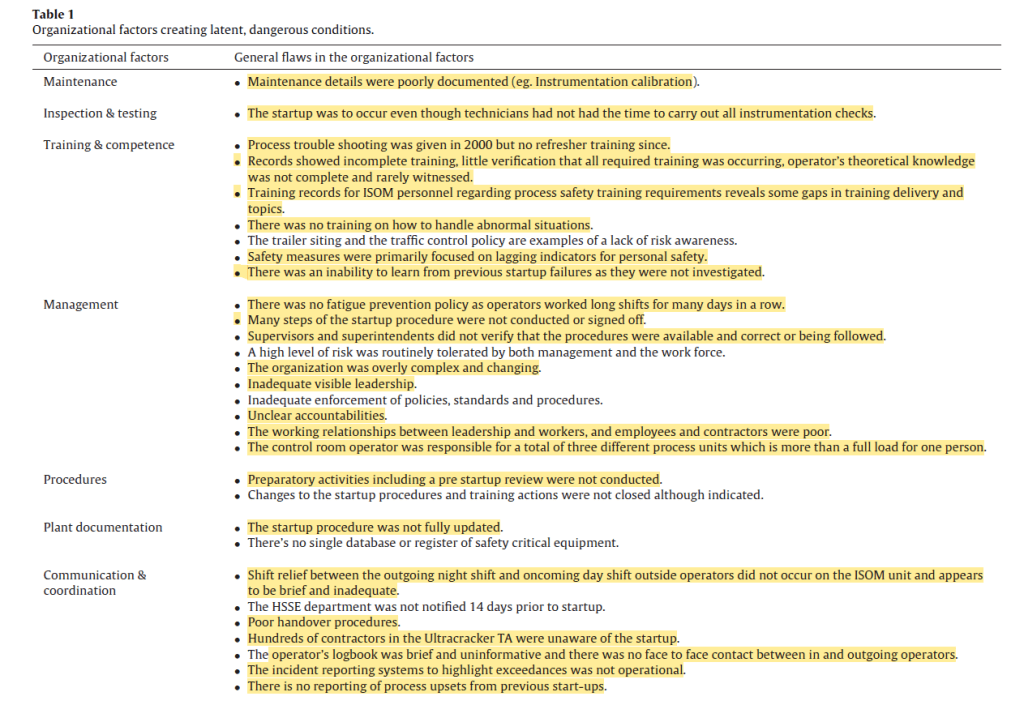
· As per image 1, several organisational factors or management delivery system were central in the poor barrier system performance

· They propose many of these factors were more ‘general’ across the organisation, more like performance influencing factors, which “may create latent, dangerous conditions if not properly managed”
· That is, rather than focusing in isolation on the specific barriers, they propose these organisational issues had broad and fuzzy influences across the scopes of work
· They also recognise that “One could argue about the categorization of some of the evidence [as shown in their study]”, but nevertheless, provides opportunities for learning and ensuring variability is within expected ranges
· “Many of the deficiencies were common occurrences rather than isolated events … Shortcomings that appeared to be structural and of influence on the accident process in a more general way by promoting errors and creating latent, dangerous conditions, have not been assigned to an organizational factor of a barrier but to an organizational factor of the accident process itself”
· Images 2 and 3 highlight a range of organisational and barrier factors

Ref: Schmitz, P., Reniers, G., & Swuste, P. (2021). Predicting major hazard accidents by monitoring their barrier systems: a validation in retrospective. Process Safety and Environmental Protection, 153, 19-28.

Shout me a coffee (one-off or monthly recurring)
Study link: https://doi.org/10.1016/j.psep.2021.07.006

 SafetyInsights.org