
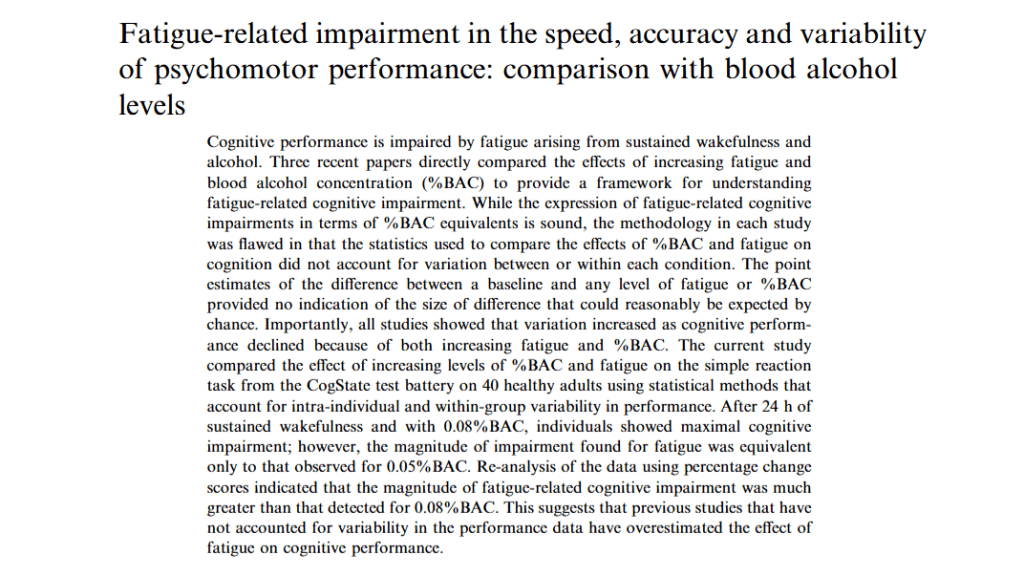
Extended wakefulness (24h) equivalent to a 0.05% Blood Alcohol Concentration (BAC), so this study found.
One of several studies which compared sustained wakefulness and different alcohol intoxication levels on cognitive performance, however this study found the earlier studies overestimated the effects.
40 adults were kept awake for 24h and tested on a simple cognitive performance test and tested under increasing blood alcohol levels.
For background:
· Three prior studies “directly compared the effects of fatigue and alcohol intoxication on performance in the same cognitive tests”
· These studies agreed “that as little as 18–24 h of sustained wakefulness could induce impairments in the speed and accuracy of cognitive performance that were equal to or greater than … individuals with [BAC] of 0.1%”
· However, the prior studies didn’t account for variations within individuals or groups, which this study accounted for
Results:
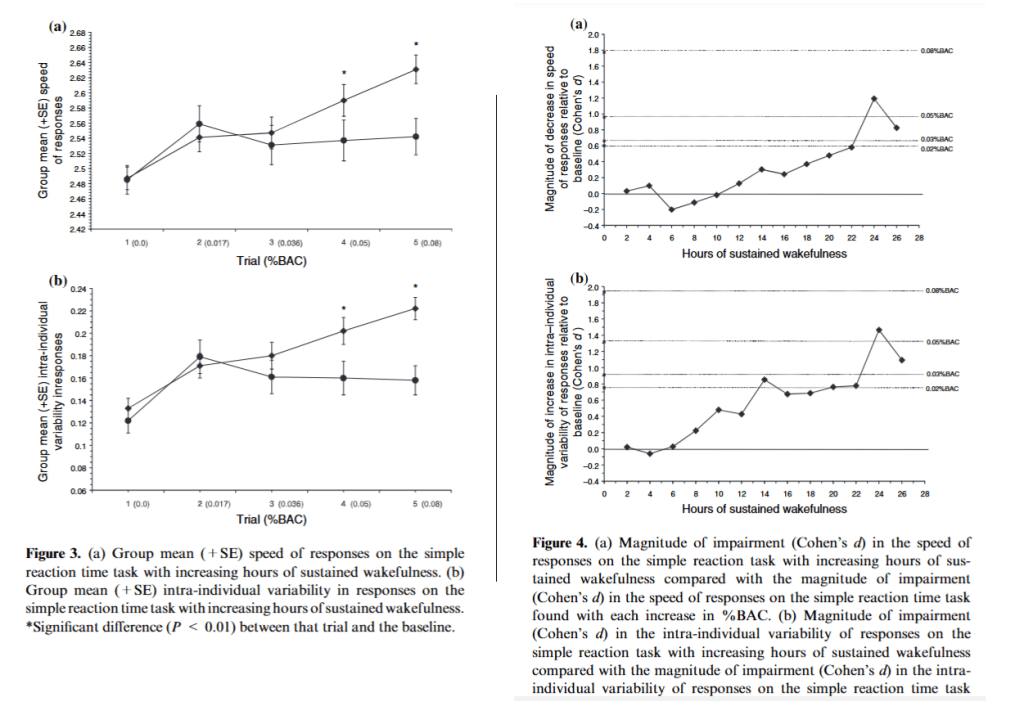
· “After 24 h of sustained wakefulness and with 0.08%BAC, individuals showed maximal cognitive impairment”
· “however, the magnitude of impairment found for fatigue was equivalent only to that observed for 0.05%BAC”
· However, when accounting for variance, magnitude of performance impairment after 24h wakefulness is equivalent to a 0.05% BAC and not the higher 0.1% BAC as found in prior work
· However, as per prior work, both sustained wakefulness and alcohol intoxication impair the speed of cognitive performance
· “This suggests that previous studies that have not accounted for variability in the performance data have overestimated the effect of fatigue on cognitive performance”
· In this study using their test, fatigue and alcohol impairment only affected reaction speed and not the accuracy of the task
· Despite this study finding smaller impairments in fatigue-related cognitive impairment, the “magnitude of impairment we did observe is still serious”
· “Even accounting for intra- and inter-subject variability, the cognitive impairment found at 24–26 h of sustained wakefulness was greater than that associated with %BAC levels at which many jurisdictions [legislate as illegal]
· These studies support “that individuals should not engage in cognitively demanding and high-risk activities, such as driving, when they have been awake for more than 20 h”
Ref: Maruff, P., Falleti, M. G., Collie, A., Darby, D., & McStephen, M. (2005). Fatigue‐related impairment in the speed, accuracy and variability of psychomotor performance: comparison with blood alcohol levels. Journal of sleep research, 14(1), 21-27.

Shout me a coffee (one-off or monthly recurring)
Study link: https://doi.org/10.1111/j.1365-2869.2004.00438.x

 SafetyInsights.org