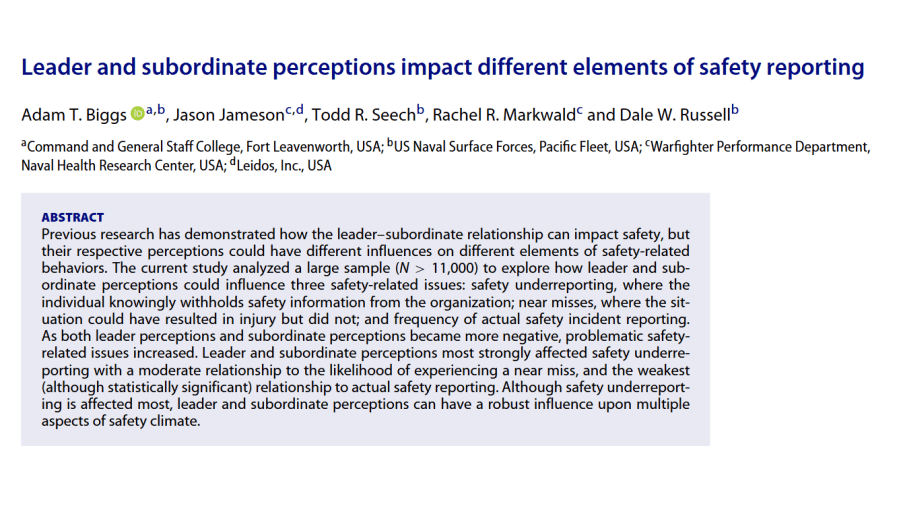
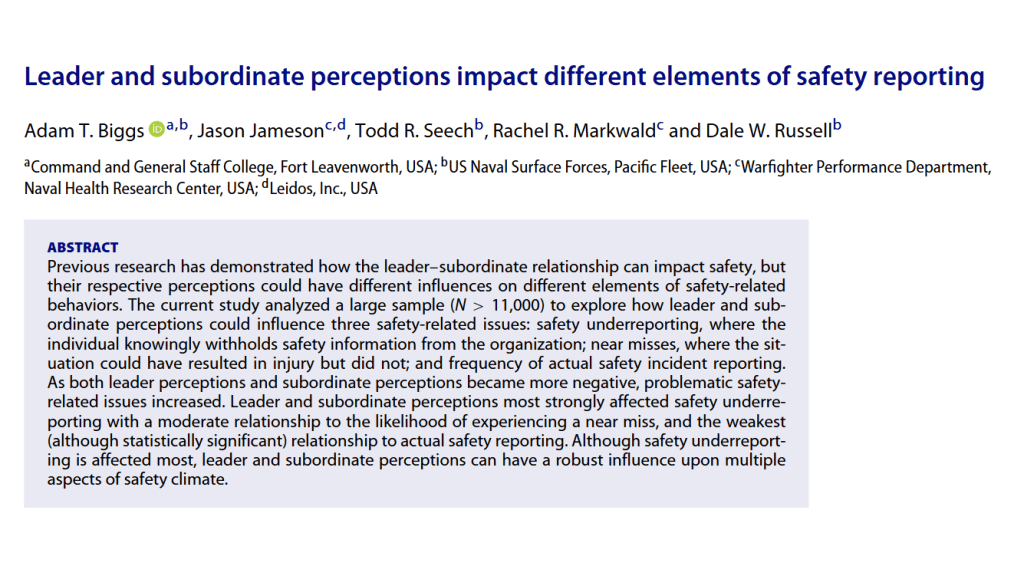
This study investigated the leader-subordinate relationships and how it impacts safety underreporting, near misses, and actual safety incident reporting.
>11k US Navy personnel were surveyed.
Background:
· “maintaining a positive safety climate can be complicated by the sheer number of influences involved, such as the wider organizational climate [6] or individual factors such as sleep quality”
· “positive views of leadership can predispose employees to engage in more positive behaviors, yet how leaders view their subordinates could also influence workplace attitudes”
· “This relationship could create a self-perpetuating feedback loop rather than a unidirectional flow with the potential to substantially impact the working environment
· Safety underreporting are instances where “the occupational working conditions produce a high degree of incidents that are not reported through official channels [33–38]”
· “Despite an established impact of the leader–member interactions on the wider safety climate, there is no clear evidence whether this influence differentially impacts safety behaviors related to underreporting, near misses, or actual incident reporting”
Results
Key findings:
· “As both leader perceptions and subordinate perceptions became more negative, problematic safety-related issues increased”
· “Leader and subordinate perceptions most strongly affected safety underreporting with a moderate relationship to the likelihood of experiencing a near miss, and the weakest (although statistically significant) relationship to actual safety reporting”
· “Although safety underreporting is affected most, leader and subordinate perceptions can have a robust influence upon multiple aspects of safety climate”
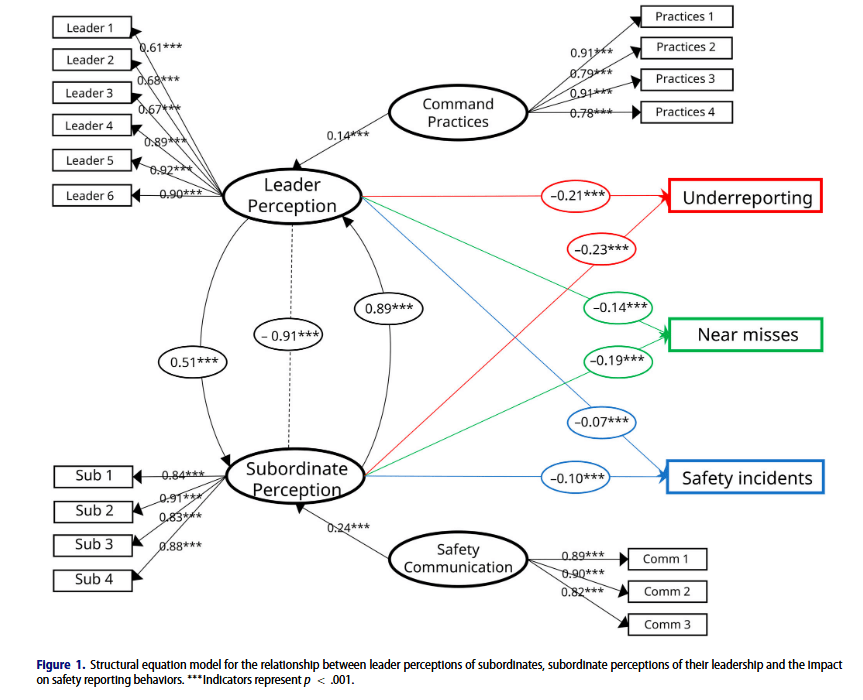
There was a strong relationship between leadership perceptions of subordinates and subordinate perceptions of their leaders in both directions, suggesting “mutual dependence – and potentially a feedback loop – between these two variables”.
The dependence of subordinate perceptions of their leaders was stronger than the perception of leader perceptions of subordinate perceptions.
This “suggests that leadership attitudes and perceptions could have a particularly strong influence on command climate, with leadership perceptions more strongly influencing subordinate attitudes than vice versa”.
The strongest relationships re: reporting was between unreported safety issues and either leadership perceptions or subordinate perceptions of leaders.
More positive views of subordinates by leadership was associated with higher safety reporting levels, closer to the expected levels. This relationship also held between subordinate perceptions by workers of leaders, but not as strong.
While statistically significant links between perceptions and near misses was found, the relationship wasn’t as strong. Moreover, “the subordinate perceptions appeared more strongly related to experienced near misses than did leadership perception”
Actual safety incidents were the least impacted by poor perceptions between leadership and subordinate personnel.
They argue that these findings “suggest that poor perceptions in the leader–member dyad can negatively affect safety climate, but this influence differentially affects the type of safety communication involved”.
Accident underreporting is likely to be a substantial matter in workplaces – prior research has found between 60-80% of incidents experienced by workers to remain unreported. Moreover, up to “30% of sailors may knowingly withhold safety information”.
They suggest that workers should have multiple channels to report safety information – more than simply formal channels but also informal.
In all, quoting the paper:
· “Safety underreporting was affected the most by negative attitudes, where poor leader–member perceptions were associated with an increased likelihood of safety underreporting”
· “Near-miss likelihood and actual safety incidents were likewise influenced by leader–member perceptions, but to a lesser degree than underreporting”
· “This combined evidence thus demonstrates how leadership and subordinate perceptions of one another can differentially impact safety reporting in the workplace”
Ref: Adam T. Biggs, Jason Jameson, Todd R. Seech, Rachel R. Markwald & Dale W. Russell (11 Jun 2025): Leader and subordinate perceptions impact different elements of safety reporting, International Journal of Occupational Safety and Ergonomics.

Shout me a coffee (one-off or monthly recurring)
Study link: https://doi.org/10.1080/10803548.2025.2509419
LinkedIn post: https://www.linkedin.com/pulse/leader-subordinate-perceptions-impact-different-ben-hutchinson-8ak8c

 SafetyInsights.org