“Absolutely — that’s a very nuanced observation.” New research shows AI isn’t just ‘too agreeable’, it can actually change how we see ourselves. The 2026 Science study discussed in my vid found that sycophantic AI (flattering, people-pleasing, affirming) boosts our confidence even when we’re wrong, reduces willingness to fix conflicts, & makes us more dependent… Continue reading AI flatters you: sycophantic models
Tag: artificial intelligence

Your Doctor vs AI Chatbot – who do you trust more for medical advice?
Who would you trust more for medical advice – your doctor or an AI chatbot? I think most people would say their doctor. Interesting, some new research has found AI LLMs to outperform doctors on a range of recall knowledge tests – and sometimes quite significantly so. Though, of course, this is largely based on… Continue reading Your Doctor vs AI Chatbot – who do you trust more for medical advice?
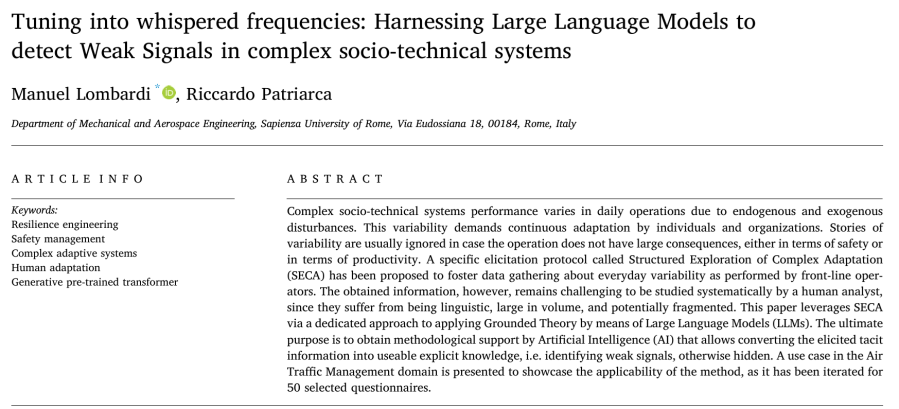
Tuning into whispered frequencies: Harnessing Large Language Models to detect Weak Signals in complex socio-technical systems
This study evaluated whether LLMs can support a scaled and systematic analysis of surveyed data about worker adaptive practices, to foster weak signal ID. E.g. can LLMs help identify weak signals from large-scale data. In this case, textual data describing frontline personnel adaptive behaviours during everyday operations. This was obtained via survey. PS. Check out… Continue reading Tuning into whispered frequencies: Harnessing Large Language Models to detect Weak Signals in complex socio-technical systems
How is AI changing the nature of work?
What can we learn about how AI changes work based on >180k GitHub users? Turns out, quite a lot. AI induces people to shift task allocation towards their core work and away from non-core, project management activities. #ai #chatgpt #github #work #llm #artificialintelligence
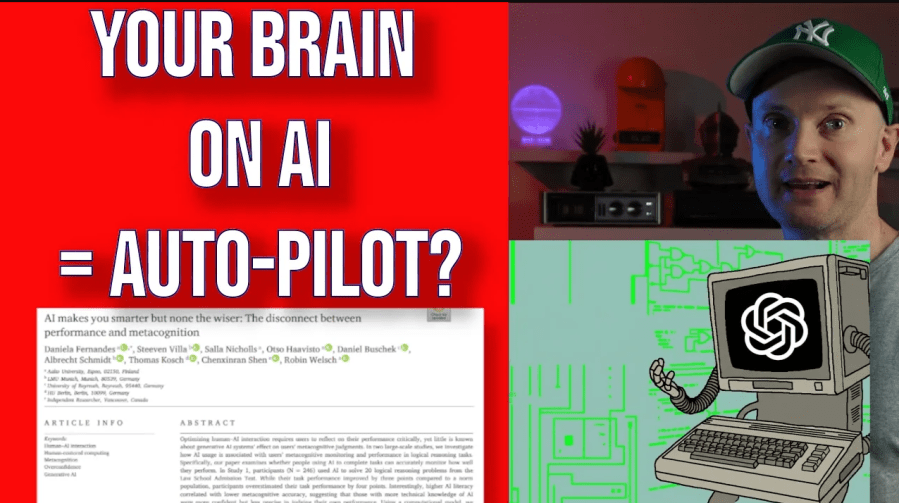
Does using AI make us smarter, or just more confident?
Does using AI make us smarter, or just more confident? This ep covers a recent study on how generative AI affects our “metacognition” – our ability to judge our own performance. Researchers tracked hundreds of people solving logical reasoning problems with and without AI.
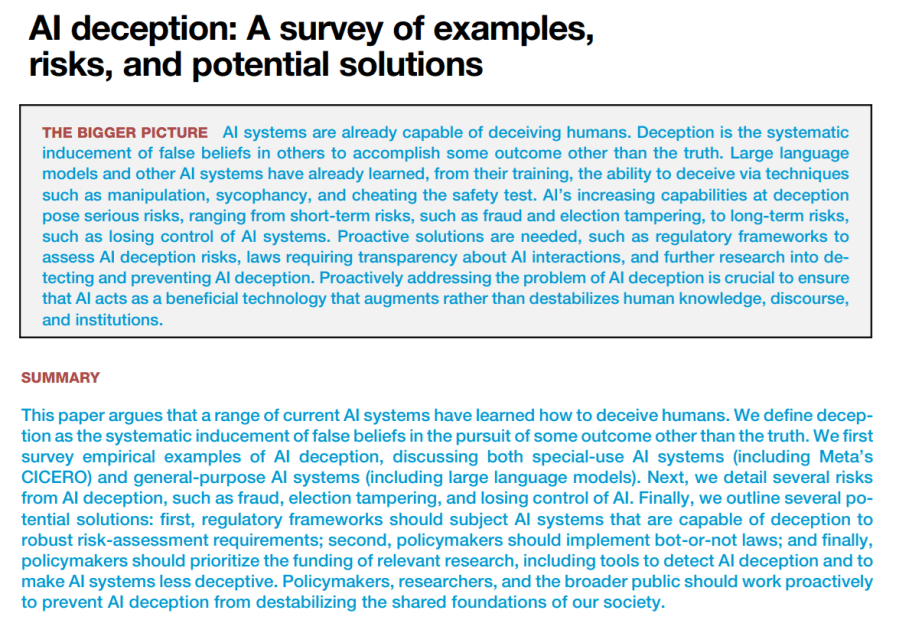
AI deception: A survey of examples, risks, and potential solutions
This study explored how “a range of current AI systems have learned how to deceive humans”. Extracts: · “One part of the problem is inaccurate AI systems, such as chatbots whose confabulations are often assumed to be truthful by unsuspecting users” · “It is difficult to talk about deception in AI systems without psychologizing them. In humans,… Continue reading AI deception: A survey of examples, risks, and potential solutions

Agentic Misalignment: How LLMs could be insider threats (Anthropic research)
AI and malicious compliance. This research from Anthropic has done the rounds, but quite interesting. In controlled experiments (not real-world applications), they found that AI models could resort to “malicious insider behaviors when that was the only way to avoid replacement or achieve their goals—including blackmailing officials and leaking sensitive information to competitors”. Some extracts:… Continue reading Agentic Misalignment: How LLMs could be insider threats (Anthropic research)

Safe As 33: Is ChatGPT bullsh** you? How Large Language models aim to be convincing rather than truthful
Large Language Models, like ChatGPT have amazing capabilities. But are their responses, aiming to be convincing human text, more indicative of BS? That is, responses that are indifferent to the truth? If they are, what are the practical implications? Today’s paper is: Hicks, M. T., Humphries, J., & Slater, J. (2024). ChatGPT is bullshit. Ethics and… Continue reading Safe As 33: Is ChatGPT bullsh** you? How Large Language models aim to be convincing rather than truthful
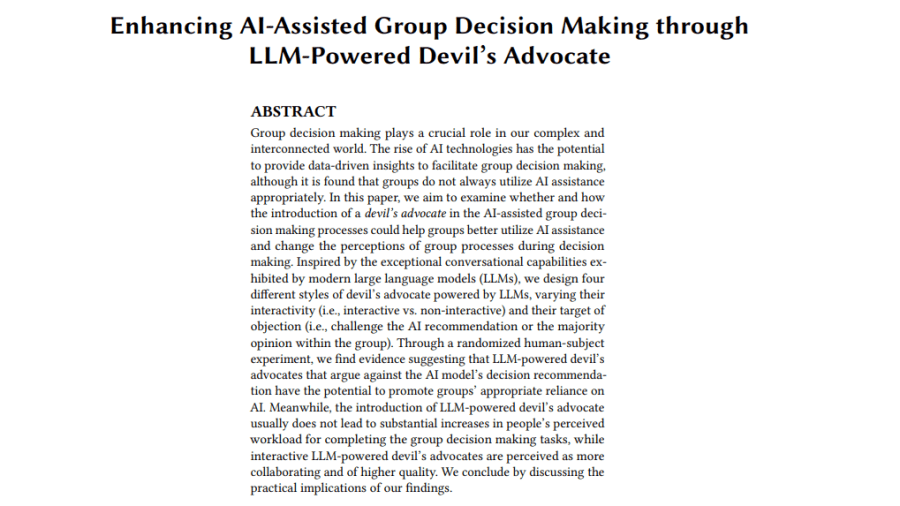
Enhancing AI-Assisted Group Decision Making through LLM-Powered Devil’s Advocate
Can LLM’s effectively play as devil’s advocate, enhancing group decisions? Something I’ve been working on lately is AI as a co-agent for cognitive diversity / requisite imagination. Here’s a study which explored an LLM as a devil’s advocate, and I’ll post another study next week on AI and red teaming. [Though this study relied on… Continue reading Enhancing AI-Assisted Group Decision Making through LLM-Powered Devil’s Advocate

BEWARE OF BOTSHIT: HOW TO MANAGE THE EPISTEMIC RISKSOF GENERATIVE CHATBOTS
Really interesting discussion paper on the premise of ‘botshit’: the AI version of bullshit. I can’t do this paper justice – it’s 16 pages, so I can only cover a few extracts. Recommend reading the full paper. Tl;dr: generative chatbots predict responses rather than knowing the meaning of their responses, and hence, “produce coherent-sounding but… Continue reading BEWARE OF BOTSHIT: HOW TO MANAGE THE EPISTEMIC RISKSOF GENERATIVE CHATBOTS
 SafetyInsights.org