This brief discussion paper explored some limitations of different safety performance indicator types based on an extensive review of the literature. Based on their review, they identified and discussed three indicator types which are based on a safety management system (SMS) model of measurement: outcome, audit and leading indicators. Outcome measures: Authors discuss that the… Continue reading How traditional construction safety performance indicators fail to capture the reality of safety
Author: Ben Hutchinson
What the Death Star can tell us about ergonomics methods
This is a really cool read. The objective was evaluating whether two ergonomic methods could reveal the Death Star’s critical thermal exhaust port flaw. Notably, it uses an interesting fictional example from the film to tell an important narrative for real-world application. The methods were:1) HE-HAZOP (Human Error Hazard and Operability) analysis; said to represent the… Continue reading What the Death Star can tell us about ergonomics methods
Root cause analysis and its effects on audits judgments and decisions in an integrated audit
As a way to bring some balance to the force with all of the critical research I’ve posted lately, which frankly, doesn’t give me much confidence to trust root cause analysis (RCA) methods (I’ve posted about four other studies highlighting the questionable ability of RCA methods to improve outcomes), this empirically studied some of the… Continue reading Root cause analysis and its effects on audits judgments and decisions in an integrated audit
Are root cause analyses recommendations effective and sustainable? An observational study
This study assessed the strength of root cause analysis (RCA) recommendations and their perceived effectiveness and sustainability to longer-term change. All sentinel event RCAs between 2010-2015 in the Victorian public health system were analysed. An expert panel assessed the strength of the recommendations. The recommendations ranking categories were: Although the coding scheme is specific to… Continue reading Are root cause analyses recommendations effective and sustainable? An observational study
Positive deviance: a different approach to achieving patient safety
This paper discusses the role of positive deviance (PD) in achieving safety. They start by talking about many existing safety approaches (in healthcare) feel like a “relentlessly negative treadmill” (p880) with incident investigations, audits and other activities focusing most attention on what goes wrong and how often, why errors occur, and “who or what is… Continue reading Positive deviance: a different approach to achieving patient safety
The problem with ‘5 whys’
This brief discussion paper explores some of the challenges with applying the 5 whys method for investigations and improvement activities. It doesn’t try to systematically canvass all of the issues, nor convince people not to use it, but provides some discussion points. The idea of this “the problem with” series in the journal is to… Continue reading The problem with ‘5 whys’
How is safety climate formed? A meta-analysis of the antecedents of safety climate
This meta-analysis reviewed the antecedents of psychological and organisational safety climate, organised into three categories: situational factors, interpersonal interactions, and personal factors. Link in comments. There’s heaps to unpack here, so I’ll focus on a few things I liked. Psychological safety climate was related to antecedents reflected under situational factors (eg leadership), interpersonal interactions (leader-member… Continue reading How is safety climate formed? A meta-analysis of the antecedents of safety climate
Construction workers’ awareness of safety information depending on physical and mental load
This studied situational awareness (SA) in relation to induced mental and physical workloads while performing work on a real construction site. They drew on Endsley’s three-level model of SA, being: Level 1: perception of elements in the current situation; said to be the “most fundamental component of SA”. Given that attention is selective, things can… Continue reading Construction workers’ awareness of safety information depending on physical and mental load
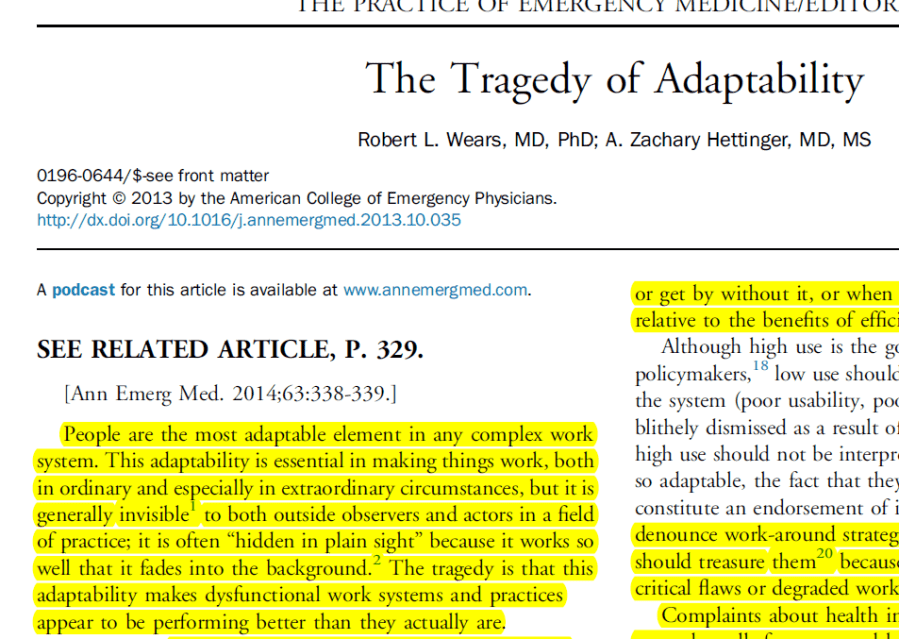
The Tragedy of Adaptability
This is one of my favourite discussion papers. Systems/processes in large and complex organisations can be difficult to use and access and not fit-for-purpose. People then find ways to adapt and “finish the design” of dysfunctional systems. For only two pages, this very brief paper hits pretty hard. “People are the most adaptable element in… Continue reading The Tragedy of Adaptability
Utilizing construction safety leading and lagging indicators to measure project safety performance
This studied 8 conventional performance indicators from 47 construction projects to see if a greater number of leading indicators, site inspections or toolboxes led to a lower lagging indicator frequency. First, no relationship was found between number of medical injuries and safety talks or site inspections. A small relationship was found between number of first… Continue reading Utilizing construction safety leading and lagging indicators to measure project safety performance
 SafetyInsights.org