This prosecution resulted from multiple workers falling to the ground with an ice compressor, as the roof space flooring gave way. It discussed moral culpability and duties between a client and their influence or control over works and contractors versus the contractors. Read the case for details on the incident. Extracts: · “Safe Work Method Statement… Continue reading SafeWork NSW prosecution: moral culpability, PCBU duties and control over works, and SWMS
Author: Ben Hutchinson
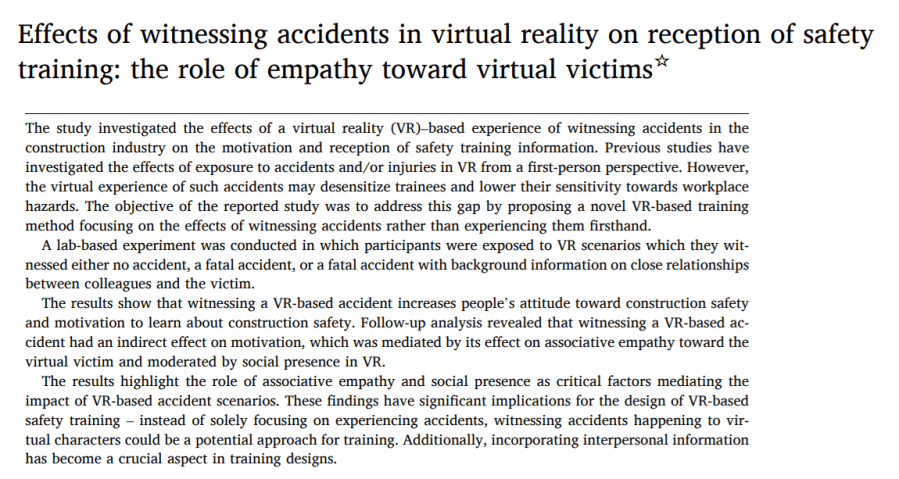
Effects of witnessing accidents in virtual reality on reception of safety training: the role of empathy toward virtual victims
Can simply witnessing a virtual accident, not experiencing it, improve the saliency of training? This interesting study used VR construction training scenarios, including no accident, witnessing an accident with distant coworker, and witnessing a close coworker. Extracts: · “witnessing an accident in VR significantly enhances one’s at[1]titudes toward safety when the victim is a distant coworker… Continue reading Effects of witnessing accidents in virtual reality on reception of safety training: the role of empathy toward virtual victims
Safe As E64: How can we move forward from notions of ‘human error’?
This paper explores how complex systems not only fail, but succeed, and provides 9 ways that we can move beyond simplistic notions of system failure due to ‘human error’. Ref: Woods, D. D., & Cook, R. I. (2002). Nine steps to move forward from error. Cognition, technology & work, 4(2), 137-144. Spotify: https://open.spotify.com/episode/4JaTtoAhb6s7xphKNt9ll9?si=yf9Xac6KSciKBmSZkwI_2Q Shout me a coffee… Continue reading Safe As E64: How can we move forward from notions of ‘human error’?
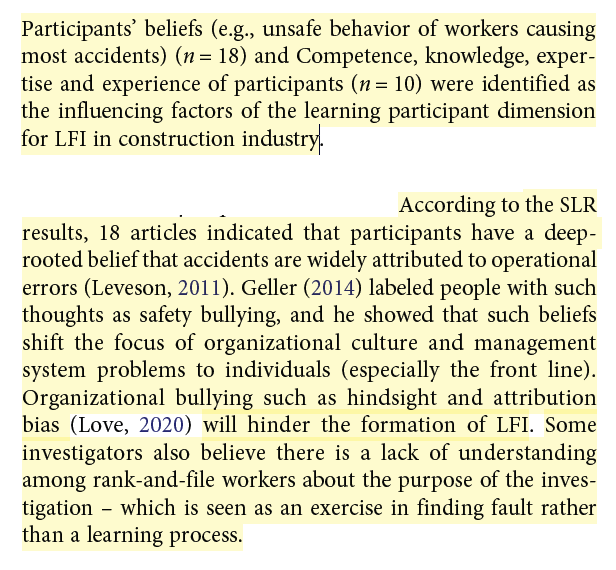
Blaming people not a robust method for learning and improvement in construction
Uh oh, spaghettio! This study found that believing people are the primary cause of accidents is a barrier to effective learning. I guess blaming people isn’t a solid approach for learning and improvement… They also point out the cycle of shallow investigations focusing on immediate ’causes’ and error, “rather than the context where the incidents… Continue reading Blaming people not a robust method for learning and improvement in construction
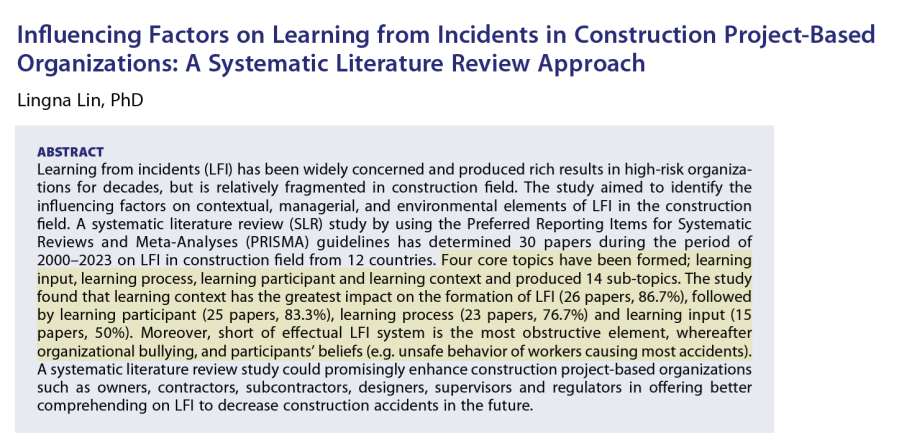
Influencing Factors on Learning from Incidents in Construction Project-Based Organizations: A Systematic Literature Review Approach
What factors facilitate or obstruct learning from incidents in construction? This systematic literature review evaluated 30 papers from 12 countries. * Parts 2 & 3 in comments * Extracts: · Overall, they identified four core learning topics: 1) learning input, 2) learning process, 3) learning participant, 4) learning context – see image 2 for context · “learning… Continue reading Influencing Factors on Learning from Incidents in Construction Project-Based Organizations: A Systematic Literature Review Approach
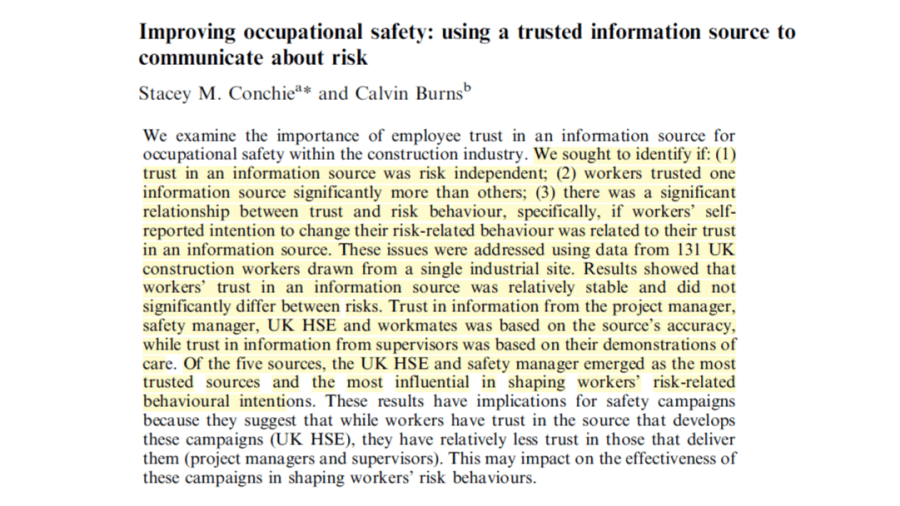
Improving occupational safety: using a trusted information source to communicate about risk
“Trust in information from the project manager, safety manager, UK HSE and workmates was based on the source’s accuracy, while trust in information from supervisors was based on their demonstrations of care” This examined employee trust in risk information from a sample of construction workers. 131 UK construction workers from the same company were surveyed.… Continue reading Improving occupational safety: using a trusted information source to communicate about risk
2010 legal appeal/prosecution: unpacking exposure to risk, value of inductions, and other concepts
This 2010 appeal involved the death of a backhoe operator, who was working near two sediment ponds. He suffered a heart attack and subsequently fell into a pond and drowned. Just a few extracts: · The ponds had a ramp, where a chain was attached with a sign saying “Strictly No Admittance”; two other signs were… Continue reading 2010 legal appeal/prosecution: unpacking exposure to risk, value of inductions, and other concepts
SafetyInsights.Org Research Compendiums: thirst trapping scientific research
Are you thirsting for the state of knowledge or research on critical controls, SIFS, leadership, or New View approaches? What about blame language, safety & risk indicators, complex systems, or psychological safety? Re-spruiking the 21 research compendiums freely available on my site – each covering a different topic. I haven’t counted, but there must easily… Continue reading SafetyInsights.Org Research Compendiums: thirst trapping scientific research
Safe As E63: Should we, or even can we, analyse ‘safety culture’ in investigations?
‘Safety Culture’ is treated by some as the holy grail of organisational safety concepts: valourised and promoted uncritically. But should we, or even can we, analyse ‘safety culture’ in investigations? Spotify: https://open.spotify.com/episode/2tx0IK3stj1djNDbwzQs4U?si=lV9PnfvVR62ynW0k7ePNNg Shout me a coffee (one-off or monthly recurring)

Safe As heading for the `tube in 2026
Safe As is expanding onto YouTube in 2026. Same thrifty content, but now with…100% more pixels? Currently testing camera and lighting with an ultra-low budget, while avoiding the look of a dank, gulag basement. Videos will be the base format and uploaded to YT, then audio for Spotify. So, we’ll see how it goes. Shout… Continue reading Safe As heading for the `tube in 2026
 SafetyInsights.org