Part 2 of Meadow’s banger ‘Indicators and Information Systems for Sustainable Development’. Extracts: · “Indicators are partial reflections of reality, based on uncertain and imperfect models” · “The stock market price is not the value of the company. No indicator is the real system. Indicators are abstractions from systems” · And are “are abstractions from abstractions, from models,… Continue reading “Indicators are partial reflections of reality, based on uncertain and imperfect models” – Part 2 Donella Meadows sustainable indicators
Tag: kpi

“Measuring what’s measurable rather than what’s important” – Better indicators part 1: Donella Meadows
A banger report from the late, great Donella Meadows, talking about sustainable indicators. WAY too much to cover, so extracts over 3-4 separate posts. Today is background on indicators before the specific and meatier stuff. Extracts: (** Part 2 in comments **) · “We have many words for indicator— sign, symptom, omen, signal, tip, clue, grade,… Continue reading “Measuring what’s measurable rather than what’s important” – Better indicators part 1: Donella Meadows
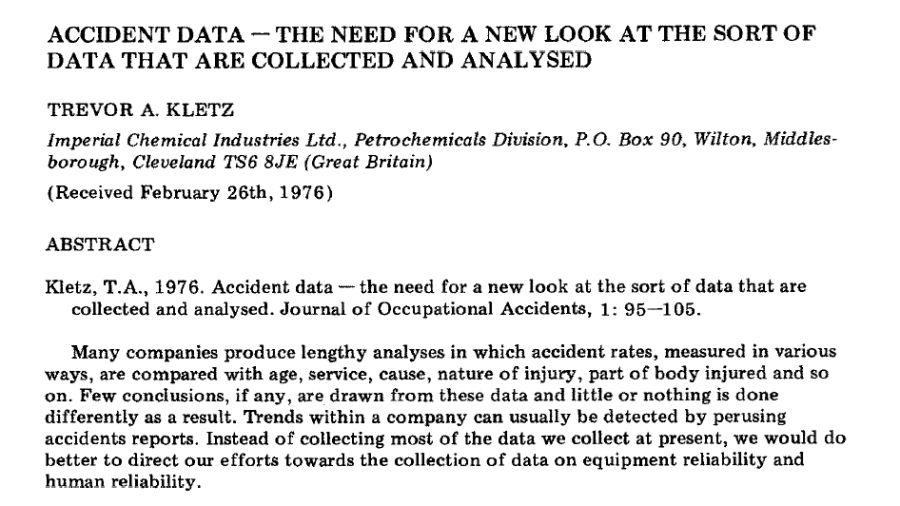
“We might just as well reprimand a light-bulb for going out” than tell people to be more careful: Trevor Kletz and his classic aphorisms
There’s no use telling people to be more careful, “We might just as well reprimand a light-bulb for going out”. Trevor Kletz with his classic aphorisms about focusing on error and blame when we should instead be improving the design of workplaces and plant. Other extracts from his 1976 article ‘Accident Data – the need… Continue reading “We might just as well reprimand a light-bulb for going out” than tell people to be more careful: Trevor Kletz and his classic aphorisms

Why safety performance indicators?
A response from Andrew Hale to Andrew Hopkins’ 2009 article about indicators (link in comments). [See tomorrow’s compendium dedicated to Hopkins & Hale] Extracts: · Hale starts with outlining why we need indicators, suggesting three obvious roles · Monitoring the level of safety in a system, which “answers the question: is the level of safety OK as… Continue reading Why safety performance indicators?

The safety measurement problem revisited
A response from Kjellén to Hopkins’ 2009 article about indicators (link in comments). [See week’s compendium dedicated to Hopkins & Hale] Extracts: · “LTI-rate gives the same weight to injuries with dramatically different consequences; that the measure is easily manipulated; and that natural statistical fluctuations make it useless for feedback control of other than the largest… Continue reading The safety measurement problem revisited
Safety metrics and reports “make no contribution to proving the effectiveness of our crucial systems” – Paper Safe, Greg Smith
A few apt extracts from Greg Smith’s excellent ‘Paper Safe’. If you’ve not yet read this or Proving Safety, then do yourself the favour. Greg argues: · Many indicators in use are measures of activity and usually tell us something has been done · But, “They tell us nothing about the quality or effectiveness of the activity”… Continue reading Safety metrics and reports “make no contribution to proving the effectiveness of our crucial systems” – Paper Safe, Greg Smith
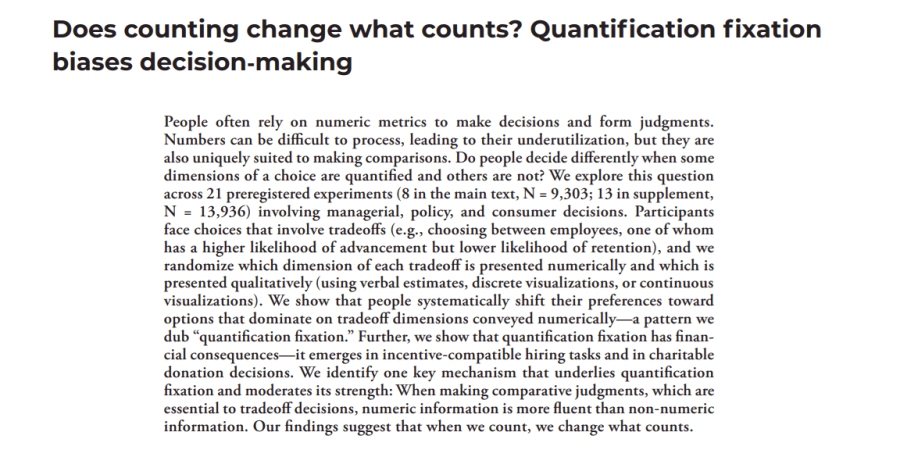
Does counting change what counts? Quantification fixation biases decision-making
Saw this posted on LinkedIn (forget who shared it) and found it really interesting. This study, across 21 experiments and 23k participants in managerial, policy and consumer contexts, studied how numbers and quantification distorts decision-making Context: · Quantification is spreading and has reached into almost every personal and professional area · New-borns are given Apgar… Continue reading Does counting change what counts? Quantification fixation biases decision-making
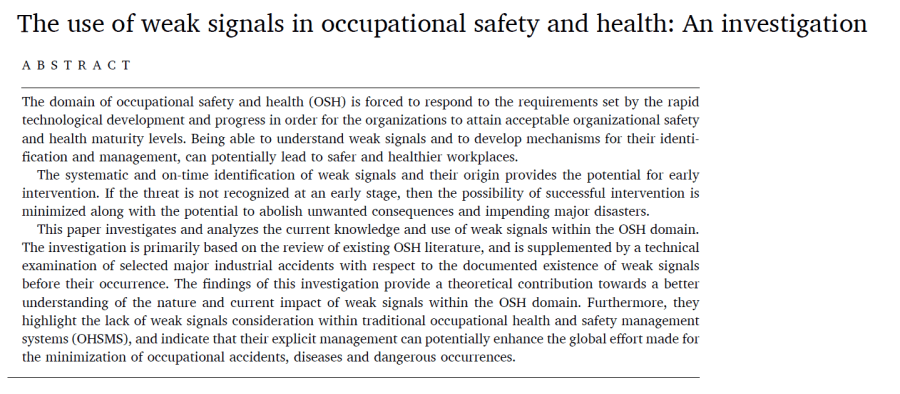
The use of weak signals in occupational safety and health: An investigation
This study explored current knowledge and use of weak signals in safety. Thanks to Clive Lloyd for sharing this a couple weeks back. As you’d expect, this sort of topic, based on accidents, is pretty replete with hindsight and outcome knowledge but is interesting nevertheless. Extracts: · They have been defined as an “…imprecise early indication… Continue reading The use of weak signals in occupational safety and health: An investigation
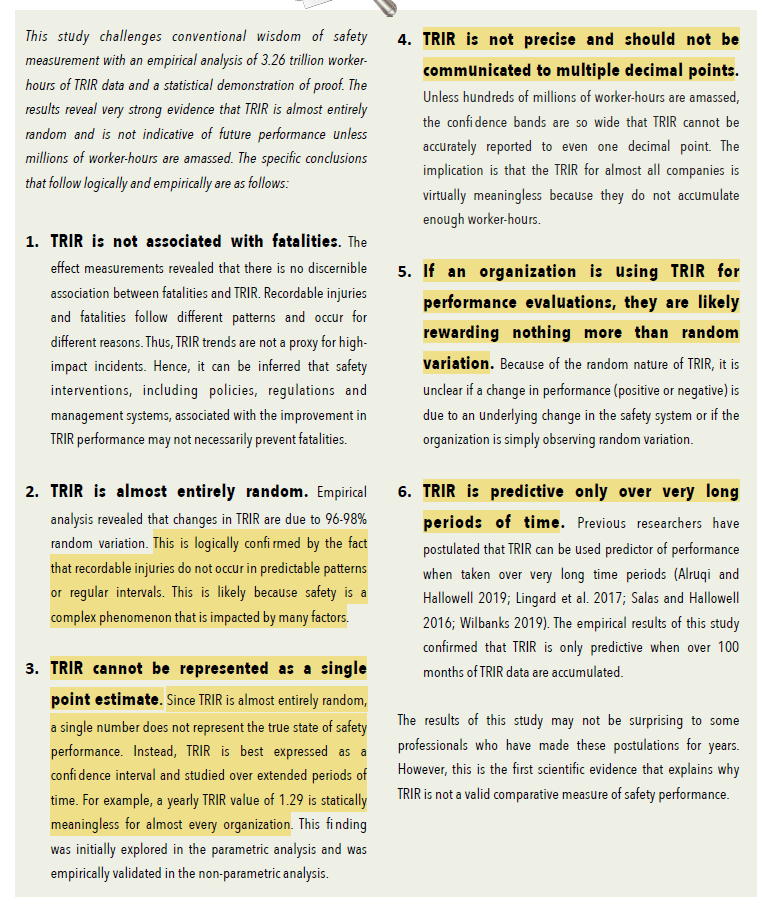
How to make injury metrics suck less?
How can we make injury metrics suck less? So this came out of a conversation with somebody (thanks Jordan Vince). I’m **not** a promoter of injury measures. I think we spend FAR too much time quibbling over what are, statistically speaking, quite rare events, when we have the entire spectrum of daily work to learn… Continue reading How to make injury metrics suck less?
Cooking the books: how injury measures and Executive incentives (can) lead to ruin
Another interesting report from Safe Work Australia, authored by O’Neill, Wolfe & Holley, which explored performance measurement & CEO/executive incentives. Too much to cover, so just a few points on injury measures: · They highlight the limits of a “single injury rate as a generic, all-purpose indicator of WHS performance”, relating to data quality and the… Continue reading Cooking the books: how injury measures and Executive incentives (can) lead to ruin
 SafetyInsights.org