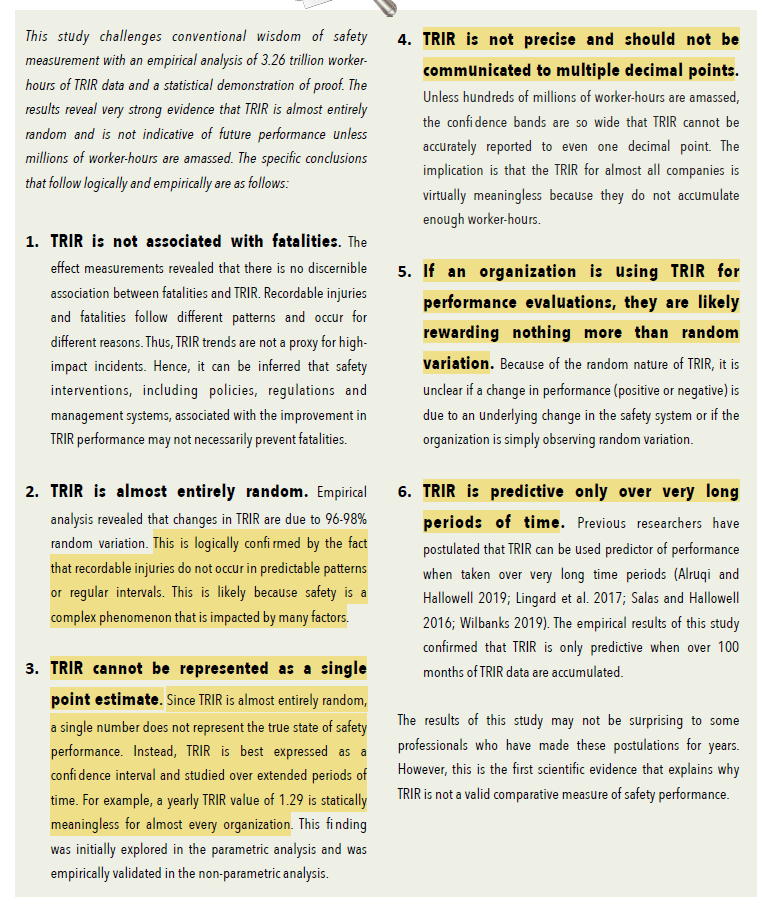
Are our use of reported injury measures, like TRIFR or LTIFR, ‘good enough’ representations, or beset with foundational statistical flaws? Today’s report is from Hallowell et al., 2020, titled ‘The Statistical Invalidity of TRIR as a Measure of Safety Performance’. From the CSRA. Make sure to subscribe to Safe AF on Spotify/Apple, and if you… Continue reading Safe As podcast #11: The fault in our stats (injury measures)
Tag: ltifr

The safety measurement problem revisited
A response from Kjellén to Hopkins’ 2009 article about indicators (link in comments). [See week’s compendium dedicated to Hopkins & Hale] Extracts: · “LTI-rate gives the same weight to injuries with dramatically different consequences; that the measure is easily manipulated; and that natural statistical fluctuations make it useless for feedback control of other than the largest… Continue reading The safety measurement problem revisited

Control charts for accident frequency: a motivation for real-time occupational safety monitoring
This paper compares real-time or active monitoring of safety incidents via cumulative sum (CUSUM) control charts. It’s an interesting read, and if you’re not savvy with control charts or statistics then just skip over the technical stuff. Some of the findings are still pretty relevant. In saying that, I’ve skipped most of the dense statistical… Continue reading Control charts for accident frequency: a motivation for real-time occupational safety monitoring

Factors affecting learning from incidents: A cross-industry review
This study systematically reviewed the research to unpack the factors that influence learning from incidents (LFI). Likely nothing new to anybody, but it is a good reference paper for tracking down specific research. Background: · Common reasons for ineffective LFI are “underreporting of incidents (Sanne, 2008), incapacity to identify latent circumstances (Jacobsson et al., 2009), the… Continue reading Factors affecting learning from incidents: A cross-industry review
How to make injury metrics suck less?
How can we make injury metrics suck less? So this came out of a conversation with somebody (thanks Jordan Vince). I’m **not** a promoter of injury measures. I think we spend FAR too much time quibbling over what are, statistically speaking, quite rare events, when we have the entire spectrum of daily work to learn… Continue reading How to make injury metrics suck less?
Cooking the books: how injury measures and Executive incentives (can) lead to ruin
Another interesting report from Safe Work Australia, authored by O’Neill, Wolfe & Holley, which explored performance measurement & CEO/executive incentives. Too much to cover, so just a few points on injury measures: · They highlight the limits of a “single injury rate as a generic, all-purpose indicator of WHS performance”, relating to data quality and the… Continue reading Cooking the books: how injury measures and Executive incentives (can) lead to ruin
Workplace health and safety performance at the client-contractor interface: Measurement, management and behaviour
A really interesting paper exploring performance measurement and management (PMM) systems in construction. They looked at: · How do clients measure WHS performance in the delivery of construction projects? · How do clients use this measurement to manage WHS performance? and · How do performance measurement and management practices adopted by construction clients influence contractors’… Continue reading Workplace health and safety performance at the client-contractor interface: Measurement, management and behaviour
The limits and of lost time injury and other injury measures: ‘risk blindness’
This Safe Work Australia report mentioned yesterday, authored by O’Neill & Wolfe, discussed measuring & reporting on WHS. One section dived into the limits of injury measures. Some highlights: · “a single injury number or frequency rate is too aggregated to provide meaningful information to guide business decisions” · “the majority of LTIs have relatively short-term consequences… Continue reading The limits and of lost time injury and other injury measures: ‘risk blindness’
An analysis of the relationship between project management and safety management in the Norwegian construction industry
This study evaluated the relationship between project management and safety management in the Norwegian construction industry. Data was from 111 unique projects and 26 firms. They assessed projects on a range of different project management capacities and safety management. Providing background: · While a robust body of research has looked at both project management/production, and… Continue reading An analysis of the relationship between project management and safety management in the Norwegian construction industry
 SafetyInsights.org