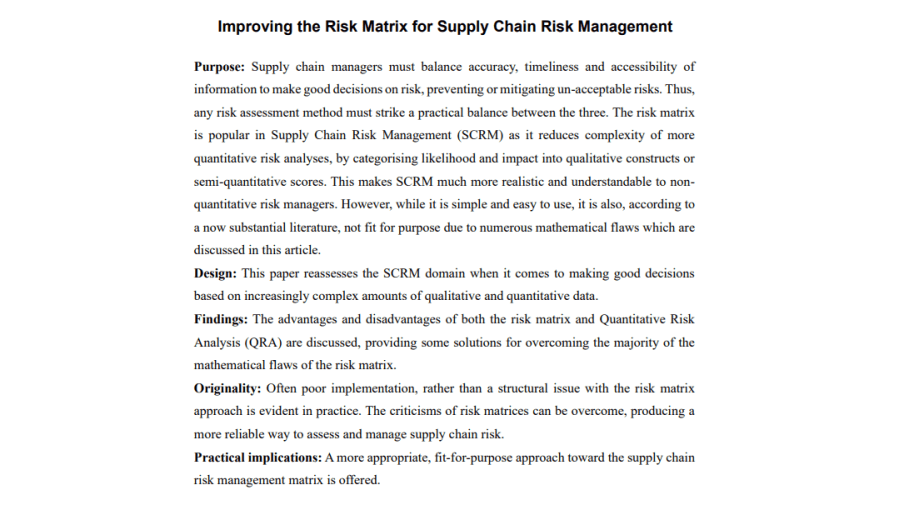
This paper discusses risk matrices (RMs) for supply chain risk management (SCRM). It was meant to be just a few dot-points, but…here we are. Extracts: · “the main aim of SCRM is to identify whether a risk is “acceptable”, “tolerable” or “unacceptable”, and, if the latter two, to identify if and how a risk might… Continue reading Improving the Risk Matrix for Supply Chain Risk Management
Tag: risk matrix
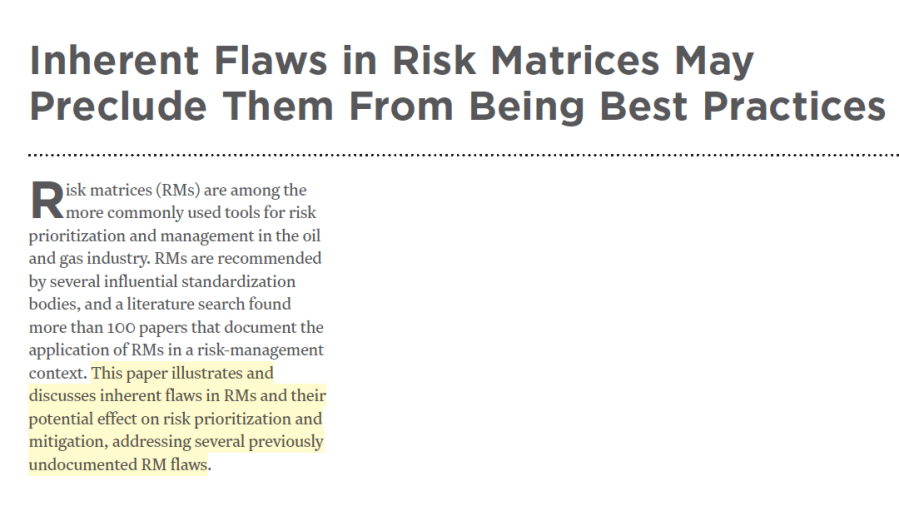
Inherent Flaws in Risk Matrices May Preclude Them From Being Best Practices
Are some risk matrices too inherently flawed to be considered as best practice? This discussion paper explored some critical flaws. Extracts: · “Risk matrices (RMs) are among the more commonly used tools for risk prioritization and management in the oil and gas industry” and “are recommended by several influential standardization bodies” · The popularity of RMs is… Continue reading Inherent Flaws in Risk Matrices May Preclude Them From Being Best Practices

Should risk matrices simply be abandoned because of their baked-in flaws?
Are risk matrices better than nothing? Should we use them because we don’t have a better alternative? Or, can matrices result in assessments **worse than random chance**, reward arbitrary calculations, and reinforce human perceptual filters and risk blindness? Are many of the issues of matrices baked into their design, rather than resulting from the users?… Continue reading Should risk matrices simply be abandoned because of their baked-in flaws?
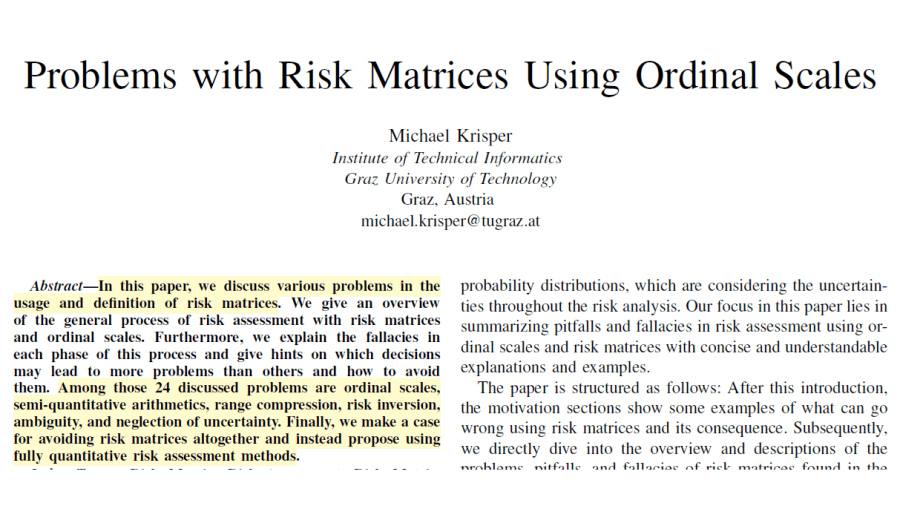
Problems with Risk Matrices Using Ordinal Scales
This covers some core problems with risk matrices. It’s argued that while they’re established tools, appearing to be “authoritative, and intellectually rigorous”, this “could be just an illusion …bred by the human bias of uncertainty aversion and authority bias”. Hence, matrices have “many flaws” that can “diminish their usefulness to the point where they become… Continue reading Problems with Risk Matrices Using Ordinal Scales
 SafetyInsights.org